HPIV@WACV2022 Extended Deadline 31/10

CALL FOR PAPERS: WACV 2022 Workshop on Hazard Perception in
Intelligent Vehicles.
https://ardhendubehera.github.io/HPIV/

This workshop will explore challenges in the analysis and assessment
of potential developing hazards to advance the research and
development of hazard perception in autonomous driving. This requires
solving the situation awareness by accurate detection and anticipation
of positions, movements and actions performed by multiple road users
(pedestrians, vehicles, cyclists and so on) that are a key to address
the anticipation of a developing potential hazard.

Important dates:
* Submission Deadline: Oct 31 2021 (23:59 PST)
* Authors Notification: Nov 09, 2021 (23:59 PST)
* Camera Ready: Nov 15, 2021 (23:59 PST)

Keynote speakers:
Prof Mohan M Trivedi (University of California, San Diego, USA)
Prof Ming C Lin (University of Maryland, USA)
Prof C. V. Jawahar (International Institute of Information Technology,
Hyderabad, India)

We welcome submissions on the following topics, but are not limited to:
Early detection of developing road events
Dynamic scene understanding
Attention modelling and predicting road users’ intentions and path
Tracking road users (e.g., cars, pedestrians, animals, etc.)
Driver status monitoring and human-car interaction
Deep/machine learning for vehicle perception
Adversarial domain adaptation for autonomous driving
Real-time (deep learning) inference of developing hazards
On board embedded hazard perception systems
Computational behaviour analysis
Sensor fusion and multi-modal AI for road condition/situation awareness
Decision making via reinforcement and/or imitation learning
Hazard modelling, description, and comparison
Action planning for the handling of hazards
Assessment and metrics for hazard perception components and systems
Explainability and ethical implications of hazard perception and
automated decision making

Organizers:
Ardhendu Behera (Edge Hill University, UK)
R Venkatesh Babu (Indian Institute of Science, Bangalore, India)
Dima Damen (University of Bristol, UK)
Yonghuai Liu (Edge Hill University, UK)
C. S. Shankar Ram (Indian Institute of Technology Madras, India)
Nik Bessis (Edge Hill University, UK)
CfP Graph Models for Learning and Recognition (GMLR) Track at 37th ACM-SAC 2022 in Brno, Czech Republic


                                                      Deadline Extended

Call for Papers


                 Graph Models for Learning and Recognition (GMLR) Track

               The 37th ACM Symposium on Applied Computing (SAC 2022)

                           April 25-29, 2022, Brno, Czech Republic

                              http://phuselab.di.unimi.it/GMLR2022


Important Dates


Submission of regular papers:    October 15, 2021 October 24, 2021

Notification of acceptance/rejection:     December 10, 2021

Camera-ready copies of accepted papers: December 21, 2021

SAC Conference:              April 25 – 29, 2022


Motivations and topics


Authors of selected top papers of this track will be asked to publish an extended version in a

Special Issue of a good quoted International Journal.


The ACM Symposium on Applied Computing (SAC 2022) has been a primary gathering forum

for applied computer scientists, computer engineers, software engineers, and application

developers from around the world. SAC 2022 is sponsored by the ACM Special Interest Group

on Applied Computing (SIGAPP), and will be held in Brno, Czech Republic. The technical track on

Graph Models for Learning and Recognition (GMLR) is the first edition and is organized within

SAC 2022.

Graphs have gained a lot of attention in the pattern recognition community thanks to their

ability to encode both topological and semantic information. Encouraged by the success of CNNs,

a wide variety of methods have redefined the notion of convolution for graphs.

These new approaches have in general enabled effective training and achieved in

many cases better performances than competitors, though at the detriment of computational costs.


Typical examples of applications dealing with graph-based representation are: scene graph

generation, point clouds classification, and action recognition in computer vision; text

classification, inter-relations of documents or words to infer document labels in natural

language processing; forecasting traffic speed, volume or the density of roads in traffic

networks, whereas in chemistry researchers apply graph-based algorithms to study the graph

structure of molecules/compounds.


This track intends to focus on all aspects of graph-based representations and models for

learning and recognition tasks. GMLR spans, but is not limited to, the following topics:


● Graph Neural Networks: theory and applications

● Deep learning on graphs

● Graph or knowledge representationa learning

● Graphs in pattern recognition

● Graph databases and linked data in AI

● Benchmarks for GNN

● Dynamic, spatial and temporal graphs

● Graph methods in computer vision

● Human behavior and scene understanding

● Social networks analysis

● Data fusion methods in GNN

● Efficient and parallel computation for graph learning algorithms

● Reasoning over knowledge-graphs

● Interactivity, explainability and trust in graph-based learning

● Probabilistic graphical models

● Biomedical data analytics on graphs


Scientific Program Committee


Davide Boscaini

Federico Castelletti

Vittorio Cuculo

Alessandro D’Amelio

Gabriele Gianini

Alessio Micheli

Ryan A. Rossi

Carlo Vercellis

Naoufel Werghi


Submission Guidelines


Authors are invited to submit original and unpublished papers of research and applications for

this track. The author(s) name(s) and address(es) must not appear in the body of the paper, and

self-reference should be in the third person. This is to facilitate double-blind review. Please,

visit the website for more information about submission


SAC No-Show Policy


Paper registration is required, allowing the inclusion of the paper/poster in the conference

proceedings. An author or a proxy attending SAC MUST present the paper. This is a requirement

for the paper/poster to be included in the ACM digital library. No-show of registered papers

and posters will result in excluding them from the ACM digital library.


Track Chairs


Donatello Conte (University of Tours)

Giuliano Grossi (University of Milan)

Raffaella Lanzarotti (University of Milan)

Jianyi Lin (Università Cattolica del Sacro Cuore)

Jean-Yves Ramel (University of Tours)


Responsible PR&MI @ ICCV 2021 – Call for Virtual Participation – October 17

Call for Virtual Participation
First International Workshop on Responsible Pattern Recognition and Machine Intelligence (Responsible PR&MI 2021)
October 17, 2021 – 7:00am-11:45am EDT – VIRTUAL
held as part of the 
18th International Conference on Computer Vision (ICCV 2021)
The workshop features two keynote talks by Prof. Arun Ross (Michigan State University) and Prof. Iyad Rahwan (Max Planck Institute for Human Development), plus six paper talks and a final discussion
The registration is open, and you can register at https://iccv2021.thecvf.com/node/47.

Looking forward to meeting you virtually at the workshop!
Silvio Barra, Mirko Marras, Aythami Morales, Vishal Patel
Responsible PR&MI Workshop Chairs

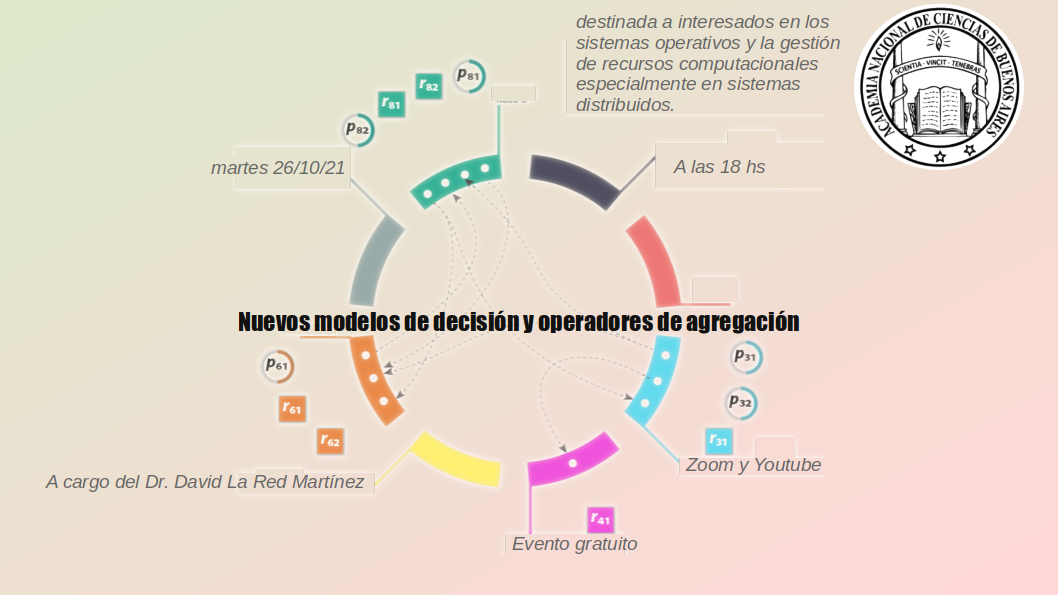
ACADEMIA NACIONAL DE CIENCIAS DE BUENOS AIRES evento del martes 26

Academia Nacional de Ciencias de Buenos Aires le está invitando a una reunión de Zoom programada.
 
Tema: Conferencia del Dr. David La Red Martínez – CETI – ANCBA
Hora: 26 oct. 2021 06:00 p. m. Buenos Aires, Georgetown
 
Unirse a la reunión Zoom
 
ID de reunión: 831 4045 6321
 

fyer David LaRedMartinez.png

Código de acceso: 969921
 

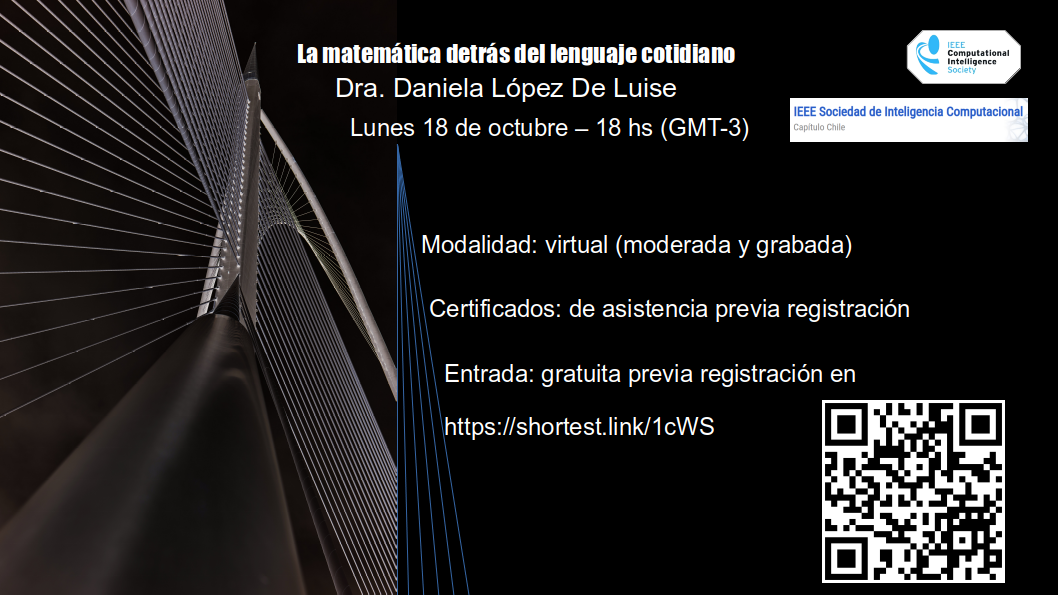
Seminario online IEEE CIS : La matemática detrás del lenguaje cotidiano

IEEE CIS Argentina en conjunto con IEEE CIS Chile

Flyer DLL 18 OCT (copia).png


Design by 2b Consult