AIDA Excellence Lecture Series: ‘Challenges and Opportunities for Human-Centred AI’, Lectures and dialog between Yoshua Bengio (Turing Award) and Ben Shneiderman 14 October 16.00-18.00 CEST

Challenges and Opportunities for Human-Centred AI: A dialog between Yoshua Bengio (Turing Award) and Ben Shneiderman, moderated by Virginia Dignum.

This online event on 14 October 16.00-18.00 CEST is part of the European Advanced Course on AI (acai2021.org) and is open to all, with the support of HumaneAI-net, EURAI, the Hertie School, and the AIDA doctoral academy.


You can attend this event through the Youtube stream: https://youtu.be/uc0bYp_-JLA


The International AI Doctoral Academy (AIDA), a joint initiative of the European R&D projects AI4Media, ELISE, Humane AI Net, TAILOR and VISION is very pleased to offer you top quality scientific lectures on several current hot AI topics.


Lectures will be offered alternatingly by:

a) Top highly-cited senior AI scientists internationally or

b) Young AI scientists with promise of excellence (AI sprint lectures)


The lectures are disseminated through multiple channels and email lists (we apologize if you received it through various channels).


If you want to stay informed on future lectures, you can register in the AIDA and CVML email lists:

https://lists.auth.gr/sympa/info/aida

https://lists.auth.gr/sympa/info/cvml


Best regards

Profs. M. Chetouani, P. Flach, B. O’Sullivan, I. Pitas, N. Sebe


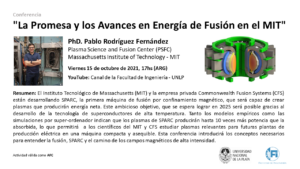
“La promesa y los avances en energía de fusión en el MIT”

“>AFC: Completar el siguiente Formulario de Inscripción 
YouTube:
Canal de la Facultad de Ingeniería
UNLP

 
Resumen:
El Instituto Tecnológico de Massachusetts (MIT) y la empresa privada Commonwealth Fusion Systems (CFS) están desarrollando SPARC, la primera máquina de fusión por confinamiento magnético que será capaz de crear plasmas que producirán energía neta. Este ambicioso objetivo, que se espera lograr en 2025, será posible gracias al desarrollo de la tecnología de superconductores de alta temperatura. Tanto los modelos empíricos como las simulaciones por super-ordenador indican que los plasmas de SPARC producirán hasta 10 veces más potencia que la absorbida, lo que permitirá a los científicos del MIT y CFS estudiar plasmas relevantes para futuras plantas de producción eléctrica en una máquina compacta y asequible. Esta conferencia introducirá los conceptos necesarios para entender la fusión, SPARC y el camino de los campos magnéticos de alta intensidad.

Read More »

2021 OkIP Conf on Automated & Intelligent Systems|| OkCity, USA|| Nov 15-18

October 12th, 2021 Daniela Lopez de Luise

– Submission: Oct 16, 2021
– Conference: Nov 15-18, 2021

WACV2022 :: xAI4Biometrics Workshop :: CfP :: EXTENDED DEADLINE 25/10

************************************************************************************************************
                             xAI4Biometrics Workshop @ WACV 2022 :: Call for Papers
************************************************************************************************************
The WACV 2022 2nd Workshop on Explainable & Interpretable Artificial Intelligence for
Biometrics (xAI4Biometrics Workshop 2022) intends to promote research on Explainable &
Interpretable-AI to facilitate the implementation of AI/ML in the biometrics domain, and
specifically to help facilitate transparency and trust.

This workshop will include two keynote talks by:
  • Walter J. Scheirer, Notre Dame University, USA
  • Speaker TBA
The xAI4Biometrics Workshop 2022 is organized by INESC TEC, Porto, Portugal.
For more information please visit http://vcmi.inesctec.pt/xai4biometrics
 
IMPORTANT DATES
Abstract submission: October 04, 2021
Full Paper Submission Deadline: October 11 October 25, 2021
Acceptance Notification: November 15, 2021
Camera-ready & Registration: November 19, 2021
Conference: January 04-08, 2022 | Workshop Date: January 04, 2022
TOPICS OF INTEREST
The xAI4Biometrics welcomes works that focus on biometrics and promote the development of:

  • Methods to interpret the biometric models to validate their decisions as well as to improve the models and to detect possible vulnerabilities;
  • Quantitative methods to objectively assess and compare different explanations of the automatic decisions;
  • Methods and metrics to study/evaluate the quality of explanations obtained by post-model approaches and improve the explanations;
  • Methods to generate model-agnostic  explanations;
  • Transparency and fairness in AI algorithms avoiding bias;
  • Methods that use post-model explanations to improve the models’ training;
  • Methods to achieve/design inherently interpretable algorithms (rule-based, case-based reasoning, regularization methods);
  • Study on causal learning, causal discovery, causal reasoning, causal explanations, and causal inference;
  • Natural Language generation for explanatory models;
  • Methods for adversarial attacks detection, explanation and defense (“How can we interpret adversarial examples?”);
  • Theoretical approaches of explainability (“What makes a good explanation?”);
  • Applications of all the above including proofs-of-concept and demonstrators of how to integrate explainable AI into real-world workflows and industrial processes.


ORGANIZING COMMITTEES


GENERAL CHAIRS
    • Jaime S. Cardoso, INESC TEC and University of Porto, Portugal
    • Ana F. Sequeira, INESC TEC, Porto, Portugal
    • Arun Ross, Michigan State University, USA
    • Peter Eisert, Humboldt University & Fraunhofer HHI
    • Cynthia Rudin, Duke University, USA
PROGRAMME CHAIRS
    • Christoph Busch, NTNU & Hochschule Darmstadt
    • Tiago de Freitas Pereira, IDIAP Research Institute, Switzerland
    • Wilson Silva, INESC TEC and University of Porto, Portugal
CONTACT
Ana Filipa Sequeira, PhD (ana.f.sequeira@inesctec.pt)
Assistant Researcher
INESC TEC, Porto, Portugal

International Workshop on Face and Gesture Analysis for COVID-19 (@FG2021)

International Workshop on Face and Gesture Analysis for COVID-19

Held in conjunction with FG 2021 (http://iab-rubric.org/fg2021/)
https://fg4covid19.github.io/#

Paper submission deadline (round 2) extedned to: October 17th, 2021
11:59 PST
*********************************************************************

ORGANIZERS
Hazım Kemal Ekenel, Istanbul Technical University, Turkey
Fevziye Irem Eyiokur, Karlsruhe Institute of Technology, Germany
Muhammad Imran, Qatar Computing Research Institute, Qatar
Alperen Kantarcı, Istanbul Technical University, Turkey
Ferda Ofli, Qatar Computing Research Institute, Qatar
Vitomir Štruc, University of Ljubljana, Slovenia
Alexander Waibel, Karlsruhe Institute of Technology, Germany and
Carnegie Mellon University, Pittsburgh

CO-ORGANIZER
European Association for Biometrics (EAB)

ABOUT
Since the end of 2019, the whole world has been living with the effects
of the COVID-19 disease. Due to the airborne nature of the novel
coronavirus, the COVID-19 disease has spread rapidly in many countries
in a short time and has also been declared a global pandemic. Several
preventive measures were implemented to reduce the spread of this
disease, including social distancing, wearing face masks, avoiding large
crowds, and others.

To help monitor public behavior and compliance with the implemented
prevention measures, to gather reliable data for epidemiological models,
facilitate authorized access and authentication, ensure safety and
security despite the COVID-19 pandemic, it is critical to develop
automated machine learning and computer vision based techniques that can
help with these tasks. The COVID-19 pandemic has initiated research and
development of computer-aided systems that can be used to prevent and
monitor not only COVID-19 but also similar diseases that may appear in
the future.

The goal of this workshop is to present the most recent and advanced
work related to face and gesture analysis in the scope of COVID-19. We
are interested in all COVID-19 related studies that focus on the
detection of face mask, subjects' behaviors in public areas, analysis of
pandemic and preventions-related real-world face and gesture data,
prevention control and monitoring systems for unconstrained real-world
conditions and related problems.

TOPICS OF INTEREST
Topics of interest include, but are not limited to:

  + Face mask detection,
  + Masked face detection and recognition,
  + Face-hand interaction detection,
  + COVID-19 monitoring and control systems related to face and gesture
analysis,
  + Social distance tracking and control systems,
  + Dataset bias analysis on COVID-19 datasets (face mask, face-hand,
social distance,…),
  + Face, gesture and body analysis for monitoring intervention-measure
compliance,
  + Behavior understanding relevant for COVID-19,
  + Analysis of social interactions relevant to COVID-19,
  + Soft-biometric analysis on masked faces (age, gender, …),
  + Generative models relevant in the scope of COVID-19,
  + Novel datasets and performance benchmarks,
  + Related applications.

PAPER SUBMISSION
For submission instructions visit: https://fg4covid19.github.io/index.html

Accepted papers will be published in the “Proceedings of FG 2021” and
included in IEEE Xplore.

Selected papers from the first submission round will be invited to
submit extended versions of their work to a special issue organized in
the Image and Vision Computing journal.

KEYNOTE SPEAKERS
Naser Damer, Fraunhofer IGD, Germany
Albert Ali Salah, Utrecht University, The Netherlands

Please feel free to reach out for further details.

Hazım Kemal Ekenel, Fevziye Irem Eyiokur, Muhammad Imran, Alperen
Kantarcı, Ferda Ofli, Vitomir Štruc, Alexander Waibel
FG4COVID19 2021 Organizers

Design by 2b Consult