
AIJ Special Issue on Risk-Aware Autonomous Systems: Theory and Practice

Dear all, 


Artificial Intelligence’s Special Issue on “Risk-Aware Autonomous Systems: Theory and Practice” is now open for submissions. The special issue is co-edited by Prof. Sara Bernardini (Royal Holloway University of London), Prof. Luca Carlone (MIT), Dr Ashkan Jasour (MIT), Prof. Andreas Krause (ETH Zurich), Prof. George Pappas (University of Pennsylvania), Prof. Brian Williams (MIT) and Prof. Yisong Yue (Caltech). Submissions will close on October 15th, 2021 and the publication of the special issue is expected for August 15th, 2022. Artificial Intelligence is a world-leading journal in AI with an Impact Factor of 6,628 and CiteScore of 7.7. 


Aims and Scope

This special issue focuses on the theory and practice of risk-aware autonomous systems that reason about uncertainty and risk online to achieve safety, and that combine machine learning and decision making to accomplish real world tasks.

The topic of risk-aware autonomous systems has seen a dramatic increase in importance over the last few years, as autonomous systems are being deployed almost daily within safety-critical applications, including self-driving vehicles, autonomous undersea and aerospace systems, service robotics, and collaborative manufacturing. This broad adoption is a testament to the fast-paced progress of the research community across multiple areas, including planning, learning, perception, decision making, and control. At the same time, today’s widely used AI algorithms for autonomy are beginning to showcase fundamental limits and practical shortcomings. In particular, excessive risk taken by these algorithms can lead to catastrophic failure of the overall system and may put human life in danger. Many AI methods used today do not attempt to quantify uncertainty; they do not assess the risks that uncertainty imposes on system safety and success; they do not guarantee bounds on this risk and they do not perform these assessments in real-time.

To push the envelope of autonomous systems’ safety, this special issue will present ground-breaking research on the theory and practice of designing the next generation of risk-aware AI algorithms and autonomous systems. Key to our envisioned methods is their ability to account for uncertainty and risk of failure during their online execution, their capabilities for proactively quantifying and mitigating risks against task goals and safety constraints, and their ability to offer formal guarantees, such as bounds on the risk of failure. Emerging risk-bounded methods often operate on models of uncertainty, specifications of intended outcomes, and specifications of acceptable risks regarding these outcomes. These models and specifications are diverse. Uncertainty models may be probabilistic, set bounded, or interval based. Intended outcomes include goals achieved, deadlines met, safety constraints respected, required accuracy in model estimation and perception, and rate of false positives. Specifications of acceptable risk include risk bounds and acceptable costs of failure. These intended outcomes and acceptable risks can apply to individual AI components, such as policy and action learners, image classifiers and planners, and the aggregate systems as a whole.

This special issue is intended to represent this diversity. It aims to cover a broad set of topics related to risk-aware autonomous systems, including but not limited to:

● risk-aware task and motion planning;
● robust and adversarial learning;
● certifiable and risk-aware perception, localization and mapping;
● robust task monitoring and execution under uncertainty;
● formal methods for monitoring and verifying uncertain systems;
● constraint and mathematical programming with chance constraints;
● robust control of intelligent systems;
● system-level monitoring and risk quantification.

Submission Instructions

We welcome high quality original (unpublished) articles. Each submission will be peer-reviewed.


All submissions should be formatted following the AI journal instructions for authors (https://www.elsevier.com/journals/artificial-intelligence/0004-3702/guide-for-authors) and submitted to: https://www.editorialmanager.com/artint/default.aspx    


To ensure that all manuscripts are correctly identified for inclusion into the special issue, please select  “VSI:Risk-Aware Autonomy”  when you reach the “Article Type” step in the submission process.


Authors can share their research in a variety of different ways and Elsevier has a number of green open access options available: https://www.elsevier.com/open-access


Important Dates

● Submissions open: 15 May 2021

● Submissions close: 15 October 2021

● Publication of the special issue: 15 August 2022


Guest Editors

● Prof. Sara Bernardini (Royal Holloway University of London, sara.bernardini@rhul.ac.uk)
● Prof. Luca Carlone (Massachusetts Institute of Technology, lcarlone@mit.edu)
● Dr. Ashkan Jasour (Massachusetts Institute of Technology, jasour@mit.edu)
● Prof. Andreas Krause (ETH Zurich, krausea@ethz.ch)
● Prof. George Pappas (University of Pennsylvania, pappasg@seas.upenn.edu)
● Prof Brian Williams (Massachusetts Institute of Technology, williams@mit.edu)
● Prof. Yisong Yue (California Institute of Technology, yyue@caltech.edu)


For more information, please contact the editors and visit: https://www.journals.elsevier.com/artificial-intelligence/call-for-papers/risk-aware-autonomous-systems-theory-and-practice

 

IEEE Computational Intelligence Society – Argentina

Estimados,

     se acerca un seminario del IEEE CIS. Con certificados de asistencia a quienes lo soliciten. Se ruega también difundir


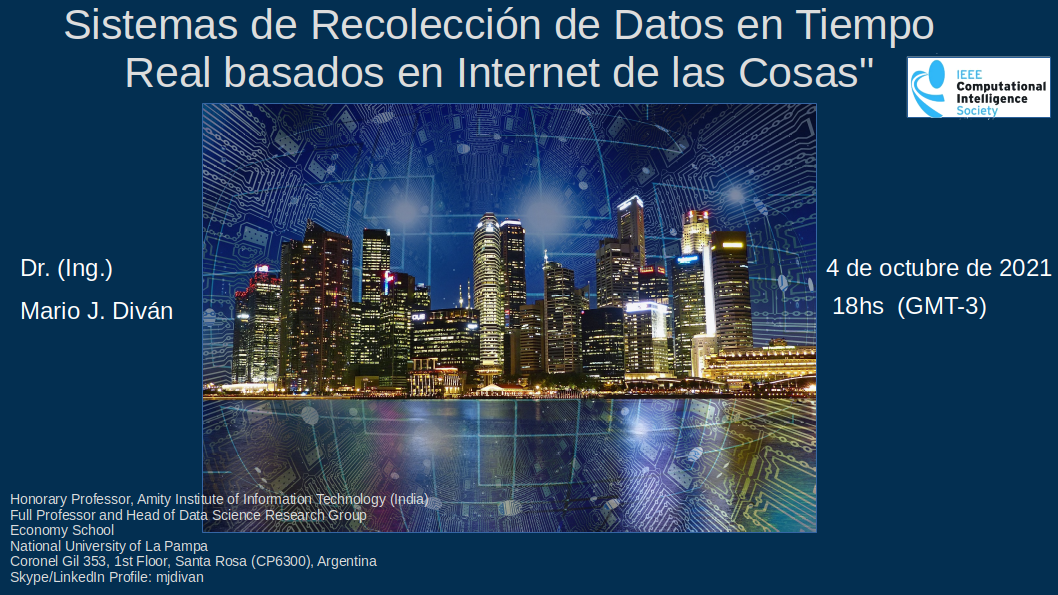
TITULO: Sistemas de Recolección de Datos en Tiempo Real basados en Internet de las Cosas
FECHA: 4 de octubre de 2021, 18hs  (GMT-3)

Dr. (Ing.) Mario José Diván
Profesor honorario de Amity Institute of Information Technology (India)
Profesor y director del Data Science Research Group – Dep. Economía (Universidad Nacional de La Pampa)

Registrese gratis en Formulario

Mario FLyer.png

Register for Free – IEEE Cybersecurity Live Stream


The IEEE Virtual Speakers Bureau, co-sponsored by IEEE Young Professionals, presents the following free livestream event:
Sept23.png

23 September, 11:30 am EDT
Speaker: Scott Schober

The presentation will cover the following topics:

  • How to spot a ‘phishing’ attack
  • Importance of proper regular data backups
  • Security is achieved in layers…enable two-factor authentication
  • Only use trusted/secure networks- do not use public Wi-Fi networks
  • Install a secure VPN
  • Question & Answer period to follow the presentation
If you can't attend live there will be a recording of the event available to view on the IEEE.tv IEEE Students Channel.
The presenter, Scott Schober, will also be presenting livestreams in October and November.

  • October – Demystifying the Dark Web
  • November – Wireless Threats
Speaker Bio:
Scott Schober is the author of three best-selling security books: Senior Cyber, Hacked Again, and Cybersecurity is Everybody’s Business. He has dedicated himself to educating as many people as possible by telling his own stories of being hacked with the hope that others can learn from his mistakes. In addition to his writing prowess, Scott is a highly sought-after author and expert for live security events, media appearances, and commentary on the topics of ransomware, wireless threats, drone surveillance and hacking, cybersecurity for consumers, and small business. He is often seen on ABC News, Bloomberg TV, Al Jazeera America, CBS This Morning News, CNN, Fox Business, and many more networks.


ABIERTA LA INSCRIPCIÓN ‼ Taller Práctico sobre Protección de Datos y Módulo 12 de Pacientes a Ciudadanos Sanitarios 📲 POSGRADO EN SALUD DIGITAL

ABIERTA LA INSCRIPCIÓN ‼ Taller Práctico sobre Protección de Datos y Módulo 12 de Pacientes a Ciudadanos Sanitarios 📲 POSGRADO EN SALUD DIGITAL

¿Problemas de visualización?
Ver con el navegador web
Inicia 22 de septiembre
¡INSCRIBITE!
Inicia 29 de septiembre
¡INSCRIBITE!
Desde el Observatorio de Salud, y bajo la dirección de la Dra. Marisa Aizenberg, seguimos avanzando con el dictado del Posgrado en Salud Digital  el primero en América! Te recordamos que sigue abierta la inscripción al Taller Práctico N°3 de Protección de Datos bajo el Reglamento Europeo y Ética de la IA 🤖 que será este miércoles, y también ya podés inscribirte el módulo 12 De Pacientes a Ciudadanos Sanitarios

¡SUMATE!

 𝑷𝒓𝒐𝒕𝒆𝒄𝒄𝒊𝒐𝒏 𝒅𝒆 𝒅𝒂𝒕𝒐𝒔 𝒃𝒂𝒋𝒐 𝒆𝒍 𝑮𝑫𝑷𝑹 𝒚 𝑬𝒕𝒊𝒄𝒂 𝒅𝒆 𝒍𝒂 𝑰𝑨
🗓 Miércoles 22 de septiembre
17 a 21 horas (horario Argentina)
  4 horas totales
  1 clase

 𝑫𝒆 𝑷𝒂𝒄𝒊𝒆𝒏𝒕𝒆𝒔 𝒂 𝑪𝒊𝒖𝒅𝒂𝒅𝒂𝒏𝒐𝒔 𝑺𝒂𝒏𝒊𝒕𝒂𝒓𝒊𝒐𝒔
🗓 Miércoles 29 de septiembre
17 a 21 horas (horario Argentina)
12 horas totales
  3 clases

Modalidad 
100 % ONLINE
Certificación
CURSO ARANCELADO
 

¿Qué estás esperando para sumarte?
Inscripciones:
observatorioderechoysalud@derecho.uba.ar

Conocé más sobre el Programa de Actualización en Salud Digital

Informes e Inscripción
Instagram
Facebook
Website

Frontiers in Big Data Cybersecurity and Privacy

Advancing State-of-the-art of Biometrics Presentation Attacks and their Detection

Link: Click

Due to a large surge of illegal access, authentication of access has gained significant attention. Biometrics recognition is one of the most secure metrics towards that goal. While the metric achieved significant performance due to advancement in machine learning and artificial intelligence algorithms, the system is still highly vulnerable against presentation attacks also known as spoofing.

More precisely, a presentation attack refers to the presentation of an artifact or human characteristic to the biometric capture subsystem in a manner that can interfere with the envisioned policy of the biometric system. As the deployment of biometric systems increases, the significance of effective security measures against presentation attacks becomes vital. Therefore, presentation attack detection has received much attention from the computer vision and pattern recognition communities. Due to the recent advances in deep learning and big data analytics, significant research is being performed in the related fields.

In recent years, several research works have been published advancing the knowledge towards the development and detection of the presentation attack instrument. However, the security field is a game of cat and mouse, where one tries to advance the attack, another tries to break the security. Beyond general-purpose classification systems, other examples testify to the existence of adversarial attacks. Security algorithms, such as presentation attack detection algorithms, are found vulnerable and require further attention. Similarly, the new attacks come into the picture such as wax figure faces which makes the earlier deployed detection algorithms less effective.

Therefore, we welcome original research papers making substantial theoretical and practical contributions on robust presentation attack detection in combination with computer vision and machine learning topics, including, but not limited to:
● Novel methodologies on presentation attack detection in visual media
● Studies on novel attacks to biometric systems and solutions
● Zero-shot learning for presentation attack detection
● Deep learning methods for biometric authentication systems using visual media
● Novel datasets and evaluation protocols on spoofing prevention on visual and multimodal biometric systems
● Generative models (e.g. GAN) for presentation attacks
● Novel methods for detecting and preventing presentation attacks
● Adversarial vulnerability of the presentation attack detection algorithms


Keywords: Presentation Attacks, Biometrics, Spoofing, Robustness, Demographic Bias, Adversarial Attacks

Submission Deadlines

31 October 2021 Abstract
15 December 2021 Manuscript
Topic Editors:
1. Dr. Akshay Agarwal, University at Buffalo
2. Dr. Daksha Yadav, West Virginia University
Design by 2b Consult