
DeepLearn 2022 Winter

5th INTERNATIONAL SCHOOL ON DEEP LEARNING
DeepLearn 2022 Winter
Bournemouth, UK
January 17-21, 2022
Co-organized by:
Department of Computing and Informatics
Bournemouth University
Institute for Research Development, Training and Advice – IRDTA
Brussels/London
******************************************************************
Early deadline: August 22, 2021
******************************************************************
SCOPE:
DeepLearn 2022 Winter will be a research training event with a global scope aiming at updating participants on the most recent advances in the critical and fast developing area of deep learning. Previous events were held in Bilbao, Genova, Warsaw and Las Palmas de Gran Canaria.
Deep learning is a branch of artificial intelligence covering a spectrum of current exciting research and industrial innovation that provides more efficient algorithms to deal with large-scale data in a huge variety of different environments: computer vision, neurosciences, speech recognition, language processing, human-computer interaction, drug discovery, biomedical informatics, image analysis, recommender systems, advertising, fraud detection, robotics, games, etc. etc. Renowned academics and industry pioneers will lecture and share their views with the audience.
Most deep learning subareas will be displayed, and main challenges identified through 24 four-hour and a half courses and 3 keynote lectures, which will tackle the most active and promising topics. The organizers are convinced that outstanding speakers will attract the brightest and most motivated students. Face to face interaction and networking will be main components of the event.
An open session will give participants the opportunity to present their own work in progress in 5 minutes. Moreover, there will be two special sessions with industrial and recruitment profiles.
ADDRESSED TO:
Graduate students, postgraduate students and industry practitioners will be typical profiles of participants. However, there are no formal pre-requisites for attendance in terms of academic degrees, so people less or more advanced in their career will be welcome as well. Since there will be a variety of levels, specific knowledge background may be assumed for some of the courses. Overall, DeepLearn 2022 Winter is addressed to students, researchers and practitioners who want to keep themselves updated about recent developments and future trends. All will surely find it fruitful to listen to and discuss with major researchers, industry leaders and innovators.
VENUE:
DeepLearn 2022 Winter will take place in Bournemouth, a coastal resort town on the south coast of England. The venue will be:
TBA
STRUCTURE:
3 courses will run in parallel during the whole event. Participants will be able to freely choose the courses they wish to attend as well as to move from one to another.
Full in vivo online participation will be possible. However, the organizers want to emphasize the importance of face to face interaction and networking in this kind of research training event.
KEYNOTE SPEAKERS:
Yi Ma (University of California, Berkeley), White-box Deep (Convolution) Networks from First Principles
Daphna Weinshall (Hebrew University of Jerusalem), Curriculum Learning in Deep Networks
Eric P. Xing (Carnegie Mellon University), TBA
PROFESSORS AND COURSES:
Peter L. Bartlett (University of California, Berkeley), [intermediate/advanced] Deep Learning: A Statistical Viewpoint
Joachim M. Buhmann (Swiss Federal Institute of Technology, Zürich), [introductory/advanced] Algorithm Validation for Data Science
Nitesh Chawla (University of Notre Dame), [introductory/intermediate] Graph Representation Learning
Seungjin Choi (BARO AI Academy), [introductory/intermediate] Bayesian Optimization over Continuous, Discrete, or Hybrid Spaces
Sumit Chopra (New York University), [intermediate] Deep Learning in Healthcare
Rüdiger Dillmann (Karlsruhe Institute of Technology), [introductory/intermediate] Building Brains for Robots
Marco Duarte (University of Massachusetts, Amherst), [introductory/intermediate] Explainable Machine Learning
Charles Elkan (University of California, San Diego), [intermediate] AI and ML Applications in Finance and Retail
Rob Fergus (New York University), [intermediate/advanced] Self-supervised Learning of Visual Representations for Recognition and Interaction
João Gama (University of Porto), [introductory] Learning from Data Streams: Challenges, Issues, and Opportunities
Mark Girolami (University of Cambridge), [introductory/intermediate] Computational Statistics and Machine Learning
Claus Horn (Zurich University of Applied Sciences), [intermediate] Deep Learning for Biotechnology
Nathalie Japkowicz (American University), [intermediate/advanced] Learning from Class Imbalances
Gregor Kasieczka (University of Hamburg), [introductory/intermediate] Deep Learning Fundamental Physics: Rare Signals, Unsupervised Anomaly Detection, and Generative Models
Karen Livescu (Toyota Technological Institute at Chicago), [intermediate/advanced] Speech Processing: Automatic Speech Recognition and beyond
David McAllester (Toyota Technological Institute at Chicago), [intermediate/advanced] Information Theory for Deep Learning
Dhabaleswar K. Panda (Ohio State University), [intermediate] Exploiting High-performance Computing for Deep Learning: Why and How?
Tomaso Poggio (Massachusetts Institute of Technology), [advanced] Deep Learning: Theoretical Observations
Fabio Roli (University of Cagliari), [introductory/intermediate] Adversarial Machine Learning
Jude W. Shavlik (University of Wisconsin, Madison), [introductory/intermediate] Advising, Explaining, Distilling, and Quantizing Deep Neural Networks
Kunal Talwar (Apple), [introductory/intermediate] Foundations of Differentially Private Learning
Tinne Tuytelaars (KU Leuven), TBA
Lyle Ungar (University of Pennsylvania), [intermediate] Natural Language Processing using Deep Learning
Yu-Dong Zhang (University of Leicester), [introductory/intermediate] Convolutional Neural Networks and Their Applications to COVID-19 Diagnosis
OPEN SESSION:
An open session will collect 5-minute voluntary presentations of work in progress by participants. They should submit a half-page abstract containing the title, authors, and summary of the research to david@irdta.eu by January 9, 2022.
INDUSTRIAL SESSION:
A session will be devoted to 10-minute demonstrations of practical applications of deep learning in industry. Companies interested in contributing are welcome to submit a 1-page abstract containing the program of the demonstration and the logistics needed. People in charge of the demonstration must register for the event. Expressions of interest have to be submitted to david@irdta.eu by January 9, 2022.
EMPLOYER SESSION:
Firms searching for personnel well skilled in deep learning will have a space reserved for one-to-one contacts. It is recommended to produce a 1-page .pdf leaflet with a brief description of the company and the profiles looked for to be circulated among the participants prior to the event. People in charge of the search must register for the event. Expressions of interest have to be submitted to david@irdta.eu by January 9, 2022.
ORGANIZING COMMITTEE:
Rashid Bakirov (Bournemouth, co-chair)
Nan Jiang (Bournemouth, co-chair)
Carlos Martín-Vide (Tarragona, program chair)
Sara Morales (Brussels)
David Silva (London, co-chair)
REGISTRATION:
It has to be done at
The selection of up to 8 courses requested in the registration template is only tentative and non-binding. For the sake of organization, it will be helpful to have an estimation of the respective demand for each course. During the event, participants will be free to attend the courses they wish.
Since the capacity of the venue is limited, registration requests will be processed on a first come first served basis. The registration period will be closed and the on-line registration tool disabled when the capacity of the venue will get exhausted. It is highly recommended to register prior to the event.
FEES:
Fees comprise access to all courses and lunches. There are several early registration deadlines. Fees depend on the registration deadline.
ACCOMMODATION:
Accommodation suggestions will be available in due time at
CERTIFICATE:
A certificate of successful participation in the event will be delivered indicating the number of hours of lectures.
QUESTIONS AND FURTHER INFORMATION:
ACKNOWLEDGMENTS:
Bournemouth University
Institute for Research Development, Training and Advice – IRDTA, Brussels/London
Unmanned Systems Fuzzy Fused Hierarchical Deep Neural Network for Unmanned Aerial Vehicles


Call for Papers Special Issue for Unmanned Systems Fuzzy Fused Hierarchical Deep Neural Network for Unmanned Aerial Vehicles 


Deep learning has recently attracted much attention due to its excellent performance in processing audio, image, and video data. However, few studies are devoted to the field of automatic modulation classification. It is one of the most well-known research topics in communication signal recognition and remains challenging for traditional methods due to complex disturbance from other sources and concepts of fuzzy learning into deep learning to overcome the shortcomings of fixed representation.


Fuzzy system is a hierarchical deep neural network that derives information from both fuzzy and neural representations. With an appropriate dynamic motion planning algorithm, UAVs would be able to maneuver in any unknown environment towards a target in real time. The fuzzy inference system takes information in real time about obstacles and target location and outputs a change in heading angle and speed. Based on the above observation we proposed a special issue in Unmanned Systems. 


Potential topics included (but not limited to) in this special issue are as follows: 

o Fuzzy logic for analysis, design and implementation of an autopilot for unmanned aircraft

 o Fuzzy controller for small size unmanned aerial vehicles

 o Fuzzy logic control for attitude estimation of UAVs 

o Vision Based Fuzzy Control Approaches for Unmanned Aerial Vehicles 

o Artificial intelligence and data mining based strategies from UAVs 

o Fuzzy based deep convolutional neural networks for vehicle detection from high-resolution aerial images

 o Adaptive neuro-fuzzy inference system for unmanned air vehicles o Fuzzy logic for stabilization system of UAVs 

o Wireless vision-based fuzzy controllers for moving object tracking


 Deadline for Submission: December 30, 2021 


Publication of the special issue: October 1, 2022 


Interested authors should submit their manuscripts for possible inclusion as a special issue paper through the journal online submission system at www.editorialmanager.com/us


 Please choose the option for the corresponding special issue when uploading your manuscript. 


Guest Editors: Dr. Anand Paul Kyungpook National University, Dr. Balas Valentina E Aurel Vlaicu University of Arad, Dr. Danilo Pelusi University of Teramo 


Unmanned Systems aims to cover all subjects related to the development of automatic machine systems, which include advanced technologies in unmanned hardware platforms (aerial, ground, underwater and unconventional platforms), unmanned software systems, modeling and control, communications systems, computer vision systems, energy systems, sensing and information processing, navigation and motion planning, computing, information fusion, multi-agent systems, mission management, machine intelligence, artificial intelligence, and innovative application case studies.


More information on Unmanned Systems can be found at www.worldscientific.com/us/.

IEEE NorCAS 2021 goes virtual with extended deadline


The IEEE Nordic Circuits and Systems Conference (NorCAS) 2021 will be organized

as a fully virtual event (Oslo, Norway) on October 26-27, 2021. With this decision to go

virtual, the participation fees have been reduced to 80-120 euros (with paper) and

0-60 euros (without paper).


The paper submission deadline is extended to August 31. For conference details, see

https://events.tuni.fi/norcas2021. In addition to the regular Analog, Digital,

and System-on-Chip tracks, we have also special sessions on:

Approximate Computing Circuits and Systems

– Novel Computation and Communication Methods and Architectures for Neural Networks

Reconfigurable Technologies in Implementing and Experimenting Software-Defined and Cognitive Radio

Ultra-Low-Voltage and voltage scalable ICs


The accepted and presented papers will be submitted for inclusion in the IEEE Xplore

database as part of the on-line conference proceedings.


The conference schedules are:

Abstract and authors submission: August 15, 2021 (recommended but not compulsory)

Paper submission deadline: August 31, 2021 (extended)

Notification of acceptance: September 20, 2021

Final camera-ready papers: October 4, 2021


The submission site at https://www.conftool.pro/norcas2021 is waiting for your submissions.

Hoping to see many of you online in October!


Regards,


Jari Nurmi (TAU)

IEEE NorCAS General Chair


CIBB 2021 :: Call for Short Papers :: Deadline September 15

CIBB 2021 :: the 17th International Conference on Computational Intelligence Methods for Bioinformatics and Biostatistics
November 15-17 2021 :: Fully Online
http://www.isa.cnr.it/cibb2021/


The main goal of the CIBB international conference is to provide a multi-disciplinary forum open to researchers interested in the application of computational intelligence, in a broad sense, to open problems in bioinformatics, computational biology, biostatistics, systems and synthetic biology and medical informatics. Cutting-edge methodologies capable of accelerating life science discoveries will be the main focus of the conference, together with data mining technologies applied to real-life scenarios in biology and health. Following its tradition and roots, this year's meeting will gather researchers and practitioners from the international scientific community interested in advancements and future perspectives in bioinformatics and biostatistics. Also, looking at current trends and future opportunities at the edge of computer and life sciences, the application of computational intelligence to system and synthetic biology, and the consequent impact on innovative medicine will be of great interest for the participants. Theoretical and experimental biologists are also invited to participate in order to present novel challenges and foster multidisciplinary collaboration.

The scientific program of CIBB 2021 will include keynote speakers, tutorials and special sessions. Contributed papers will be presented in plenary oral sessions, and special sessions. The CIBB 2021 conference will be an online event. This call for papers invites researchers to submit a short paper (4-6 pages) that will go through a peer review and, if accepted, will be presented at the conference. After the conference, the authors of all the accepted short papers will be invited to submit an extended version of their manuscript for the conference proceedings book in Springer Lecture Notes in Computer Science (LNCS) or for a journal supplement in BMC Bioinformatics or BMC Medical Informatics.

Topics of interest include:

  • Machine learning methods for bioinformatics and health informatics
  • Next generation sequencing bioalgorithms
  • Multi-omics data analysis
  • High dimensional statistical analysis of omics data
  • Algorithms for alternative splicing analysis
  • Algorithms for molecular evolution and phylogenetic analysis
  • Methods for the visualization of high dimensional complex omic data
  • Software tools for bioinformatics
  • Methods for comparative genomics
  • Computational tools applied to proteomics
  • Methods for functional classification of genes
  • Methods for unsupervised analysis, validation and visualization of
  • structures discovered in bio-molecular data
  • Health-Informatics and Medical Informatics
  • Biomedical and Microscopy Imaging
  • Methods for the integration of clinical and genetic data
  • Heterogeneous data integration and data fusion for diagnostics
  • Algorithms for pharmacogenomics
  • Biomedical text mining
  • Methods for diagnosis and prognosis within personalized medicine
  • Statistical methods for the analysis of clinical data
  • Prediction of secondary and tertiary protein structures
  • Advanced pathway enrichment analysis methods
  • Mass spectrometry data analysis in proteomics
  • Algorithms for molecular evolution and phylogenetic analysis
  • Bio-molecular databases and data mining
  • Mathematical modeling and automated reasoning on biological and
  • synthetic systems
  • Computational simulation of biological systems
  • Methods and advances in systems biology
  • Spatio-temporal analysis of synthetic and biological systems
  • Network systems biology
  • Models for cell populations and tissues
  • Methods for the engineering of synthetic components
  • Modelling and engineering of interacting synthetic and biological systems
  • Software tools for bioinformatics, biostatistics, systems and synthetic biology

Please check the official CIBB 2021 website for additional information: http://www.isa.cnr.it/cibb2021/

Dates
Paper submission: 15 September 2021
Acceptance/rejection notification: 15 October 2021
Camera ready due: 30 October 2021
Conference: 15 – 17 November 2021

Submission of papers
Prospective authors should submit short papers prepared according to the following instructions:

  • The short papers should be submitted in PDF format (this is the only accepted format).
  • The short papers length should be at least 4 pages and should not exceed 6 pages in total.
  • The short papers should be written in British English or North American English. Please perform a grammar spell-check and correct any typos or mistakes before the submission.
  • The short papers should include 10 references at most.
  • We warmly recommend the use of the provided templates available for LaTeX (preferred), LibreOffice Writer, and Microsoft Word. The LaTeX template is also available for free on Overleaf.com.

Short papers should adhere, as much as appropriate, to the following structure and sections:

  • Scientific background
  • Data and methods
  • Results
  • Conclusions
  • References (maximum 10)

The submission website will be available soon on the website.

Publication
The PDF versions of accepted short papers will be distributed at the conference. At least one author of an accepted paper is required to register and present the paper at the conference. The authors of all the accepted short papers (both of the main track and of the special sessions) will be invited to submit an extended version of their work to the post-conference monograph or supplements. We plan to invite all the papers for a volume in the Springer series of Lecture Notes in Bioinformatics (LNBI), or to a supplement of an international scientific journal (such as BMC Bioinformatics and BMC Medical Informatics, as in the latest editions). Please see the past editions webpage to find the books of the proceedings and supplements of the past editions of the conference to get a sense of them.

Keynote speakers
Karsten Borgwardt (ETH Zurich)
Ombretta Melaiu (Ospedale Pediatrico Bambino Gesù)
André M. Carrington (Ottawa Hospital and Region Imaging Associates)
Jacques Balayla (McGill University)

Special sessions

  • Artificial intelligence and statistical methods for neurodegenerative diseases
  • Modeling and simulation methods for computational biology and systems medicine
  • Bio-inspired AI and AI-inspired (bio)chemical intelligence: a viable two-way path?
  • Towards standardizing machine learning in life sciences: the FAIR principles and the DOME recommendations
  • Machine learning in healthcare informatics and medical biology

Please check the official CIBB 2021 website for additional information: http://www.isa.cnr.it/cibb2021/

You can contact the CIBB 2021 organizers at: 
cibb2021@protonmail.com

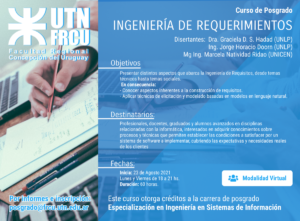
ÚLTIMA SEMANA de INSCRIPCIÓN !!!! CURSO DE POSGRADO: Ingeniería de Requerimientos (modalidad VIRTUAL)

Estimados 

El Departamento de Ingeniería en Sistemas de Información tiene el agrado de invitarlos a participar del curso de posgrado cuya información se encuentra en el archivo adjunto. 

Comienza el LUNES 23 de AGOSTO 
Horarios. Lunes y Viernes de 18:00 a 21:00 horas.

👉Más  información 

👉Formulario de Inscripción


Este curso otorga créditos a la carrera de posgrado

“Especialización en Ingeniería en Sistemas de Información”


Por informes e inscripción: posgrado@frcu.utn.edu.ar

Saludos cordiales

Ing. Callejas, Adrián                      Ing. Cristaldo, Patricia

Sec. Departamento ISI                  Dir. Departamento ISI

Design by 2b Consult