
1st CfP – CAOS: Cognition And OntologieS @FOIS – September – Bolzano, Italy

CAOS 2021 – Call for Papers

Cognition And OntologieS
in conjunction with FOIS held September 11-18 in Bolzano, Italy
(hybrid event)


The purpose of the workshop is to bridge the gap between the cognitive sciences and research on ontologies and, thus, to create a venue for researchers interested in interdisciplinary aspects of knowledge representation.


More specifically CAOS investigates how key cognitive phenomena and concepts (and the involved terminology) can be found across language, psychology and reasoning and how they can be formally and ontologically understood and analysed. It moreover seeks answers to ways such formalisations and ontological analysis can be exploited in Artificial Intelligence and information systems in general.

We welcome submissions on topics related to the ontology of hypothesized building blocks of cognition (such as image schemas, affordances, categories, and related notions) and of cognitive capacities (such as concept invention, language acquisition and categorisation), as well as system demonstrations modelling these capacities in application settings. We also welcome submissions addressing the cognitive and epistemological adequacy of ontological modelling.

Topics of interest include (but are not limited to):

Modelling cognitive phenomena:

·  Language acquisition

·  Formalisation / modelling of language

·  Embodied cognition

·  Concept invention

·  AI for language understanding

·  Image schemas / affordances for AI

·  Knowledge acquisition in AI and Robotics

·  Natural language applications / system-demonstrations

Epistemological and cognitive foundation of ontologies:

·  Cognitive foundations of ontologies and ontologies of cognitive theories (e.g. connection with conceptual spaces, diagrammatic representations, mental models, prototypes, image schemas, scripts etc.).

·  Empirical foundations of ontologies: ontologies driven from observations, measurements, tests, and in general from data acquired using empirical procedures.

·  Representation of different perspectives on the same domain: contexts, granularity, resolution, ontological levels.

·  Quantitative approaches/analyses, probabilities, uncertainty, and ontologies.

·  Neural networks and ontological modelling.

·  Integration of ontologies with different formats and levels of representation (e.g. neural-symbolic integration).

·  Inductive reasoning in ontologies.

·  Ontological Extensions of Cognitive Architectures.


We welcome researchers from all career stages to participate. Work in progress (short papers) are also welcome since a central goal of the workshop is the discussion of ongoing interdisciplinary work.


All papers must be original and not submitted to or accepted by any other workshop, conference or journal. Note, that for inclusion in the JOWO proceedings, short and position papers are required to be at least 5 pages long.

All contributions will be peer-reviewed, and the review process will be managed in a collaborative and transparent manner using the EasyChair System as part of the JOWO organisation.

Submissions

Submission deadline: July 3, 2021
Submission link: https://easychair.org/conferences/?conf=jowo2021
(select the track “Cognition And OntologieS”)  

Details and instructions:

We encourage three types of contributions:

Full research paper: 
Submitted papers must not exceed 14 pages (excluding the bibliography).
Please note that the minimum length is 10 pages.

Short paper: Submitted papers must not exceed 7 pages (excluding the bibliography). Please note that the minimum length is 5 pages.

Abstracts for presentation: 2-4 page abstracts for presentation.
Note that these will not be included in the proceedings.

Papers should be submitted non-anonymously in PDF format in compliance with the new 1-column CEUR-ART Style. Word and Latex templates can be found at
https://ceurws.wordpress.com/2020/03/31/ceurws-publishes-ceurart-paper-style/

All contributions to JOWO workshops will be published in a joint CEUR proceedings volume, compare:

JOWO 2020: http://ceur-ws.org/Vol-2708/
JOWO 2019: http://ceur-ws.org/Vol-2518/
JOWO 2018: http://ceur-ws.org/Vol-2205/

Workshop policy

CAOS 2021 is planned as a hybrid event. Hence, there will be a physical meeting in Bolzano which hopefully most will be able to join. However, given the uncertainty about travel in September, we will make arrangements for remote participation. If the physical meeting cannot be held due to social restrictions, the workshop will go fully virtual.

Organisation

Maria M. Hedblom: University of Bremen, Germany.
Oliver Kutz: Free University of Bozen-Bolzano, Italy.
Guendalina Righetti: Free University of Bozen-Bolzano, Italy

Program Committee
(as of yet)

Taisuke Akimoto, Kyushu Institute of Technology  
Lucas Bechberger, Osnabrück University  
Brandon Bennett, University of Leeds

Daniel Beßler, University of Bremen
João Miguel Cunha, University of Coimbra
Roberta Ferrario, CNR Italy   
Karl Hammar, Jönköping University
Antonio Lieto, University of Turin   
Ana-Maria Olteteanu, Freie Universität Berlin  
Daniele Porello, University of Genova  
Marco Schorlemmer, Artificial Intelligence Research Institute, IIIA-CSIC  
Ana Tanevska, Italian Institute of Technology
Tony Veale, University College Dublin
Michael Verdonck, Universitair Ziekenhuis Brussel
 

Invitation for Participation in the first ScanBIM Challenge

Dear Colleagues,

We invite you to participate in the first Scan-to-BIM challenge focused on key problems when converting 3D point cloud data obtained using lidar, photogrammetry, or depth map cameras to Building Information Models (BIMs). For maintenance, retrofitting, or renovation AEC entities could greatly benefit from access to BIMs of their facilities. Furthermore, asset owners could use BIMs for operations and maintenance as BIMs enable storing and having access to attributes such as maintenance history, material type, and manufacturer specifications. The challenge will include two tasks: (I) Floorplan Reconstruction and (II) 3D Building Model Reconstruction. For details on the two tasks please see below.

Top participants will be invited to present in the first Workshop and Challenge on Computer Vision in the Built Environment for the Design, Construction and Operation of Buildings, which will also feature invited talks and a panel discussion.

More information and dataset download can be found on the workshop website, if you have seen an earlier version of this invitation, please note that the validation and testing data have been made available now:

https://cv4aec.github.io/

We look forward to seeing your participation in the challenge!

The Workshop Organizers

Iro Armeni, Postdoctoral Researcher, ETHZ

Erzhuo Che, Professor, CEE, Oregon State University

Yong Cho, Professor, CEE, Georgia Tech University 

Martin Fischer, Professor, CEE, Stanford University

Daniel Hall, Professor, CEE, ETHZ 

Jaehoon Jung, Professor, CEE, Oregon State University

Fuxin Li, Professor, CS, Oregon State University

Michael Olsen, Professor, CEE, Oregon State University

Marc Pollefeys, Professor, CS, ETHZ 

Silvio Savarese, Professor, CS, Stanford University

Yelda Turkan, Professor, CEE, Oregon State University 

** CHALLENGE INFORMATION **

Important Dates

  • Challenge submission deadline: June 1st, 2021

  • Notification to authors: June 10th, 2021

  • Workshop day: June 20, 2021, Saturday. Day 2 of CVPR 2021

I. Floorplan reconstruction task

Dataset: For the floorplan reconstruction task, the training set consists of the point clouds of 20 buildings with multiple floors each, with a total of 49 point clouds, as well as corresponding aligned 2D building models for each floor with multiple extracted layers. These layers include: walls, curved walls, doors, windows, stairs, and columns. The buildings have complicated floor structures which could include dozens of rooms, curved walls and many doors on each floor. The validation set contains 21 point clouds and their corresponding 2D building models, and is now available. The testing set contains another 21 point clouds. For the testing set, only the point clouds will be made available, while the 2D building models will not be made available and we will host a server to evaluate the submissions.

Evaluation Metrics: The evaluation consists of both geometric and topological metrics. For geometric metrics, the IoU of the floor area will be measured, as well as the endpoint accuracy, and orientation of walls, doors, and windows. We will also evaluate topological metrics that measure whether the connectivity of the rooms match the ground truth.

II. 3D building model reconstruction task

Dataset: For the 3D building model reconstruction task, the training set consists of point clouds of 4 buildings with multiple floors, as well as the corresponding 3D building model in AutoCAD DXF format. We aim to release 2 more buildings for the validation set and 2 more as the testing set. The evaluation on the testing set will also be hosted on the evaluation server in a similar manner to the floorplan reconstruction task.

Evaluation Metrics: The evaluation will be done manually by an expert panel.


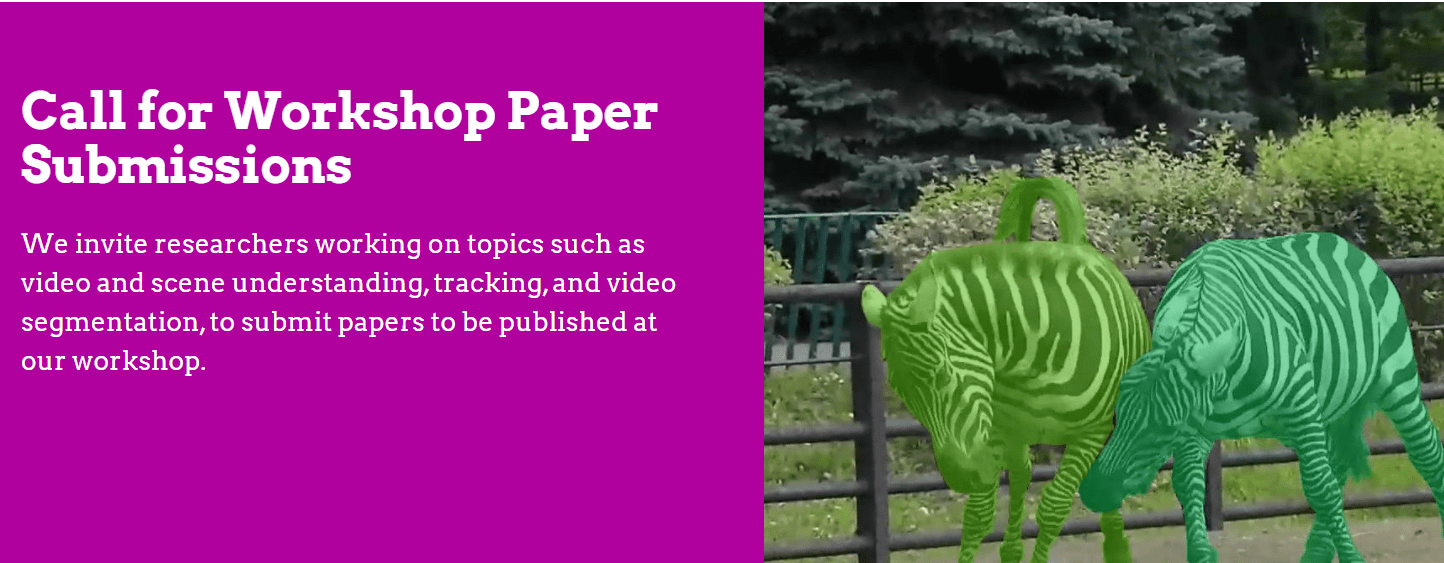
RVSU CVPR’21 Workshop Call for Papers (Tracking and Video Understanding). Deadline June 4th.

cfp2-min.png

RVSU Workshop:

The RVSU workshop (https://eval.vision.rwth-aachen.de/rvsu-workshop21/) is putting out a call for submission track papers (https://eval.vision.rwth-aachen.de/rvsu-workshop21/?page_id=74) on Tracking and Video Understanding.

The deadline for paper submissions is June 4. Papers are restricted to 4 pages to not prevent simultaneous submission at full conferences. We are looking forward to accepting interesting work about Tracking, Video Segmentation and other Video Understanding topics.

Topics:

 – Video Scene Understanding

 – Multi-Object Tracking

 – Video Segmentation

 – Single Object Tracking

 – 3D Tracking

 – Ethical and Safe Video Algorithms and Research

 – Video Domain Adaptation

 – Benchmarking and Evaluation for Video Scene Understanding

 – Analyzing Humans in Video

 – Future Trajectory Prediction

 – Vision for Self-Driving in Dynamic Scenes

 – Self-Supervised and Unsupervised Video Representation Learning

 – Simulation for Dynamic Scene Understanding

 – Low-level Feature Tracking

 – Action Recognition and Video Classification

 – Video Detection

 – Architectures for Video

 – Optical Flow and Scene Flow

 – Video Object Discovery

 – Online / Real-Time Video Algorithms

CFP: AIMLSystems2021

Please find below the Call for Papers for the AIML Systems 2021
Conference. Looking forward to receiving your submissions.

The ROAD Challenge @ ICCV 2021

The ROAD Challenge: Event Detection for Situation Awareness in Autonomous Driving

Call for participation

https://sites.google.com/view/roadchallangeiccv2021/challenge

Aim of the Challenge

The accurate detection and anticipation of actions performed by multiple road agents (pedestrians, vehicles, cyclists and so on) is a crucial task to address for enabling autonomous vehicles to make autonomous decisions in a safe, reliable way. While the task of teaching an autonomous vehicle how to drive can be tackled in a brute-force fashion through direct reinforcement learning, a sensible and attractive alternative is to first provide the vehicle with situation awareness capabilities, to then feed the resulting semantically meaningful representations of road scenarios (in terms of agents, events and scene configuration) to a suitable decision-making strategy. In perspective, this has also the advantage of allowing the modelling of the reasoning process of road agents in a theory-of-mind approach, inspired by the behaviour of the human mind in similar contexts.

Accordingly, the goal of this Challenge is to put to the forefront of the research in autonomous driving the topic of situation awareness, intended as the ability to create semantically useful representations of dynamic road scenes, in terms of the notion of a road event.

The ROAD dataset

This concept is at the core of the new ROad event Awareness Dataset (ROAD) for Autonomous Driving

https://github.com/gurkirt/road-dataset


ROAD is the first benchmark of its kind, a multi-label dataset designed to allow the community to investigate the use of semantically meaningful representations of dynamic road scenes to facilitate situation awareness and decision making. It contains 22 long-duration videos (ca 8 minutes each) annotated in terms of “road events”, defined as triplets of Agent, Action and Location labels and represented as ‘tubes’, i.e., series of frame-wise bounding box detections.


ROAD is a large, high-quality benchmark comprising 122K labelled video frames and 560K detection bounding boxes associated with 1.7M labels.


The above GitHub repository contains all the necessary instructions to pre-process the 22 ROAD videos, unpack them to the correct directory structure and run the provided baseline model.


Tasks and Challenges

ROAD allows one to validate detection tasks associated with any meaningful combination of the three base labels. For this Challenge we consider three video-level detection Tasks:

T1. Agent detection, in which the output is in the form of agent tubes collecting the bounding boxes associated with an active road agent in consecutive frames.

T2. Action detection, where the output is in the form of action tubes formed by bounding boxes around an action of interest in each video frame.

T3. Road event detection, where by road event we mean a triplet (Agent, Action, Location) as explained above, once again represented as a tube of frame-level detections.

Each Task thus consists in regressing whole series (‘tubes’) of temporally-linked bounding boxes associated with relevant instances, together with their class label(s).

Baseline

As a baseline for all three detection tasks we propose a simple yet effective 3D feature pyramid network with focal loss, an architecture we call 3D-RetinaNet:

http://arxiv.org/abs/2102.11585

The code is publicly available on GitHub:

https://github.com/gurkirt/3D-RetinaNet

Timeframe

Challenge participants have 18 videos at their disposal for training and validation. The remaining 4 videos are to be used to test the final performance of their model. This will apply to all three Tasks.

The timeframe for the Challenge is as follows:

·        Training and validation fold release: April 30 2021

·        Test fold release: July 20 2021

·        Submission of results: August 10 2021

·        Announcement of results: August 12 2021

·        Challenge event @ workshop: October 10-17 2021

Evaluation

Performance in each task is measured by video mean average precision (video-mAP), with an Intersection over Union (IoU) detection threshold set to 0.1, 0.2 and 0.5 (signifying a 10%, 20% and 50% overlap between predicted and true bounding box within each tube), because of the challenging nature of the data. The final performance of each task will be determined by the equally-weighted average of the performances at the three thresholds.

In the first stage of the Challenge participants will, for each task, submit their predictions as generated on the validation fold and get the evaluation metric in return, in order to get a feel of how well their method(s) work. In the second stage they will submit the predictions generated on the test fold which will be used for the final ranking.

A separate ranking will be produced for each of the Tasks.

Evaluation will take place on the EvalAI platform. For each Challenge stage and each Task the maximum number of submissions is capped at 50, with an additional constraint of 5 submissions per day.

Detailed instructions about how to download the data and submit your predictions for evaluation at both validation and test time, for all three Tasks, are provided on the Challenge website.

Design by 2b Consult