



dataset for challenging driving scenarios! DSEC features over 400GB of
data including stereo VGA Prophesee event cameras, stereo RGB cameras,
Velodyne lidar, and RTK-GPS, recorded in challenging high-dynamic-range,
day and night, sunrise and sunset, urban and Swiss-mountain driving
scenarios! Additionally, it provides ground-truth disparity for the
development and evaluation of event-based stereo and depth estimation
algorithms. Check it out and participate in our upcoming CVPR2021
competition: http://rpg.ifi.uzh.ch/dsec.html
More info in our paper:
“DSEC: A Stereo Event Camera Dataset for Driving Scenarios”:
http://rpg.ifi.uzh.ch/docs/RAL21_DSEC.pdf
Mathias Gehrig, Jan-Willem Aarents, Daniel Gehrig, Davide Scaramuzza
Call for extended abstracts GCPR 2021 Workshop on Scene Understanding in Unstructured Environments
 April 20th, 2021
  Daniela Lopez de Luise
 1st Workshop on Scene Understanding in Unstructured Environments (SUUE 2021)
====================================================================
Virtual/Hybrid, September 28th 2021, held in conjunction with DAGM German Conference on Pattern Recognition (GCPR 2021)
https://unstructured-scene-understanding.com
Important Dates ==================================================================== * June 17, 2021 – Submission Deadline
* July 22, 2021 – Notification to Authors
* September 28, 2021 – Workshop Talks Call for Extended Abstract
====================================================================
We invite submissions of 3 pages max, excluding references. Please submit via CMT (https://cmt3.research.microsoft.com/SUUE2021). The submission deadline is June 17th 2021 23:59 (CEST). We allow presenting previously published work. More information on the submission process can be found on the workshop website (https://unstructured-scene-understanding.com/submission.html).
Overview
====================================================================
The vast majority of research in scene understanding is applied in urban and structured environments. Unfortunately, these methods often fail when used in unstructured environments with challenging lighting conditions and many natural structures in the scene.
These conditions require different model assumptions and robust algorithms.
The main objective of this workshop is to create a platform for researchers, from both academia and industry, to explore fundamental research and applications on scene understanding in unstructured environments. It aims to foster discussion and exchanges, ideally creating a long-term flourishing communication channel in the community.
The workshop will take place on September 28, 2021 as part of the DAGM German Conference on Pattern Recognition (GCPR) in Bonn, Germany. The conference will either be organized as a hybrid or virtual conference. We therefore invite the international research community to participate. The workshop also includes the Outdoor Semantic Segmentation Challenge on the novel TAS500 dataset of fine-grained annotations of outdoor driving scenes. Train and benchmark your semantic segmentation algorithms on these real world outdoor driving scenes. The challenge deadline is on July 31, 2021. The best submissions will be invited to present their solution as part of the workshop on September 28, 2021.
Topics
====================================================================
Topics include the following but not limited to
* Scene Understanding in Unstructured Environments
* Multimodal Learning
* Transfer Learning
* Applications in Field Robotics
Extended list is available on the workshop website (https://unstructured-scene-understanding.com/submission.html).
Workshop Chairs
====================================================================
Prof. Abhinav Valada (University of Freiburg)
Jens Behley (University of Bonn)
Nina Heide (Fraunhofer IOSB)
Peter Mortimer (Bundeswehr University Munich)
====================================================================
For any additional information feel free to contact us at suueworkshop@googlegroups.com
We are looking forward to your submissions and your attendance at the SUUE 2021 this September!
Paper Invitation for Special Issue “Sensor Fusion and Signal Processing”
April 20th, 2021 Daniela Lopez de Luise 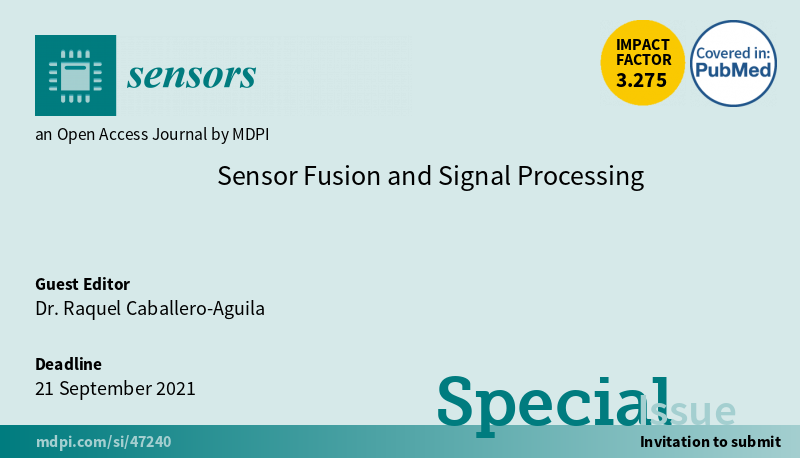
Call for Papers in Sensors (IF 3.275)
Special Issue: Sensor Fusion and Signal Processing
Topics:
–Signal estimation in sensor networks;
–Information fusion techniques and applications;
–Fusion estimation algorithms;
–Sensor fusion for detection;
–Control systems and sensor fusion;
–Sensor fusion for automotive applications;
–Target tracking, fusion and control;
–Signal and image processing.
Submission deadline: 21 September 2021
Website: https://www.mdpi.com/journal/sensors/special_issues/sensor_signal_processing
Sensors is a fully open access journal. All submissions are peer-reviewed, and accepted papers will be published immediately.
Kind regards,
Raquel Caballero-Águila (Guest Editor)
Special Track on AI for Tackling Dis/Misinformation during Pandemics @ ACM GoodIT2021
April 20th, 2021 Daniela Lopez de Luise during Pandemics In conjunction with the ACM International Conference
on Information Technology for Social Good (GoodIT 2021)
The GoodIT conference is sponsored by ACM SIGCAS, the Association for
Computing Machinery's Special Interest Group on Computers & Society.
The conference focuses on the application of IT technologies to social
good.
The Special Track on AI for Tackling Dis/Misinformation during
Pandemics focuses on new data technologies based on artificial
intelligence, data governance, machine learning, natural language
processing, and social network analysis to aid experts in analyzing
large volumes of social media data in order to detect fake news,
misinformation, and disinformation. A number of open challenges need
more investigation from the research community, such as recent trends
in composing information disorder by combining false and real content,
the mechanisms that drive fake content diffusion during pandemics, how
to differentiate fake content from personal viewpoints, why people
tend to believe fake content and make decisions based on it during
pandemics, and what are the different motivations behind the
dissemination of fake content. Fact-checking and claim verification
are two important strategies that are worth incorporating in the
automated tackling and curtailment of fake content during and after
pandemics.
************ Key Dates ************
Papers Submission Due: May 1, 2021
Authors Notifications: June 22, 2021
Final Manuscript Due: July 10, 2021
GoodIT 2021: September 09-11, 2021
************ Important Links ************
Special Track Website: https://aitdmp.conceptechint.net
Submission Link: https://goodit2021.hotcrp.com/
************ Submission Guidelines ************
All submissions will be reviewed using a single-blind review process.
The identity of referees will not be revealed to authors, but authors
can keep their names on the submitted papers, on figures,
bibliography, etc.
Papers should not exceed 6 pages (US letter size) double column
including figures, tables, and references in standard ACM format.
Papers must be submitted electronically in printable PDF form.
Templates for the standard ACM format can be found here:
https://www.acm.org/publications/proceedings-template No changes to
margins, spacing, or font sizes are allowed from those specified by
the style files. Papers violating the formatting guidelines will be
returned without review.
ACM has partnered with Overleaf, a free cloud-based, collaborative
authoring tool, to provide an ACM LaTeX authoring template. The ACM
LaTeX template on Overleaf platform is available to all ACM authors
at: www.overleaf.com/gallery/tagged/acm-official
Accepted papers will be included in the ACM Digital Library. Special
issues associated with the conference are being organized.
************ Topics ************
Papers on practical as well as on theoretical topics and problems in
various topics related to rumors, fake news, misinformation, and
disinformation during and after pandemics, are invited, with special
emphasis on novel techniques and tools for automated tackling and
curtailment of fake content during and after pandemics. Topics include
(but are not limited to):
-AI approaches for the detection of online influence and manipulation
-AI approaches to identify misinformation and disinformation campaigns
-AI approaches for spotting misinformation and disinformation spreaders.
-Social media mining for automated detection of misinformation
propagation and disinformation circulation
-AI approaches for automated identification and verification of claims
-AI approaches for intention detection for misinformation and
disinformation contents
-AI approaches for credibility assessment of Social media sources
-AI approaches for fake news curtailment, filtering and prevention.
-AI approaches for analysis/detection of distributed and
multi-platform misinformation and disinformation disseminations
-AI approaches for predicting the Impact of misinformation and
disinformation during pandemics
-New datasets and evaluation methodologies to aid in automated
detection and analysis of misinformation and disinformation content in
social media channels
**********The Conference Sponsored by**********
Association for Computing Machinery's Special Interest Group on
Computers & Society http://www.sigcas.org/
This workshop is supported by the Association of Cyber Forensics and
Threat Investigators (www.acfti.org) and the Industrial Cybersecurity
Center (www.cci-es.org).
Fwd: [CVML] CFP PE-WASUN 2021
April 20th, 2021 Daniela Lopez de Luise
C a l l F o r P a p e r s
ACM(*) PE-WASUN 2021
18th ACM(*) International Symposium on Performance Evaluation of
Wireless Ad Hoc, Sensor, and Ubiquitous Networks
(Jointly with the 24th ACM(*) MSWiM Conference)
http://pewasun.upc.edu/PEWASUN2021
(*) ACM sponsored pending
Alicante, Spain.
November 22nd– 26th, 2021
**********************
Scope
**********************
Wireless ad hoc, sensor, along with ubiquitous networks have recently witnessed their fastest growth period ever in history, and this trend is likely to continue for the foreseeable future. However, as such networks become increasingly complex, performance modelling and evaluation will play a crucial part in their design process to ensure their successful deployment and exploitation in practice.
This symposium will bring together scientists, engineers, and practitioners to share and exchange their experiences, discuss challenges, and report state-of-the-art and in-progress research on all aspects of wireless ad hoc, sensor, and ubiquitous networks with a specific emphasis on their performance evaluation and analysis.
Topics of interest include, but are not limited to:
· Predictive performance models of ad hoc, sensor, and ubiquitous networks.
· Probabilistic models for ad hoc, sensor and ubiquitous networks.
· Queuing and network information theoretic analysis
· Analytical modeling and simulation methods
· Automatic performance analysis
· Tracing and trace analysis
· Software tools for network performance and evaluation
· Performance measurement, evaluation and monitoring tools for ad hoc, sensor and ubiquitous networks
· Case studies demonstrating the role of performance evaluation in the design of ad hoc, sensor and ubiquitous networks
· Network performance improvement through optimization and tuning
· Mobility modeling and management
· Traffic models for ad hoc, sensor networks
· Performance evaluation of wireless mesh networks
· Performance evaluation of pervasive and ubiquitous networks
· Performance evaluation of VANETs
· Performance of wireless and sensor devices
· Performance of spectrum agile and cognitive wireless sensor networks
· Analysis of multimedia applications over wireless ad-hoc and sensor networks
· Performance of pervasive computing and services
· Analysis of mobile cloud networking and computing
· Performance of continuity of service over heterogeneous networks, seamless connectivity
· Analysis of security and privacy in ad hoc networks and ubiquitous networks
· Simulation methods, performance and analysis
· Real experimentation, deployments, open platforms
General chair
Mónica Aguilar Igartua Universitat Politècnica de Catalunya, Spain (monica.aguilar@upc.edu)
General co-chair
Isabelle Guérin-Lassous Université Lyon 1/LIP, France (isabelle.guerin-lassous@ens-lyon.fr)
Program Co-Chairs
Luis de la Cruz Llopis Universitat Politècnica de Catalunya, Spain (luis.delacruz@upc.edu)
Thomas Begin Université Claude Bernard Lyon 1, France (thomas.begin@ens-lyon.fr)
Web/poster Chair
Juan Pablo Astudillo León Universitat Politècnica de Catalunya, Spain (juan.pablo.astudillo@upc.edu)
Demo/Tools Chair
Pablo Barbecho Bautista Universitat Politècnica de Catalunya, Spain (pablo.barbecho@upc.edu)
Publicity Chair
Leticia Lemus Universitat Politècnica de Catalunya, Spain (leticia.lemux@entel.upc.edu)
Program Committee Members
http://pewasun.upc.edu/PEWASUN2021/committees.html
*********************
Paper Submission
*********************
Authors are invited to submit their papers through EasyChair on the
following link: https://www.easychair.org/conferences/?conf=pewasun2021
The length of the papers should not exceed 8 single-spaced pages
(in two-column format), ACM style including tables and figures. A template
for ACM SIG Proceedings style (LaTeX2e and MS Word) can be found at
https://www.acm.org/publications/proceedings-template
Accepted papers will appear in the ACM symposium proceedings.
The authors of accepted papers must guarantee that their paper will be
presented at the Symposium. At least one author of each accepted paper
must be registered for the symposium, in order for that paper to appear
in the proceedings and to be scheduled for presentation.
*******************
Important Dates
*******************
Full paper due: June 15th, 2021
Acceptance notification: July 31th, 2021
Camera ready due: TBA
Speaker Author Registration: TBA
Symposium: November 22nd – 26th, 2021 – Jointly with MSWiM'21
For more information, please refer to the conference website: http://pewasun.upc.edu/PEWASUN2021
We hope to see you in Alicante.
Yours sincerely,
The PE-WASUN 2021 Committee