



Univ. de Colorado, que nos visitará en la Facultad de Informática el
próximo 3 de octubre. El Dr. Dig expondrá sobre el trabajo de
investigación de su grupo y las herramientas que han construido para
la utilización de IA Generativa en la construcción de software.
La conferencia será presencial y en idioma inglés. Será el 3 de
octubre a las 11hs., de aproximadamente 1 hora de duración.
Les adjuntamos el flyer donde encontrarán el resumen de la charla, la
biografía del Dr. Dig y un link para registrarse. Es muy importante
que se registren para adecuar el espacio a la cantidad de asistentes.
Secretaría de Posgrado
 Flyer_Visita_DannyDig.jpg.pdf
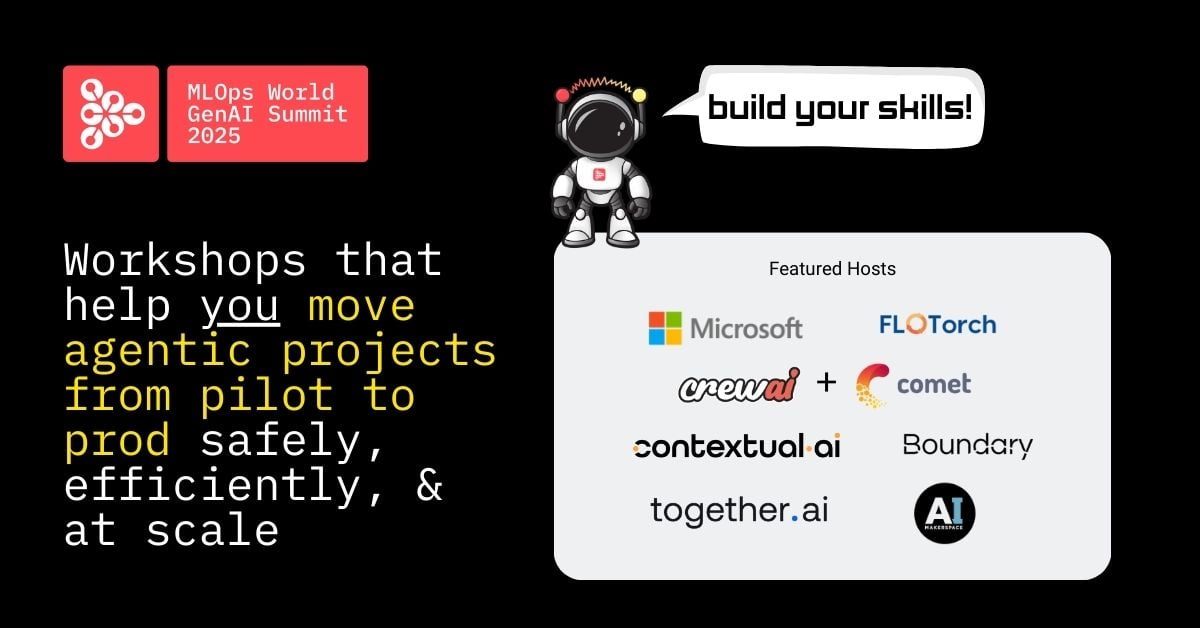
MLOps World 2025: New Hands-On Workshops for Context, Evals & RAG
 September 25th, 2025
  Daniela Lopez de Luise
|

CFP LAFUSION 2025
September 25th, 2025 Daniela Lopez de Luise Information Fusion – (https://lafusion.cos.ufrj.br/ ).
The Third Latin American Workshop on Information Fusion (LAFUSION 2025) focuses on the latest research results on Information Fusion in Latin America. Besides, this workshop aims to create a community of Information Fusion researchers in Latin America.
Information fusion is a multidisciplinary field that focuses on combining and integrating information from diverse sources to improve the resulting information's accuracy, completeness, and reliability. It involves merging data or knowledge from multiple sensors, databases, or information systems to generate a unified and coherent representation of the underlying reality. Therefore, its main goal is to extract meaningful and actionable insights by leveraging the strengths of individual information sources while compensating for their limitations, uncertainties, or redundancies. It aims to provide a more comprehensive and accurate understanding of a given situation or phenomenon than what can be achieved by using individual sources in isolation.
Workshop submissions
The second type of submission is the workshop papers (10 Pages). Authors of accepted positions and regular papers are expected to present their work in a plenary session as part of the main workshop program (hybrid). Accepted regular papers will be published in a public library.
Workshop papers must be original (i.e., not previously published) and not currently under review by any other conference or journal. Submissions related to the featured topic are especially welcome, but all other submissions in the scope of Information Fusion are equally welcome. All submissions will be evaluated based on the same criteria. All submitted papers must conform to the Springer CCIS conference template. LAFUSION 2025 will adopt a double-blind review process for regular papers. Authors must make a good faith effort to anonymize their submissions to ensure that their identities are not disclosed to reviewers, and reviewers are discouraged from actively working to uncover author identities. Submitting to arXiv (or similar) is allowed to promote early dissemination, provided cross-citations are not made.
You can submit your paper through: https://cmt3.research.microsoft.com/LAFUSION2025/Submission/Index
This year, the workshop will be held at Naval War School in Rio de Janeiro.
Important Dates:
PAPER SUBMISSION: October 15th, 2025
ACCEPTANCE NOTICE: October 5th, 2025
CAMERA READY SUBMISSION: November 15th, 2025
WORKSHOP DATE: November 27th, 28th, 2025
For more details: cmicelifarias@cos.ufrj.br
CFP: HPCMALL 2026. 3rd International Workshop on Malleability Techniques Applications in High-Performance Computing.
September 25th, 2025 Daniela Lopez de Luise High-Performance Computing.
Together with SCA/HPCAsia 2026, January 26-29 2026, Osaka, Japan
## Submission Timeline #############
– Paper submission: 8 November 2025 (AOE)
– Notification of Acceptance: 30 November 2025
– Camera-ready paper due: 15 December 2025
* Submission link: (https://easychair.org/conferences?conf=hpcmall2026)
## Workshop Chairs
– Prof. Jesus Carretero, University Carlos III of Madrid, Spain.
– Prof. Martin Schulz, Technical University of Munich, Germany.
– Prof. Estela Suarez, Juelich Supercomputing Centre,
Forschungszentrum Juelich GmbH and University of Bonn, Germany.
## Motivation and Objectives
The current static usage model of HPC systems is becoming increasingly
inefficient. This is driven by the continuously growing complexity and
heterogeneity of system architectures, in combination with the
increased usage of coupled applications, the need for strong scaling
with extreme scale parallelism, and the increasing reliance on complex
and dynamic workflows. As a consequence, we see a rise in research on
dynamic resource management in HPC, including malleable systems,
middleware software, and elastic applications, which are designed to
adjust resource usage dynamically in order to extract the maximum
efficiency of large-scale clusters. By providing an intelligent global
coordination of resource usage, through runtime scheduling of
computation, network usage and I/O across all components of the system
architecture, malleable HPC systems can maximize the exploitation of
the available resources, while at the same time minimizing the overall
makespan of applications in many, if not most, cases. Of particular
concern is the emerging class of data-intensive applications and their
interactions with classic simulation workloads, driven by the growing
need to process extremely large data sets. Further, by utilizing new
scheduling paradigms for emerging multi-tier storage hierarchies,
malleability allows to dynamically adjust the computation and storage
needs of applications, on the one side, and the global system on the
other.
Such malleable systems, however, face a series of fundamental research
challenges, including: How do we capture the current status of systems
and detect inefficient resource usage? Who initiates changes in
resource availability or usage? How is it communicated? How to compute
the optimal usage? How can applications cope with dynamically changing
resources? What should malleable programming models and abstractions
look like? How to design resource management frameworks for malleable
systems? Which resources benefit from malleability and which (if any)
should still be managed statically?
In order to address these challenges, the HPCMALL 2026 workshop will
bring together researchers from diverse areas of HPC that are impacted
or actively pursuing malleability concepts, from application
developers to system architects, from programming models to system
software researchers. In addition to high-quality, refereed
publications and talks, the workshop will provide a lively discussion
forum for researchers working in HPC and pursuing the concepts of and
around malleability, to reflect on the advances achieved in the field
since the previous editions of this workshop.
### Topics
We are looking for original high-quality research and position papers
on applications, services, and system software for malleable
high-performance computing systems. Topics of interest include, but
are not limited to:
– System and system architecture considerations in designing malleable
architectures.
– Emerging software designs to achieve malleability in
high-performance computing.
– High-level parallel programming models and programmability
techniques to improve applications' malleability.
– Runtime techniques to provide malleable execution models for
computation, communication, and I/O.
– Resource management frameworks and interfaces supporting malleable
scheduling, resource allocations and application execution.
– Computing and I/O scheduling algorithms providing and/or exploiting
static or dynamic malleability.
– Interaction between state-of-the-art HPC systems and large-scale
disaggregated resources, e.g., for AI or Quantum appliances, and their
dynamic usage.
– Use of AI and ML techniques to steer malleability in systems and applications.
– Ad-hoc storage systems and I/O scheduling techniques helping I/O malleability.
– Support for malleable execution of applications in performance,
debugging, and correctness tools.
– Energy efficiency and malleability (applications, over-provisioned
systems wrt. power/energy, storage systems, etc.).
– Experiences and use cases applying malleability to HPC applications.
## Publication
Papers will be published together with SCA/HPCAsia proceedings.
## Submission Guidelines
### Online Submission System
Authors submitting papers for HPCMALL 2026 must do so via the
“EasyChair submission web page for HPCMALL2026”
(https://easychair.org/conferences?conf=hpcmall2026). Authors are
invited to submit technical papers of no more than 12 pages in PDF
format, including figures and references. The papers should be
formatted according to the ACM Proceedings Style and submitted through
the Online Submission System.
Submitted papers must contain original work that has not appeared in
and is not under consideration for another conference, journal, or
workshop. The review process is double-blind. There will be no
revision rebuttal process and the review will be one-pass.
### Submission Format
All authors should submit manuscripts for review in a single-column
format. Manuscripts must be at most 12 pages in PDF format including
figures and references, formatted according to the ACM Proceedings
Style. The ACM templates for Word and LaTeX are shown below. Also, ACM
has partnered with Overleaf and the ACM LaTeX template on Overleaf
platform is available.
Please follow STEP 1 (Microsoft Word/LaTeX) at “2. The Workflow and
Templates” in [https://www.acm.org/publications/authors/submissions](https://www.acm.org/publications/authors/submissions).
Please note that there are two different instructions for Word and
LaTeX template users.
## ACM Templates
* Word (docx) –
[download](https://www.acm.org/binaries/content/assets/publications/taps/acm_submission_template.docx)
* LaTex (zip) [download](https://portalparts.acm.org/hippo/latex_templates/acmart-primary.zip)
use a “manuscript” format option (Please refer to
sample/sample-manuscript.tex).
* Overleaf use a “manuscript” format option.
## Program committee
* Marco Aldinucci, University of Torino, Italy.
* Carlos Jaime Barrios Hernandez. Université Grenoble Alpes, Inria. France.
* Alberto Cascajo. Universidad Carlos III de Madrid. Spain.
* Javier Fernandez-Muñoz. Universidad Carlos III de Madrid. Spain.
* Maria Fazio. Università degli Studi di Messina. Italy.
* Balazs Gerofi, RIKEN, Japan.
* Sonja Happ. PArTec AG. Germany.
* Dominik Huber. Technical University of Munich. Germany.
* Sergio Iserte. Barcelona Supercomputing Center. Spain.
* Thomas Jakobsche. University Basel. Switzerland.
* Raffaele Montella. University of Naples “Parthenope'” (UNP), Italy.
* Krzysztof Rojeck. Częstochowa University of Technology (PCZ), Poland.
* Martin SCHREIBER. Université Grenoble Alpes, Inria. France.
* David E. Singh, Universidad Carlos III de Madrid. Spain.
* Ahmad Tarraf. Technical University of Darmstadt. Germany.
* Hiroyuki Takizawa. Tohoku University. Japan.
* Massimo Torquatti, University of Pisa, Italy.
Stage ou mission au Labo SETIT/ Sfax Tunisie
September 23rd, 2025 Daniela Lopez de Luise Bonjour cher(e) collègue
Pour la bonne organisation des stages et missions qui seront effectués courant 2025/2026 (par vous-même ou par un de vos collègues) au sein du Laboratoire : Smart systems for Engineering & E-health based on Technologies of Image and Telecommunications (SETIT) Sfax-Tunisie, il est demandé aux chercheurs intéressés de remplir le formulaire suivant : https://forms.gle/nWefupY3snARVWH58
Lors de votre stage, vous pouvez participer à un Workshop sur le Plagiat : Prévenir le Plagiat dans les Publications Scientifiques
Durée :
3 demi-journées (3 heures chacune)
À propos du Workshop :
Dans un contexte académique de plus en plus compétitif, la question du plagiat devient cruciale. Ce workshop a pour objectif de sensibiliser les chercheurs, étudiants et professionnels aux enjeux du plagiat, tant sur le plan éthique que légal. Avec la recrudescence de l'utilisation de l'intelligence artificielle pour la rédaction d'articles, il est essentiel d'apprendre aux participants les techniques les plus adaptées pour éviter le plagiat.
À travers des présentations interactives et des études de cas, nous explorerons les différentes formes de plagiat, leurs conséquences et les meilleures pratiques pour les éviter. Nous aborderons également les méthodes de rédaction qui garantissent l'originalité des travaux tout en respectant les normes académiques, ainsi que les nouvelles tendances en matière de détection du plagiat, notamment les logiciels utilisés par les revues scientifiques pour identifier les contenus générés par l'IA.
Objectifs du Workshop :
- Sensibilisation au Plagiat : Comprendre les différentes formes de plagiat, y compris le plagiat intentionnel et non intentionnel.
- Intégrité Scientifique : Discuter de l'importance de l'honnêteté académique et des implications du plagiat sur la réputation et la carrière des chercheurs.
- Outils pratiques : Fournir une formation sur l'utilisation du logiciel iThenticate, un outil essentiel pour détecter et prévenir le plagiat dans les publications scientifiques.
Utilisation de iThenticate :
Les participants auront l'occasion de se familiariser avec iThenticate, un logiciel de pointe qui analyse les documents et signale les passages potentiellement plagiés. Des démonstrations pratiques seront réalisées pour illustrer son utilisation efficace.
Avantage :
Chaque participant bénéficiera de 10 crédits pour l'utilisation de ce logiciel pendant 6 mois, afin de garantir un suivi et une assistance dans leurs futures publications.
Pour toute question ou information supplémentaire, veuillez nous contacter.
Les frais de participation au workshop sont fixés à 2Euros (payable en Dinars tunisiens)
Cordialement
Pr Med salim BOUHLEL
Directeur du labo SETIT
WhatsApp +216 20 20 00 05