MONAMI 2020 & related conferences going virtual! Submit your paper and get more citations & extra exposure by presenting online to a global audience (Springer, Scopus, ISI, more)

Web version
Forward

Chiba, Japan Cyberspace
Conference Dates: November 10 – 12, 2020

Submission Deadline: 
July 1, 2020 (late track)

EAI is proud to announce that MONAMI is going virtual and beyond borders.

Get the same full publication and indexing, enjoy EAI’s fair evaluation and recognition, present your paper to a global audience, and experience virtual meetings live as well as on-demand from the safety and comfort of your home.

Scroll down to see more EAI online conferences with an upcoming submission deadline!

SCOPE

“Intelligent Mobility and Edge Computing for a Smarter World”

MONAMI 2020 offers the opportunity to leading researchers, industry professionals and academics around the world to meet and discuss the latest advances in these areas and present results related to technologies for realizing the sustainable ecosystem of the future mobile computing systems. The aim of the forum is to disseminate the latest innovative mobile network solutions for increased competition and cooperation in an environment with a multitude of access technologies, network operators and business actors, with special focus on IoT and mobile edge computing (MEC).

We are pleased to invite you to submit your paper to MONAMI 2020. Submissions should be in English, following the Springer formatting guidelines (see Submission). 

Submit Paper

Read more: Call for Papers

MONAMI 2020 will take place online due to safety concerns and travel restrictions caused by COVID-19. Although we will miss having everyone meet and connect in person, we feel strongly that knowledge exchange must continue, if not more so. That is why we have equipped our online conferences with live viewing with chat, virtual Q&A, and a multitude of other measures to provide you with a great experience. All of this while making the registration for co-authors and non-authors completely free to give you the biggest possible audience. You can learn more about EAI’s online conferences here.

PUBLICATION

All accepted and presented papers will be submitted for publishing by Springer and made available through SpringerLink Digital Library.

Proceedings will be submitted for inclusion in leading indexing services, Ei Compendex, ISI Web of Science, Scopus, CrossRef, Google Scholar, DBLP, as well as EAI’s own EU Digital Library (EUDL).

Selected papers will be invited to submit an extended version to:

Selected papers will be recommended to a fast track of:

All accepted authors are eligible to submit an extended version in a fast track of:

Additional publication opportunities:

          Important dates 

          Submission Deadline: july 1, 2020 (late track)

          Notification Deadline: august 10, 2020

          Camera-ready deadline: september 20, 2020

          Conference dates: november 10-12, 2020

          CALL FOR WORKSHOP PAPERS

          MONAMI 2020 will hold following international workshops, seeking high-quality original research papers:

          Workshop on Edge Intelligence

          5G/B5G Security Workshop

          Workshop on IoT Robot

          EREDA Workshop

          Keynote speakers

          Meet the Keynote Speakers for MONAMI 2020:

          Professor of Fraser University,
          Canada

          Mianxiong Dong
          Professor of Muroran Institute
          of Technology, Muroran, Japan

          Professor of Computer Science, City University of Hong Kong

          Professor of National Institute of Informatics, NII, Japan

          Discover more EAI online conferences with an upcoming submission deadline:

          EAI WiCON 2020
          13th EAI International Wireless Internet Conference

          EAI BODYNETS 2020
          15th EAI International Conference
          on Body Area Networks: Smart IoT big data for intelligent health management

          EAI TRIDENTCOM 2020
          15th EAI International Conference
          on Tools for Design, Implementation and Verification of Emerging Information Technologies

          EAI MobiQuitous 2020
          17th EAI International Conference
          on Mobile and Ubiquitous Systems: Computing, Networking and Services

          EAI ADHOCNETS 2020
          12th EAI International Conference
          on Ad Hoc Networks

          EAI Qshine 2020
          16th EAI International Conference
          on Heterogeneous Networking for Quality, Reliability, Security and Robustness

          EAI BROADNETS 2020
          11th EAI International Conference
          on Broadband Communications, Networks, and Systems 

          EAI ICTCC 2020
          6th EAI International Conference
          on Nature of Computation and Communication

          EAI COMMUNITY BENEFITS

          Granting you visibility and fair review through
          Community Review

          Credits counting towards your EAI Index, membership ranks and global recognition.

          Receive invaluable real-time feedback on your presentation on-site via EAI Compass.

          Follow us!

          facebook    You Tube   twitter  

          ECCV 2020 Workshop – Beyond mAP: Reassessing the Evaluation of Object Detectors – Call for Papers (1 month to go)


          Call for Papers: ECCV 2020 Workshop – Beyond mAP: Reassessing the Evaluation of Object Detectors


          Workshop link

          https://nikosuenderhauf.github.io/roboticvisionchallenges/eccv2020


          Workshop summary

          This workshop assesses current evaluation procedures for object detection, highlights their shortcomings and opens discussion for possible improvements.

          Through a focus on evaluation using challenges, the object detection community has been able to quickly identify which methods are effective by examining performance metrics. However, as this technological boom progresses, it is important to assess whether our evaluation metrics and procedures adequately align with how object detection will be used in practical applications. Quantitative results should be easily reconciled with a detector’s performance in applied tasks. This workshop provides a forum to discuss these ideas and evaluate whether current standards meet the needs of the object detection community.


          The workshop also hosts the 3rd iteration of our probabilistic object detection (PrOD) competition. Details to be found at the workshop website and the competition page below


          (https://competitions.codalab.org/competitions/20597)


          Call for Papers

          We invite authors to contribute papers to the workshop. Topics of interest comprise, but are not limited to:

          • New evaluation measures/metrics for object detection
          • New evaluation/visualization tools to analyze object detection systems
          • New evaluation procedures for better understanding object detection performance
          • Examinations of current evaluation procedures
          • New datasets designed to examine specific challenges in object detection
          • New detection methods that provide contributions/insights unrewarded by current evaluation procedures (e.g. improved detector calibration, probabilistic object detection, etc.)

          Author Instructions

          • Submissions must follow the ECCV format and be up to 4 pages in length including references
          • It is accepted if this is an abbreviated version of a larger paper published elsewhere if properly referenced
          • Submit your paper through CMT (link)
          • Accepted papers will provide a short video outlining their work which will be part of the ECCV online workshop system (details to come)

          If you have any questions don't hesitate to contact.


          Best regards,

          Dr David Hall

          Research Fellow

          Robotic Vision Benchmarking and Evaluation Project

          Australian Centre for Robotic Vision

          Queensland University of Technology

          e-mail: d20.hall@qut.edu.au

          Phone: +61 7 31380656

          ORCiD: 0000-0002-5520-0128

          Website: https://sites.google.com/view/davidhallcv/home

          CURSO DE POSGRADO: Desarrollo de Nuevas Estrategias para la Resolución de Fallas y el Mantenimiento en Instalaciones Energizadas (TcT).

          CURSO DE POSGRADO
          Desarrollo de Nuevas Estrategias para la Resolución de Fallas y el Mantenimiento en Instalaciones Energizadas – Trabajos con Tensión.
          (11º Edición)
          Edición Especial Virtual – Clases On Line en Vivo
          Fecha de Inicio 17 de Julio de 2020
          Inscripción Abierta.
          La Universidad Tecnológica Nacional (UTN Concordia), la Asociación Electrotécnica Argentina (AEA) y el Comité Argentino de la Comisión de Integración Energética Regional (CACIER), Organizan el 11º Curso de Posgrado sobre: “Desarrollo de Nuevas Estrategias para la Resolución de Fallas y el Mantenimiento en Instalaciones Energizadas” (Trabajos con Tensión).

          Con motivo de la situación de público conocimiento motivada por la pandemia del COVID-19, se ha decidido que en esta oportunidad, la 11ª Edición de este Curso de Posgrado se realice bajo la modalidad virtual, con el dictado de clases On-line en vivo.

          Para ello se utilizarán las plataformas que permitan la adecuada y efectiva comunicación en cada una de las sesiones virtuales a realizar.

          Actualmente en Argentina, los sistemas de Transmisión y Distribución de Energía Eléctrica se encuentran cada vez más al límite de sus capacidades operativas, y en consecuencia se hace más difícil retirar de servicio Líneas o Subestaciones para realizar los mantenimientos de las mismas. El desarrollo de las metodologías de mantenimiento con las instalaciones energizadas, permite minimizar este grave problema. Por este motivo, la implementación del Trabajo con Tensión (TcT) ha tomado un auge importante a nivel mundial, fundamentalmente, en países con problemas similares al nuestro, y ha dejado de ser una manera sofisticada de mantenimiento para convertirse en rutinaria.

          No obstante lo expuesto, los Ingenieros Electricistas o Electromecánicos formados en nuestro país, no adquieren en su carrera de grado conocimientos suficientes que les permitan acceder a estas metodologías, por cuanto carecen del correspondiente sustento científico que les permita la aplicación de las mismas. En consecuencia, desconocen los pasos a seguir para su implementación, y la potencialidad y economía que brindan estos nuevos métodos a partir de su aplicación.
          Por otra parte, los avances realizados en materia de Investigación de Fallas en Aisladores Poliméricos, especialmente dirigida hacia instalaciones energizadas, permitieron por un lado determinar las necesidades del sector y por otro lado posibilitaron contar con especialistas del tema en cuestión.

          A través de este Curso de Posgrado, se pretende abordar el tema en forma integral, indagando sobre las diferentes fallas que se presentan en Líneas y Subestaciones de Transmisión y Distribución, desarrollando las estrategias que permitan su resolución con las instalaciones en servicio. Para ello, se simularán situaciones y se extenderán los resultados a instalaciones existentes, contemplando en todos los casos la normativa presente a nivel nacional e internacional.
          Finalmente, se estudiarán métodos y normas existentes, y se propondrán mejoras adecuando las mismas a las disponibilidades y realidades de nuestro país y la región.

          Fundamentos y Objetivos
          Temario
          Información y Costo
          Docentes
          Opciones de Auspicio
          Bibliografía Sugerida
          Fechas
          Formulario de Inscripción
          ORGANIZA
          Website
          Website
          Email
          Email
          Facebook
          Facebook
          Twitter
          Twitter
          Copyright © 2020 CACIER, Todos los derechos reservados. 
          CACIER – COMITE ARGENTINO DE LA CIER
          Av. Leandro N. Alem 428 Piso 6, (C1003AAR) C.A.B.A., Argentina
          (+54-11) 4311-7220 / 4312-1376

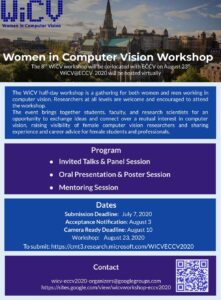
          Women in Computer Vision Workshop @ECCV 2020

          ;text-indent:0px;text-transform:none;white-space:normal;word-spacing:0px;background-color:#fdfdfd;text-decoration-style:initial;text-decoration-color:initial;font-weight:normal”>

          Important Dates

          • Submission Deadline: July 7, 2020
          • Acceptance Notification: August 3, 2020
          • Camera Ready Deadline: August 10, 2020
          • Workshop: August 23, 2020

          Submission Instructions

          • We encourage female (undergraduate and graduate) students, post-docs, and junior researchers in all areas of computer vision to submit a short paper (5 pages single column excluding references) describing new, concurrently or previously published research or work-in-progress.
          • The reviewing process is double-blind.
          • Authors of all accepted papers will be invited to present their work virtually in the workshop.
          • The presenter need not be the first author of a submission.
          • While all presenters will be female, all genders are invited to attend the workshop.
          • All accepted papers will be listed on the workshop website. Please note that there will be no formal proceedings from this workshop.

          Paper template: Please use the final ECCV 2020 template. Papers are expected to be a maximum of 5 pages not including references. 

          Registration awards: We are hoping to cover registration fees to ECCV for primary authors of accepted papers. If you wish to be considered for a registration grant, please mark 'yes' to the question 'Are you applying for a registration grant?' when submitting your paper on CMT.

          Mentoring: We will provide all authors of accepted papers with virtual mentoring opportunities from senior members of the research community.


          Contact

          https://sites.google.com/view/wicvworkshop-eccv2020/

          wicv-eccv2020-organizers@googlegroups.com

          Read More »

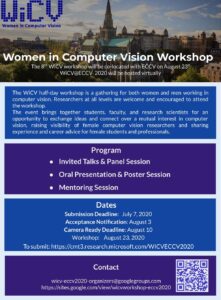
          Women in Computer Vision Workshop @ECCV 2020

          June 18th, 2020 Daniela Lopez de Luise

          ;text-indent:0px;text-transform:none;white-space:normal;word-spacing:0px;background-color:#fdfdfd;text-decoration-style:initial;text-decoration-color:initial;font-weight:normal”>

          Important Dates

          Submission Instructions

          • We encourage female (undergraduate and graduate) students, post-docs, and junior researchers in all areas of computer vision to submit a short paper (5 pages single column excluding references) describing new, concurrently or previously published research or work-in-progress.
          • The reviewing process is double-blind.
          • Authors of all accepted papers will be invited to present their work virtually in the workshop.
          • The presenter need not be the first author of a submission.
          • While all presenters will be female, all genders are invited to attend the workshop.
          • All accepted papers will be listed on the workshop website. Please note that there will be no formal proceedings from this workshop.
          Submission page: https://cmt3.research.microsoft.com/WICVECCV2020/

          Paper template: Please use the final ECCV 2020 template. Papers are expected to be a maximum of 5 pages not including references. 

          Registration awards: We are hoping to cover registration fees to ECCV for primary authors of accepted papers. If you wish to be considered for a registration grant, please mark 'yes' to the question 'Are you applying for a registration grant?' when submitting your paper on CMT.

          Mentoring: We will provide all authors of accepted papers with virtual mentoring opportunities from senior members of the research community.


          Contact

          https://sites.google.com/view/wicvworkshop-eccv2020/

          wicv-eccv2020-organizers@googlegroups.com

          Read More »
          Design by 2b Consult