



Updates in Management of (PNH)
 May 19th, 2020
  Daniela Lopez de Luise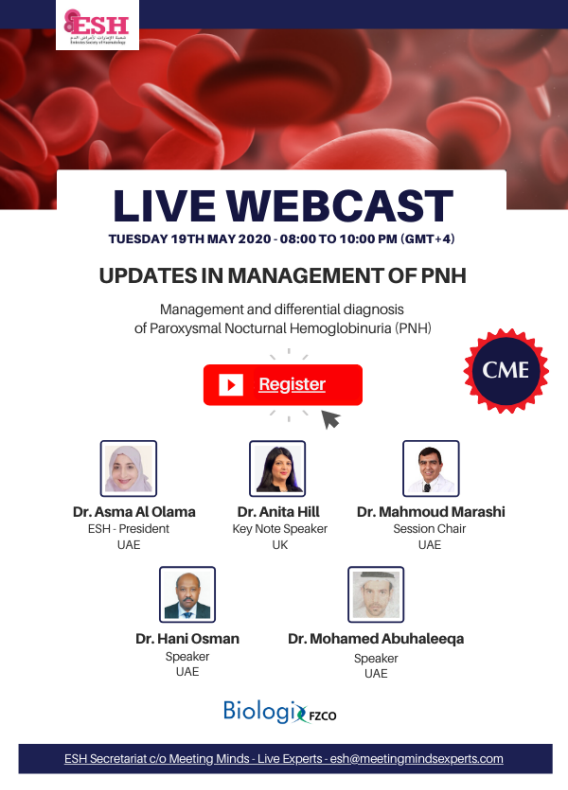

Invitation for the 2020 Summer School on Autonomous Systems, 17-21th August 2020, Aristotle University of Thessaloniki, Thessaloniki, Greece
May 19th, 2020 Daniela Lopez de Luise Dear Autonomous Systems (cars, drones) engineers, scientists, and enthusiasts,
you are welcomed to register to the 2020 Summer School on Autonomous Systems having focus on autonomous drones, cars and marine vessels:
http://icarus.csd.auth.gr/aiia-summer-school-on-autonomous-systems-2020/
It will take place on 17-21/8/2020 as an e-school hosted by the Aristotle University of Thessaloniki (AUTH), Thessaloniki, Greece. As Greece had an excellent record
on combatting COVID-19 (no case in AUTH), we shall also consider the case of a physical school at AUTH (in parallel to the e-school, same registration),
if regulations permit it. See details in the summer school course www pages, as provisions slightly vary from course to course.
The summer school consists of two short courses:
a) ‘Short course on Deep Learning and Computer Vision for Autonomous Systems 2020’, 17-18th August 2020:
http://icarus.csd.auth.gr/dl-and-cv-for-autonomous-cars-2020/
b) ‘Programming short course and workshop on Deep Learning and Computer Vision for Autonomous Systems’, 19-21th August 2020:
http://icarus.csd.auth.gr/autonomous-systems-2020/
You can follow the above-mentioned links for registration on either or both courses.
For questions, please contact: Ioanna Koroni <koroniioanna@csd.auth.gr>
The first course contains 16 lectures providing an in-depth presentation of computer vision and deep learning problems algorithms with applications on autonomous drones, cars and marine vessels.
The second programming short course and workshop offers a mix of lectures and programming workshops (hands-on lab exercises) and aims at developing registrants’ programming skills for Deep Learning and Computer Vision, with focus on drone planning/control and imaging.
Both short courses are organized by Prof. I. Pitas, IEEE and EURASIP fellow, He is AUTH prime investigation for H2020 project AerialCore, Coordinator of the European Horizon2020 R&D project Multidrone, Director of the Artificial Intelligence and Information analysis Lab (AIIA Lab), Aristotle University of Thessaloniki, Greece and Chair of the IEEE SPS Autonomous Systems Initiative. He is ranked 249 top Computer Science and Electronics Scientist internationally by Guide2research (2018).
Thessaloniki is a very pleasant city at the end of August, very close to world-class resorts in Chalkidiki peninsula. Aristotle University of Thessaloniki is the biggest University in Greece and in SE Europe. It is highly ranked internationally and its campus is at the city center.
Relevant links:
1. European Horizon2020 R&D projects Aerial-Core: https://aerial-core.eu/, Multidrone: https://multidrone.eu/, AI4Media: https://ai4media.eu/
2. AIIA Lab: http://www.aiia.csd.auth.gr/
3. Prof. I. Pitas: https://scholar.google.gr/citations?user=lWmGADwAAAAJ&hl=el
Course descriptions
a) ‘Short course on Deep Learning and Computer Vision for Autonomous Systems 2020’, 17-18th August 2020.
http://icarus.csd.auth.gr/dl-and-cv-for-autonomous-cars-2020/
Part A (8 hours), Computer vision topic list
- Introduction to autonomous systems imaging
- Introduction in computer vision
- Image acquisition, camera geometry
- Stereo and Multiview imaging
- Introduction to neural networks. Perceptron, backpropagation
- Deep neural networks. Convolutional NNs
- Introduction to multiple drone imaging
- Drone mission planning and control
Part B (8 hours) Deep learning topic list
- Localization and mapping
- Deep learning for object/target detection
- Object tracking and 3D target localization
- Parallel GPU and multicore CPU programming. GPU programming
- Fast convolution algorithms
- Drone cinematography
- Introduction to car vision
- Introduction to autonomous marine vehicles
b) ‘Programming short course and workshop on Deep Learning and Computer Vision for Autonomous Systems’, 19-21th August 2020.
http://icarus.csd.auth.gr/autonomous-systems-2020/
Part A (8 hours), Deep learning sample topic list
- Deep neural networks. Convolutional NNs
- Deep learning for target detection
- PyTorch basics
- Target detection with PyTorch
- Object oriented Tensorflow in Google Colab
Part B (8 hours), Computer vision sample topic list
- 2D target tracking
- Parallel GPU and multi-core CPU architectures . GPU programming
- CUDA programming
- OpenCV programming for object tracking
- Drone mission simulations
Part C (8 hours), Drone planning/control sample topic list
- Drone mission planning and control
- Drones with ROS and Gazebo simulations
Sincerely yours
Prof. I. Pitas
Social Media Prediction (SMP) Challenge 2020 of ACM Multimedia Conference 2020
May 19th, 2020 Daniela Lopez de Luise Please Publish some information about
Social Media Prediction (SMP) Challenge 2020 of ACM Multimedia Conference 2020. Thanks. The details are as follows:
The Social Media Prediction (SMP) Challenge 2020 of ACM Multimedia Conference 2020.
Co-located with ACM Multimedia 2020 in Seattle,USA
ACM MM Website: https://2020.acmmm.org/
SMP Challenge Website: http://smp-challenge.com/
Important Dates:
Competition registration time: March 15, 2020 – June 15, 2020
Evaluation Results Announce : June 20, 2020
Paper Submission Deadline : July 13, 2020
Challenge Description:
The SMP Challenge is an annual competition organized by a joint team from multiple research organizations. We are seeking excellent research teams to provide new ways of forecasting problems and meaningfully improve people’s social lives and business scenarios. Temporal Popularity Prediction is a massive-scale, multimodal and time-series forecasting problem that is central to various scenarios, such as online advertising, social recommendation, demand forecasting, etc. We released a large-scale Social Media Prediction Dataset (SMPD) with over 486K posts, 70K users and rich information including user profiles, images, texts, times, locations, and categories.
Our Task:
The task is a massive scale, multimodal and time-series forecasting problem that is central to various scenarios, such as online advertising, social recommendation, demand forecasting, etc. The task is focused on predicting the future clicks
or visits of new social media posts (photos, videos or news) before they were shared on social media(e.g.,Flickr,Twitter or Facebook, etc.).
We would award the Best Performance Award and the Top Performance Award to the top-performing teams. The high-quality paper of top-performing teams would have opportunities to be accepted in the Proceedings of the 28th ACM Multimedia Conference
Save the Date: IS&T EI2021 Call for Papers
May 19th, 2020 Daniela Lopez de Luise View 200+ open access fast track articles from EI 2020 to gain a better understanding of the types of research topics presented during the Electronic Imaging Symposium.
https://www.ingentaconnect.com/content/ist/ei;jsessionid=1diht6d9e009b.x-ic-live-03
IS&T International Symposium on Electronic Imaging (EI 2021)
17-21 January 2021
www.electronicimaging.org
Connect with us on LinkedIn and @ElectroImaging for #EI2021 updates!
Roberta Morehouse, CMP
Marketing Manager
Society for Imaging Science and Technology (IS&T)
www.imaging.org
MULTIMED2021 | Special Session in MMM2021
May 19th, 2020 Daniela Lopez de Luise MULTIMED2021: Multimedia and Multimodal Analytics in the Medical Domain and Pervasive Environments, Special Session in the 27th International Conference on Multimedia Modeling (MMM 2021), Prague, Czech Republic, January 25-27, 2021.
https://mmm2021.cz/special-session-multimed2021/
*IMPORTANT DATES*
– Submission deadline: July 12, 2020
– Notifications: September 20, 2020
– Camera ready version: October 18, 2020
*SCOPE AND MOTIVATION*
This special session aims at presenting the most recent works and applications in the area of multimedia analysis and digital health solutions in medical domains and pervasive environments. More specifically, multimedia research is becoming more and more important for the medical domain, where an increasing number of videos and images are integrated in the daily routine of surgical and diagnostic work. This includes management and inspection of the data, visual analytics, as well as learning relevant semantics and using recognition results for optimizing surgical and diagnostic processes. At the same time, pervasive technologies and eHealth systems seem to offer a promising solution for accessible and affordable self-management of health problems. Specifically, multiple layers of intelligence could transform wearable devices, smart home equipment and multimedia information into meaningful behavioral monitoring, including activity recognition. In turn, trends and patterns can be highlighted while the user model and situation can deliver intuitive, personalised and context-aware spoken feedback. This special session provides the opportunity to discuss specific research and technical topics in the aforementioned areas, sharing their results and practical development experiences in the fields.
*TOPICS*
Research topics of interest for this special session include, but are not limited to:
– Multimedia indexing and retrieval for multimodal interaction in the health domain
– Multimedia indexing and retrieval with video recordings from medical endoscopy
– Multimodal conversation and dialogue systems for social companion agents
– Speech and audio analysis and retrieval
– Video content exploration in endoscopic video
– Speech and audio analysis and retrieval for health applications
– Fusion of multimodal information for health and care-giving applications
– Semantic web approaches for multimedia health applications
– Semantic Web technologies in eHealth, mHealth, uHealth, Ambient Assisted Living and medical applications
– Semantic reasoning of health multimedia data in interactive systems
– Semantically-enriched situation awareness in smart homes
– Semantic interoperability in IoT platforms, sensors, mobile and wearable devices in pervasive environments
– Knowledge modelling, interpretation, context-awareness in pervasive environments
– Activity recognition based under uncertainty, noise and incomplete data
– Multimodal analytics for human machine interaction in the health domain
– Web and social media retrieval for knowledge-based social companion applications
– Multimodal conversation, dialogue systems and personal coaches
– Facial analysis and gesture recognition in social agents
– Intelligent user interfaces for multimedia retrieval
– Multilingual and multimodal communication in interactive basic care and health assistive systems
*SUBMISSIONS*
Special session papers will supplement the regular research papers and be included in the proceedings of MMM 2021. For more information on submitting a paper to the special session, please visit the Author guidelines page of the main MMM conference (http://mmm2021.cz/author-guidelines/).
*ORGANIZING COMMITTEE*
– Georgios Meditskos, Information Technologies Institute, Centre for Research and Technology Hellas, Greece
– Klaus Schoeffmann, Klagenfurt University, Austria
– Leo Wanner, ICREA – Universitat Pompeu Fabra, Spain
– Stefanos Vrochidis, Information Technologies Institute, Centre for Research and Technology Hellas, Greece
– Athanasios Tzioufas, Medical School of the National and Kapodistrian University of Athens, Greece