La Universidad de Córdoba tiene el gusto de invitarlos a participar del 5to CONGRESO NACIONAL Y 2do INTERNACIONAL DE SEMILLEROS DE INVESTIGACIÓN Y EMPRENDIMIENTO (CONASIE 2025), que se llevará a cabo los días 30 de septiembre al 3 de octubre de 2025, en el Centro de Convenciones de la ciudad de Montería. Este congreso reunirá a estudiantes y docentes vinculados a semilleros de investigación que desarrollan actividades de ciencia, tecnología, innovación y emprendimiento.
Inscripción: Para confirmar su asistencia, le solicitamos que se registren antes del 15 de agosto de 2025 a través del sitio web https://semilleros.appsprod.unicordoba.edu.co/.
Agradecemos de antemano su participación y aporte a este evento científico.
Atentamente,
MARIO ANDRÉS SÁNCHEZ RUBIO
Jefe de Oficina Investigación
Universidad de Córdoba
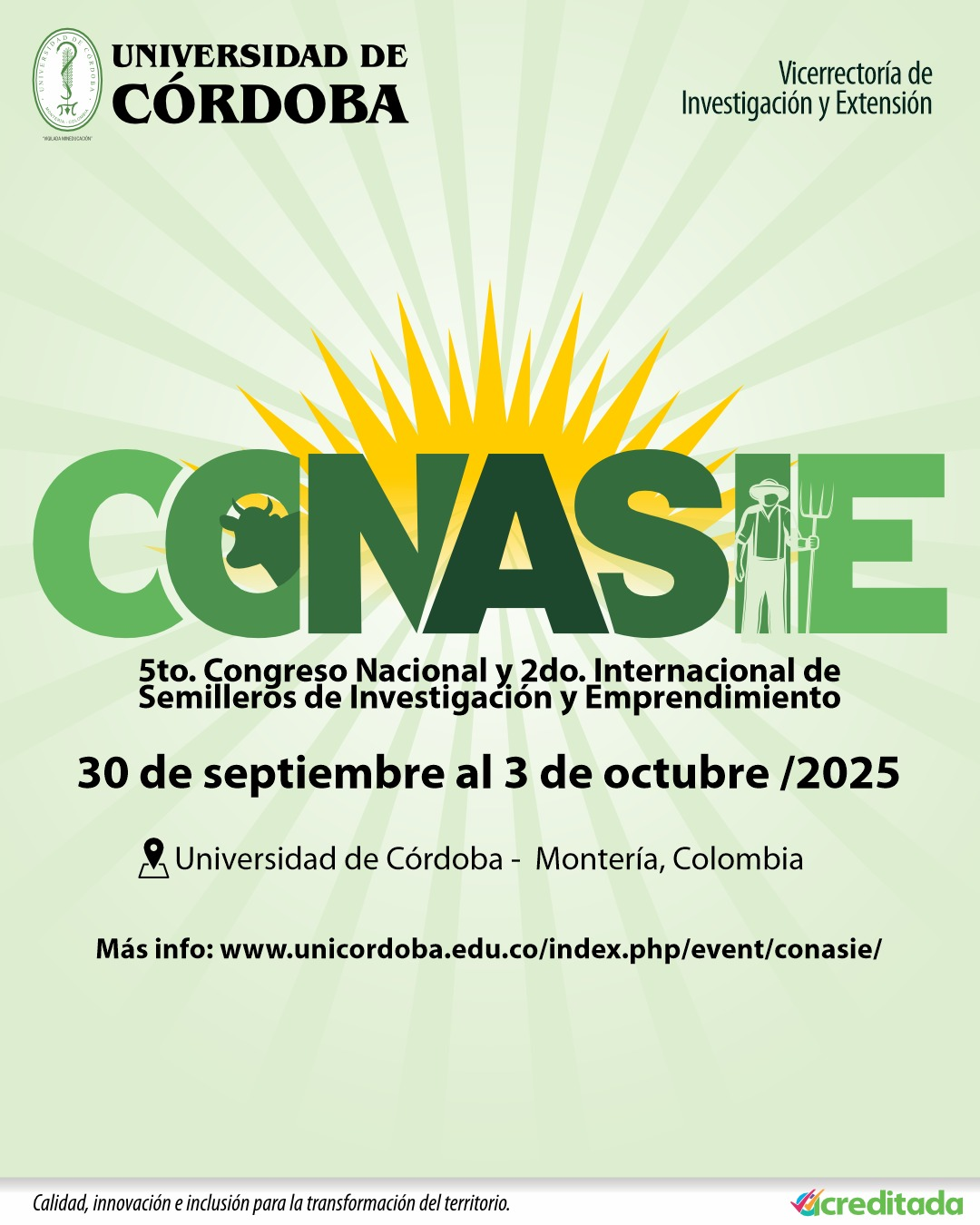
 Semilleros-CONASIE-2025.pdf
Invitación al CIAMTE 2025 – Congreso Iberoamericano de Aprendizaje Mediado por Tecnología
 June 17th, 2025
  Daniela Lopez de Luise
 Nos complace invitarlxs a participar del 14º Congreso Iberoamericano de Aprendizaje Mediado por Tecnología (CIAMTE 2025), un evento internacional dedicado al uso de tecnologías digitales aplicadas a la enseñanza y el aprendizaje, con un enfoque especial en la Educación Superior en Iberoamérica.
📅 Fechas: 23 al 25 de julio de 2025
🖥️ Modalidad: presencial e híbrida
📍 Sede presencial: Facultad de Humanidades, Artes y Ciencias Sociales (FHAyCS) – UADER, Concepción del Uruguay, Entre Ríos, Argentina
🌐 Transmisión virtual: plataformas digitales de la Universidad Nacional Autónoma de México (UNAM)
Este congreso se desarrollará en formato híbrido gracias al trabajo conjunto entre la Universidad Autónoma de Entre Ríos (UADER) en Argentina y la UNAM (México), con el apoyo de la Facultad de Estudios Superiores Zaragoza, la RED RITUAL, la RED IDEA, la Facultad Regional de Concepción del Uruguay (UTN), la Sede Uruguay de la FCyT y otras áreas de Rectorado.
CIAMTE 2025 propone un espacio para compartir experiencias, conocimientos e investigaciones en torno al aprendizaje mediado por tecnología. En esta edición, se destacan la Pedagogía Emergente y la perspectiva Maker, así como el enfoque en tecnología, salud y bienestar.
Además de recuperar y difundir experiencias significativas, el objetivo es seguir impulsando la innovación, generando nuevas ideas y abordajes para la práctica educativa mediada por tecnologías digitales.
Ejes temáticos:
• Ambientes virtuales e híbridos
• Metaversos y e-actividades educativas
• Educación Maker y recursos 3D
• Investigación educativa y tecnología
• Aprendizaje móvil, redes sociales y empoderamiento
• Pedagogías emergentes e inteligencia artificial
• Tecnología, salud y calidad de vida
• Realidad aumentada, simuladores y robótica
• Diseño pedagógico y e-Curriculum ante desafíos actuales
• Humanidades digitales, ciencia abierta y recursos abiertos
Modalidades de participación:
- Ponentes invitados
- Ponentes inscriptos (presencial o virtual)
- Asistentes (presencial o virtual)
- Estudiantes asistentes (presencial o virtual)
Recordatorio importante:
La fecha límite para enviar propuestas de exposición es el 30 de junio de 2025.
📄 Envío de propuestas: Formulario
📝 Inscripciones (asistentes y expositores): Formulario
📌 Más información: Sitio web oficial
Esperamos contar con su valiosa participación para seguir fortaleciendo los vínculos académicos y promoviendo la innovación educativa en nuestra región.
Quedamos a disposición para cualquier consulta.
Saludos cordiales,
Comité Organizador – CIAMTE 2025
DiversityOne Open Challenge at Ubicomp 2025: Exploring People’s Everyday Life Behavior with Mobile Data
June 17th, 2025 Daniela Lopez de Luise held at
The ACM International Joint Conference on Pervasive and Ubiquitous Computing (UbiComp)
Espoo, Finland, October 12-16, 2025
Workshop website: https://datascientiafoundation.github.io/diversityone-2025/
The open challenge aims to explore the DiversityOne dataset, one of the larger and most geographically diverse datasets for everyday life behavior modeling. The dataset combines questionnaires about demographic and psychosocial variables from 18K participants, and passive smartphone sensor data and self-reported annotations from 782 students across eight universities in eight countries. The study followed ethical approval procedures in each of the participating institutions and is compliant with the European General Data Protection Regulation (GDPR). This dataset is a rich, flexible and valuable research resource that can be used to answer research questions in multiple fields: machine learning, mobile sensing, computational social science, behavioral recognition, and many others. This challenge offers the opportunity to work on the dataset and gain useful feedback on your research. We welcome contributions from researchers from diverse backgrounds and geographical provenances. In particular, we welcome contributions that address aspects including, but not limited to:
-
AI/ubiquitous computing/mobile sensing
-
data-centric AI
-
interactive machine learning
-
noisy annotation detection and correction
-
domain adaptation
-
transfer learning
-
activity and mood recognition
-
responsible and ethical AI
-
Computational social science
-
network analysis of social systems
-
sequence analysis of diary data
-
analysis of communities of practices
-
machine learning or rule-based analysis of social behavior
-
Designing with data
-
studies focusing on the design and documentation of the dataset collection
-
studies focusing on the design affordances of the dataset
-
data-centric design
-
user-centered design
Why join?
-
Explore a rich, large-scale dataset for research
-
Receive feedback for your work from an expert program committee
-
A selection of the accepted papers will be invited to submit an extended version to IEEE Pervasive Computing.
Important dates
-
From April 3, 2025: Submit your research proposal using the web form and request the datasets that you need to answer your research questions. The full list of available datasets and documentation is accessible on the data catalog. More details are on the workshop website.
-
June 8 July 1, 2025: Abstract deadline.
-
June 25 July 4, 2025: Submission deadline
-
June 29 July 21, 2025: Author notification
-
July 30, 2025: Deadline for camera-ready version of workshop papers to be included in the ACM DL
-
October 12 or 13, 2015: Full-day Workshop.
Important links
Submission platform: https://new.precisionconference.com/submissions (Society: SIGCHI > Conference: Ubicomp/ISWC 2025 > Track: Ubicomp/ISWC 2025 DiversityOne-Challenge).
Workshop website: https://datascientiafoundation.github.io/diversityone-2025/
Dataset paper https://dl.acm.org/doi/10.1145/3712289
Data catalog https://datascientiafoundation.github.io/LivePeople-ws/datasets/
Dataset webpage https://datascientia.eu/projects/diversityone/
Paper submission
Short paper (max 4 pages, excluding references). The paper should report the motivation, methodology, results, future analyses and an ethical statement highlighting potential societal impacts. The submitted works should reflect on, analyze, or test the DiversityOne dataset.
Additional info:
-
Conference webpage UbiComp / ISWC 2025 https://www.ubicomp.org/ubicomp-iswc-2025/
-
For any questions, please do not hesitate to contact us at datadistribution.knowdive [at] unitn.it
Organizers
-
Andrea Bontempelli (University of Trento)
-
Matteo Busso (University of Trento)
-
Lakmal Meegahapola (ETH Zurich)
-
Amalia de Götzen (Aalborg University)
-
Fausto Giunchiglia (University of Trento)
-
Daniel Gatica-Perez (Idiap Research Institute & EPFL)
Registrations for the 12th Iberian Conference on Pattern Recognition and Image Analysis are open!
June 17th, 2025 Daniela Lopez de Luise
Call For Papers — 2nd AI-CogDev workshop @ICDL2025
June 17th, 2025 Daniela Lopez de Luise CALL FOR PAPERS – IEEE ICDL 2025 2nd AI-COGDEV WORKSHOP
=======================================================
Call for AI-CogDev – “Architecting Intelligence: Exploring Intersections in Cognitive Robotics and Developmental Learning” workshop.
IEEE International Conference on Development and Learning (ICDL 2025)
September 16th, Prague, Czech Republic
=== Important dates ===
Submission deadline: June 27th, 2025
Notification of acceptance: July 11th, 2025
Camera-ready deadline: August 1st, 2025
Workshop date and time: September 16th, 2025 – 14:00 – 17:30
Workshop website: https://sites.google.com/view/aicogdev-workshop
=== Why Developmental Cognitive Architectures Matter ===
Humans are perhaps the most adaptable species on Earth—not because we are inherently the best at any one thing, but because we excel at learning. We don’t come equipped with a perfect model of the world; instead, we continuously update our partial understanding through experience. We can’t read minds, but we learn to interpret others’ behaviors and intentions through interaction and empathy.
As researchers, we build models that capture some of the brain’s inner workings, describe its functional components, and replicate isolated behaviors in controlled environments. But to bring these models into the complex, ever-changing real world, we must go beyond static systems. We must design adaptive, developmental architectures—systems that grow, learn, and evolve, much like human infants do.
This workshop seeks to revitalize the conversation around Developmental Cognitive Architectures, creating a space for both established experts and emerging researchers to exchange ideas, share insights, and explore how we can shape the future of intelligent, autonomous systems.
Workshop Objectives:
- Explore how developmental principles—such as sensorimotor learning, curiosity-driven exploration, and social interaction—can inform the design of intelligent robotic systems.
- Highlight cutting-edge work in cognitive robotics that draws inspiration from developmental processes.
- Identify key challenges and open research questions that must be addressed to advance the field.
- Foster interdisciplinary collaboration across AI, robotics, psychology, neuroscience, and engineering.
We warmly invite all those curious about the intersection of learning, cognition, and robotics to join us in this important discussion.
Topics of interest include, but are definitely not limited to:
· Cognitive Architectures applied to real or simulated embodiments
· Developmental Learning and Developmental Robotics
· Symbol grounding and concept emergence in autonomous systems
· Open-ended Reinforcement Learning
· Intrinsically Motivated Learning
· Affection and Cognition in Development
· Ethical and trust considerations of developmental agents in real-world scenarios
· Brain/Psychologically -inspired development/ computational intelligence
=== Call for Contributions ===
To encourage rich and thought-provoking discussions on the theme of learning, especially at the intersection of Cognitive Architectures and Developmental AI, we warmly invite participants to submit their contributions to the workshop.
We welcome a variety of submission formats, including:
- Extended abstracts (2 to 4 pages)
- Short position papers (1 page)
In addition to state-of-the-art research, we strongly encourage submissions that include works in progress, preliminary findings, and critical reflections or position papers. This inclusive format aims to foster dialogue and highlight emerging ideas that may serve as valuable springboards for the workshop's panel discussions.
Please submit your work in PDF format via the AI-CogDev submission form (https://forms.gle/HQeovAuEQwoXpgF26).
Accepted contributions will be featured in poster sessions and may also be presented orally. The paper will be uploaded to the workshop website.
We look forward to your insights and to shaping this conversation together.
=== Organizers ===
Dr. Letícia Mara Berto, University of Campinas, Brazil
Marco Gabriele Fedozzi, University of Genova and Italian Institute of Technology, Italy
Renan Baima, University of Luxembourg, Luxembourg
Best Regards,
Renan LIMA BAIMA
Doctoral Researcher – FINATRAX/ FiReSpARX group
SnT – Interdisciplinary Centre for Security, Reliability, and Trust
UNIVERSITÉ DU LUXEMBOURG
CAMPUS KIRCHBERG
29, Avenue John F. Kennedy
L-1855 Luxembourg Kirchberg
renan.limabaima@uni.lu
Join the conversation
News | Twitter | LinkedIn | Partner with SnT