|
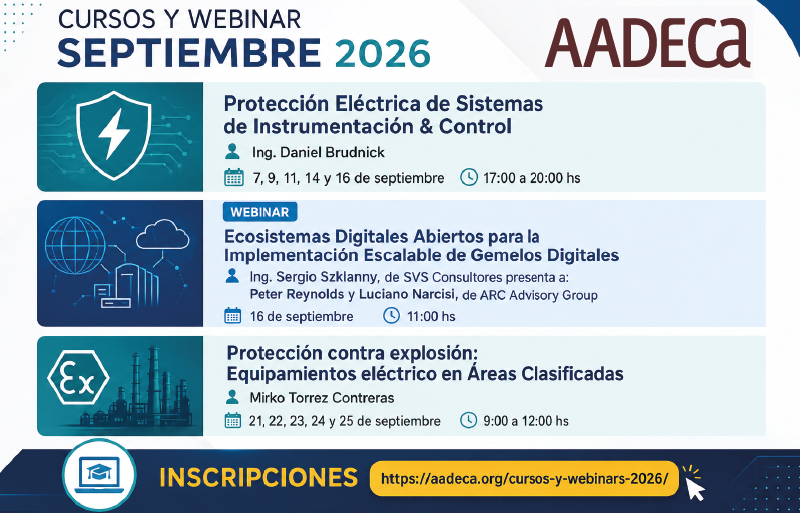
¡No te quedes afuera! Estamos a pocos días de comenzar y los cupos son limitados…. Te esperamos!
Consultas a cursos@aadeca.org o por whatsapp 011 3201-2325 |
INGENIERIA BASICA EN INSTRUMENTACIÓN Y CONTROL 2026 – 15% de descuento en tu inscripción, ¡No te quedes afuera!
March 24th, 2026
Daniela Lopez de Luise Tratamiento de AGUAS RESIDUALES Industriales
March 24th, 2026
Daniela Lopez de Luise Si no lees correctamente este mensaje, haz clic aquí
|
|
|||
|
El tratamiento de aguas residuales es un procedimiento compuesto por una serie de procesos físicos, químicos y biológicos que tienen como objetivo eliminar los contaminantes físicos, químicos y biológicos presentes las aguas residuales de procesos productivos, comerciales o domésticos. El objetivo del tratamiento es producir agua limpia o reutilizable en el ambiente y un residuo sólido o fango (también llamado biosólido o lodo) convenientes para su disposición o reuso. El agua se usa con tres fines principales: uso domestico (agua potable), uso agrícola y uso industrial, el cual incluye el uso del agua en procesos productivos como el minero o pesquero. Los vertidos de aguas residuales son la fuente de la mayor parte de la contaminación antropogénica que puede hallarse en las aguas naturales. Por ello, el control de esta contaminación mediante el tratamiento o depuración de dichas aguas es un aspecto fundamental desde el punto de vista ecologico y legal. Aguas residuales, en general, son aquellas aguas alteradas en su composición por el uso al que han sido sometidas, lo que conlleva a una pérdida de calidad y una necesidad de tratamiento o depuración. Cualquiera que sea su procedencia, los vertidos de aguas residuales presentan una amenaza para los seres vivos y el medio ambiente, ya que producen una alteración del medio natural o cuerpo receptor (masa de agua o terreno) donde se produce la descarga. El adecuado tratamiento de aguas residuales industriales y su posterior reutilización para múltiples usos contribuye a un consumo sostenible del agua y a la regeneración ambiental del dominio público hidráulico y marítimo y de sus ecosistemas. Sin olvidar que el agua de calidad es una materia prima crítica para la industria. Este curso le brindará los conocimientos necesarios para devolver el agua al medio ambiente en una condición libre de contaminación, basado en la normatividad vigente. |
||||
|
OBJETIVOS
ALCANCE DEL CURSO METODOLOGÍA |
||||
|
CONTENIDO DETALLO |
||||
|
MÓDULO I: MÓDULO II: MÓDULO III: PRE TRATAMIENTO TRATAMIENTO PRIMARIO TRATAMIENTO SECUNDARIO TRATAMIENTO TERCIARIO MÓDULO IV: MÓDULO V: MÓDULO VI: MÓDULO VII:
|
||||
|
EXPOSITOR Actualmente es Gerente General de Amuna Corp. S.A.C., también se ha desempeñado como Gerente de Operaciones de RWL Water S.A.C. y como Jefe de Operaciones y Proyectos de Aguas y Efluentes S.A. Ejecutivo Senior, Ingeniero Químico por la Universidad Nacional Mayor de San Marcos, colegiado y habilitado, Maestro en Gestión Pública por la Universidad Tecnológica de Perú – UTP, con basta trayectoria y experiencia en Gestión de Operaciones empresariales y Gestión Comercial Especialista en la gestión integral del agua, así como en la implementación de políticas y estrategias para aumentar la productividad y rentabilidad.
Amplia Experiencia Profesional en empresas como: |
||||
|
|
|||
|
||||
SS-RPE: Special Session on Research Projects Exhibition
March 24th, 2026
Daniela Lopez de Luise CALL FOR PAPERS
Special Session on Research Projects Exhibition @ COMPSAC 2026
(co-located with the 50th IEEE Computers, Software and Applications Conference – COMPSAC 2026)
WEBSITE
Submission must be done via EasyChair (https://easychair.org/conferences/?conf=compsac2026), selecting the “Special Session on Research Projects Exhibition” track.
The paper must clearly present the project and provide, at a minimum, the following information:
• Project details: full name, acronym, duration (from–to), participants, funding agency/institution, and URL
• Authors and contributors: names of presenter(s) and main contributors
• Abstract and keywords describing the project
• Objectives and expected outputs: summary of project objectives and expected tangible results
• Relevance: explanation of how the project (or one of its work packages) aligns with the themes of COMPSAC symposia
• Current status and results: summary of ongoing progress, intermediate results, or milestones achieved (if the project is ongoing)
ICCNS 2026 CFP: The IEEE co-sponsored 4th International Conference on Intelligent Computing, Communication, Networking and Services, 22-25 Sept. 2026 | Bucharest, Romania.
March 24th, 2026
Daniela Lopez de Luise
The 4th International Conference on Intelligent Computing, Communication, Networking and Services (ICCNS2026)
https://iccns-conference.org/2026/
22-25 Sept. 2026 | Bucharest, Romania.
Hybrid Event and Technically Co-Sponsored by IEEE Romania Section
ICCNS 2026 CFP:
With the advancements in wireless communication systems like Fifth Generation (5G), beyond 5G (B5G) and the Sixth Generation (6G), new and unprecedented services will be available for users with nearly unlimited capacity. These services will be the core driver of the future digital transformation of our cities and communities. This will be accompanied by a ubiquitous deployment of the Internet of Things (IoT) infrastructure and supported by computing capacity that will be available at the edge of the network and at the cloud. The computing infrastructure will be handling the processing of the data generated by the users and services. Such a complex and diverse system will require efficient and sustainable applications running on the computing\Networking infrastructure and also smart control and automation systems to integrate and manage its different components. Artificial Intelligence (AI) and its applications will play a significant role in the design, deployment, automation and management of the future services. This will include the applications that will be running on the edge and the cloud servers, the networking applications to handle the flow of data between the users and the computing system and the intelligent automation and management software operating on the system. The International Conference on Intelligent Computing, Networking and Services is aiming to provide an opportunity to present the state of the art research in the intersections of Computing, Networking and Services that is supported by Artificial Intelligence. Researchers from both the industry and academia are encouraged to submit their original research contributions in all major areas, which include, but not limited to the following tracks:
- Track 1: Artificial Intelligence Fundamentals
- Track 2: Intelligent Internet of Things and Cyber-Physical Systems
- Track 3: Edge Intelligence and Federated Learning
- Track 4: Intelligent Networking in Beyond 5G (B5G) and 6G Wireless Communication
- Track 5: Intelligent Big Data Management and Processing
- Track 6: Intelligent Security and Privacy
- Track 7: Blockchain Research & Applications for Intelligent Networks and Services
Submissions Guidelines and Proceedings
Manuscripts should be prepared in 10-point font using the IEEE 8.5″ x 11″ two-column format. All papers should be in PDF format, and submitted electronically at Paper Submission Link. A full paper can be up to 8 pages (including all figures, tables and references). Submitted papers must present original unpublished research that is not currently under review for any other conference or journal. Papers not following these guidelines may be rejected without review. Also submissions received after the due date, exceeding length limit, or not appropriately structured may also not be considered. Authors may contact the Program Chair for further information or clarification. All submissions are peer-reviewed by at least three reviewers. Accepted papers will appear in the ICCNS Proceeding, and be published by the IEEE Computer Society Conference Publishing Services and be submitted to IEEE Xplore for inclusion.
Submitted papers must include original work, and must not be under consideration for another conference or journal. Submission of regular papers up to 8 pages and must follow the IEEE paper format. Please include up to 7 keywords, complete postal and email address, and fax and phone numbers of the corresponding author. Authors of accepted papers are expected to present their work at the conference. Submitted papers that are deemed of good quality but that could not be accepted as regular papers will be accepted as short papers. Length of short papers can be up to 6 pages.
Important Dates:
- Paper submission deadline: April 15, 2026
- Notification of acceptance: July 15, 2026
- Camera-ready Submission: August 5, 2026
Contact:
Please send any inquiry on ICCNS to: info@iccns-conference.org
Call for Papers 2026 – I+T+C Journal (Unicomfacauca, Colombia)
March 24th, 2026
Daniela Lopez de Luise – Zero Costs (No APC): The evaluation and publication process is 100% free of charge.
– Agile response times: First editorial decision within 30 days, peer review feedback within 60 days, and publication within 30 days after acceptance.
– Rigorous process: Double-blind peer review to ensure scientific quality and verification with anti-plagiarism software (URKUND).
– Mechatronics, Electronics, and Automation
– Mechanical Engineering
– Systems, Software Development, and Technology
– Industrial Engineering
– Environmental and Agricultural Sciences
– ICT Education and Management