



3rd Symposium on NLP for Social Good (NSG 2025)
 March 11th, 2025
  Daniela Lopez de Luise
 About NSG 2025:
Artificial intelligence (AI), specifically, Natural Language Processing (NLP) is being hailed as a new breeding ground for immense innovation potential. While scholars believe that NLP has enormous potential for excessive growth, one question remains: how can it be used for the better welfare of the society? Researchers believe that NLP-based technologies could help to solve societal issues such as equality and inclusion, education, health, and hunger, and climate action etc. and many more. The field is focused on delivering positive social impact in accordance with the priorities outlined in the United Nations’ 17 Sustainable Development Goals (SDGs). Tackling these questions requires a concerted, collaborative effort across all sectors of society. The Symposium on NLP for Social Good is a novel effort that aims to enable NLP researchers and scholars from interdisciplinary fields who want to think about the societal implications of their work for solving humanitarian and environmental challenges. The symposium aims to support fundamental research and engineering efforts and empower the social sector with tools and resources, while collaborating with partners from all sectors to maximise effect in solving problems within public health, nature & society, climate & energy, accessibility, crisis response etc.
Call for Papers:
NSG 2025 invites authors to submit papers on research that exploits different NLP techniques to address different social issues (e.g. education, law, healthcare, climate change or any priorities in SDG).
Topics of interest include but are not limited to:
* Applications and solutions on different topics corresponding to NLP for Social Good (NSG) theme.
* Natural Language Interfaces and Interaction: design and implementation of Natural Language Interfaces, user studies with human participants on issues related to NSG topics.
* Large Language Models & Vision Language Models: Opportunities and Risks of using LLMs and VLMs in NSG.
* Innovative and Responsible Use of Natural Language Processing for Social Good.
* eXplainable Artificial Intelligence (XAI): Scope of Interpretability in NSG topics.
* Corpus/Dataset Analysis: Corpus or dataset collection or analysis for NSG related topics
* Multi-modal solutions to the theme of NSG.
*Unique proposition and contribution in any 17 goals of SDG using NLP.
Important Dates (AoE):
Paper submission deadline: 4th May, 2025
Paper notification: 25th May, 2025
Camera-ready deadline: 1st June, 2025
NSG 2025: TBD
Submission Guidelines: Authors should follow the CEUR single-column conference format and submit their manuscripts in pdf via Easychair (submission will open on 10th March, 2025). Submissions must be 2 to 8 pages of content (plus any number of additional pages for reference). We are also accepting submissions as Position papers. The review process is double-blind.
All questions about submissions should be emailed to nlp4socialgood@gmail.com
Organizing Committee:
Procheta Sen, University of Liverpool, UK
Tulika Saha, IIIT Bangalore, India
Danushka Bollegala, University of Liverpool, UK
CVPR Workshop Deadline Extended
March 11th, 2025 Daniela Lopez de Luise Wassim El Ahmar, Ph.D., P.Eng.
Part-time Professor – Long Term Appointment
School of Electrical Engineering and Computer Science
800 King Edward, SITE 4063, Ottawa, Ontario, Canada
Université d'Ottawa | University of Ottawa
CFP: 50th IEEE Conference on Local Computer Networks
March 11th, 2025 Daniela Lopez de Luise The 50th IEEE Conference on Local Computer Networks
Sydney, New South Wales, Australia
October 14-16, 2025
https://www.ieeelcn.org
***************************************************
IMPORTANT DATES
+ Paper registration: April 20, 2025
+ Paper submission: April 27, 2025
+ Notifications: July 1, 2025
+ Camera ready: August 1, 2025
***************************************************
CALL FOR PAPERS
The IEEE LCN 2025 conference seeks papers presenting significant
research contributions in theoretical and practical aspects of computer
networking. LCN is a highly interactive conference that enables an
effective exchange of research outcomes and ideas among academics,
research students, and industry. For the past 49 years, major
developments from network protocols and sensor networks to AI-supported
networking and emerging areas like quantum networking have been reported
at this conference.
LCN welcomes submissions on wide range of computer networking research,
including but not limited to the following:
+ Adaptive networking applications
+ AI-enabled networking
+ Cognitive radio networks
+ Cross-layer optimization
+ Cyber-physical systems
+ Data center networking
+ Decentralized Systems and Blockchain Networks
+ Delay-tolerant networks
+ Digital Twins
+ Edge and Cloud computing
+ E-Health networking
+ Embedded networks
+ Green and sustainable networking
+ Information-centric networking
+ Internet of Things
+ Local area networks
+ Large Language Models (LLMs) and generative AI for networking
+ Machine-to-machine communications for smart environments
+ Mobile and ubiquitous networking
+ Mobility and Location-dependent services
+ Networking for Virtual, Augmented, Mixed Reality applications
+ Network coding
+ Network management, reliability and QoS
+ Network security and privacy
+ Network traffic characterization and measurements
+ Opportunistic networking
+ Optical and high-speed access networks
+ Overlay and peer-to-peer networks
+ Performance evaluation of networks
+ Personal and wearable networks
+ Quantum communication and networking
+ Routing and transport protocols
+ Satellite communication and networks
+ Smart Cities, Buildings and Districts
+ Smart Grid communications
+ Social networks
+ Software Defined Networking and Network Function Virtualization
+ Test beds for network experiments
+ Underwater sensor networks
+ Vehicular networks
+ Wireless ad hoc & sensor networks
+ Semantic communication
***************************************************
SUBMISSION GUIDELINES
Authors are invited to submit papers describing original, previously
unpublished work, not currently under review by another conference,
workshop, or journal. The LCN Conference implements a double-blind
review process. Authors must make a good faith effort to anonymize their
submissions, and they should not identify themselves either explicitly
or by implication. Papers must be registered on EDAS and submitted in
PDF format.
There are a number of tracks that are designed to improve interactions
of experts over different stages in research development.
-Full Regular papers (maximum 8 pages plus references, 10 pt font in
IEEE format) should present novel perspectives within the general scope
of the conference.
Regular paper submission link:
https://www.edas.info/newPaper.php?c=33261&track=128478
-Short papers (maximum 6 pages plus references, 10 pt font in IEEE
format) are an opportunity to present preliminary or interim results on
hot topics in a poster session.
Short paper submission link:
https://www.edas.info/newPaper.php?c=33261&track=128479
All papers are published in the IEEE LCN proceedings and IEEE Xplore.
All published papers must include title, complete contact information
for all authors, abstract, and keywords on the cover page. IEEE reserves
the right to remove papers from IEEE Xplore that are not presented at
the conference.
Detailed submission instructions are available at the conference
website. Direct your questions to Program Chairs: Kanchana Thilakarathna
and Gurkan Solmaz (program@ieeelcn.org).
# Remote Presentation Option:
LCN considers in-person meetings indispensable for personal exchanges,
discussions, and networking opportunities. Recognizing the evolving
landscape of academic conferences and the need for flexibility, LCN
offers a Remote Presentation Option. Upon registration, authors have the
option to select physical or remote presentation modes. When opting for
remote presentation, a fee of 500 USD is required in addition to the
author registration. The additional fee for remote presentations may be
waived under specific conditions.
# LCN Awards:
LCN Awards will include a Best Paper Award, a Best Remote Presentation
Award, a limited number of Student Travel Grants, and N2Women Young
Researcher Fellowships.
***************************************************
LCN 2025 YOUTUBE
Check out the invitation to IEEE LCN 2025 on the IEEE LCN YouTube
channel: https://youtu.be/SP6ebwIOQyY
Please subscribe to the channel and turn on all modifications to receive
further updates in the channel, like LCN 2025 presentation recordings of
keynotes and best paper candidate talks.
***************************************************
Kind Regards,
LCN 2025 Organizing Committee
Website: https://www.ieeelcn.org/
QR para anotarse a CLASES ABIERTAS Y GRATUITAS -TALLERES INFANTIL Y ADOLESCENTES
March 11th, 2025 Daniela Lopez de Luise 

Taller anual de Guitarra infantil Profesor Catriel Rivadero
Para alumnos de 2° a 7° grado primaria (4 a 10 alumnos).Traer su guitarra.
CLASE ABIERTA EL MIERCOLES 26 de MARZO de 16:30 a 17:30
Para anotarse ingresar al sig. enlace: Clase abierta y gratuita de Guitarra 26/03/25
Taller anual de Guitarra para adolescentes Profesor Catriel Rivadero
Para alumnos de 1° a 5° año secundaria (4 a 10 alumnos).Traé tu guitarra.
CLASE ABIERTA EL MIÉRCOLES 26 de MARZO de 17:30 a 18:30
Para anotarse ingresar al sig. enlace: Clase abierta y gratuita de Guitarra 26/03/25

Clases presenciales para alumnos de 4° a 7° grado
CLASE ABIERTA EL JUEVES 27 DE MARZO DE 16:30 A 17:30 HS
Para anotarse ingresar al sig. enlace: Clase abierta de Historieta Kawaii 27/03/25
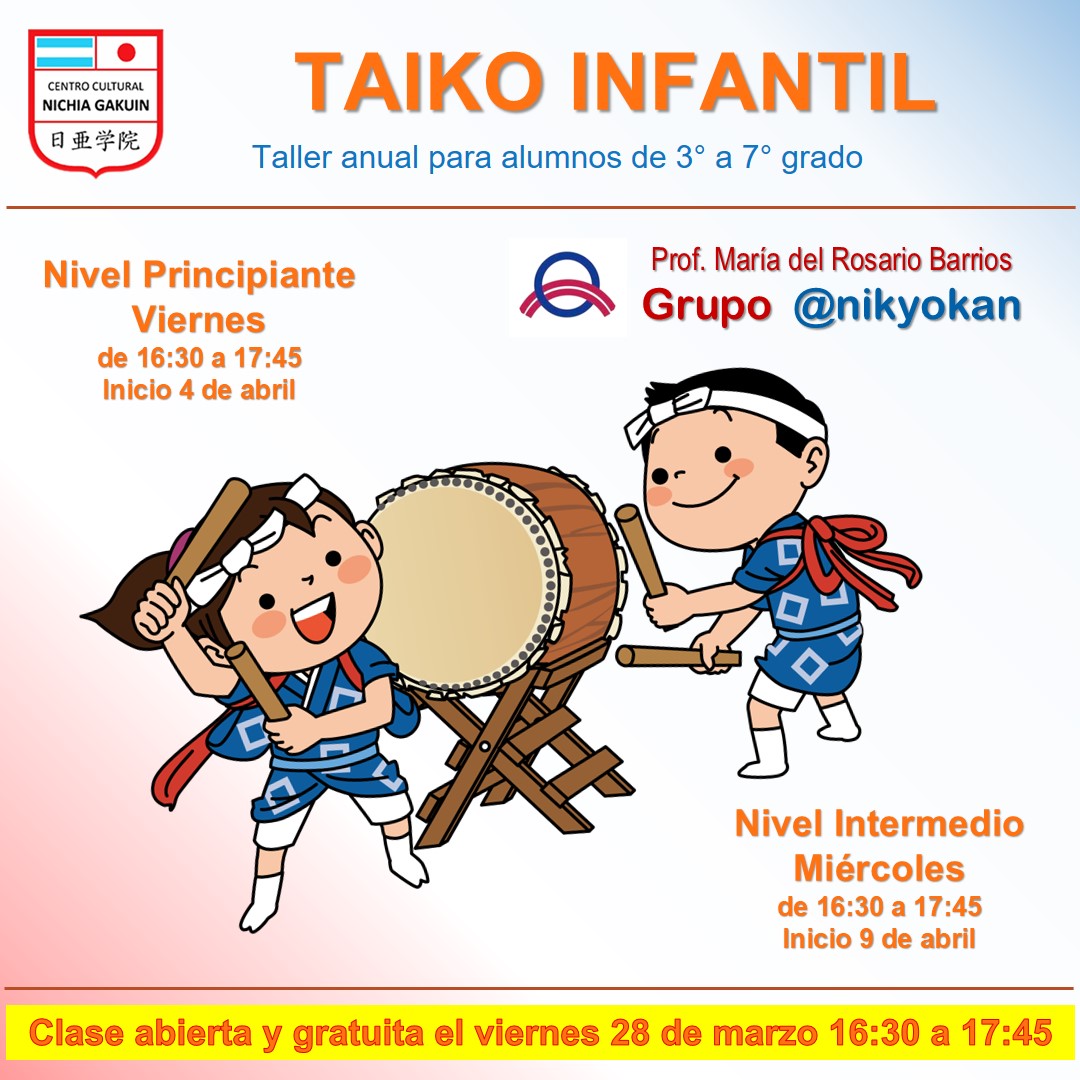
Para Alum. a partir de 8 años hasta 12 años. Clase presencial
CLASE ABIERTA EL VIERNES 28 DE MARZO DE 16:30 A 17:45
Para anotarse ingresar al sig. enlace: Clase abierta y gratuita de Taiko infantil 28/03/25
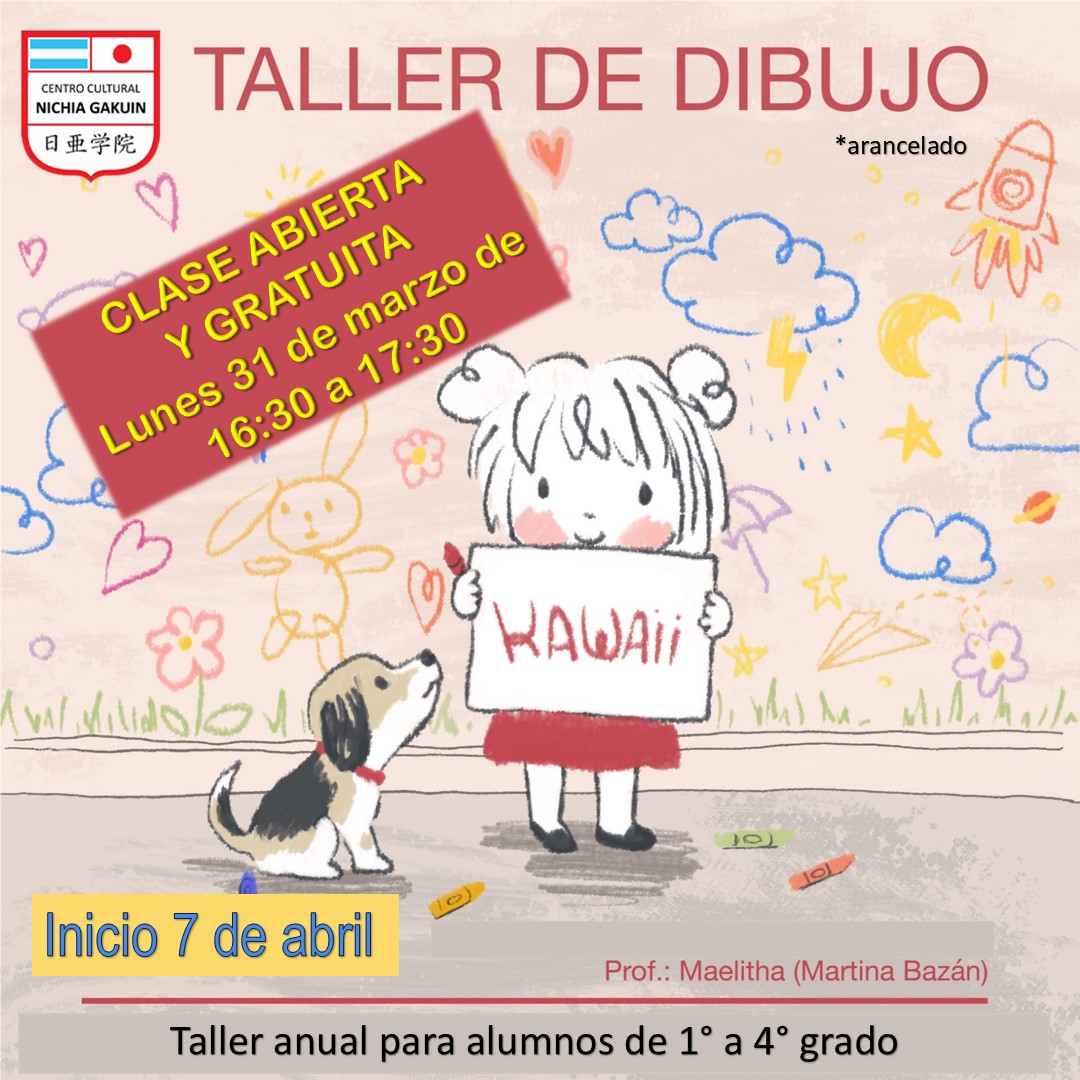
Taller anual de dibujo infantil estilo kawaii Prof. Martina Bazán (Maelitha)
Clases presenciales para alumnos de 1° a 4° grado
CLASE ABIERTA EL LUNES 31 DE MARZO DE 16:30 A 17:30 HS
Para anotarse ingresar al sig.link:Clase abierta y gratuita de Dibujo estilo Kawaii 31/03/25
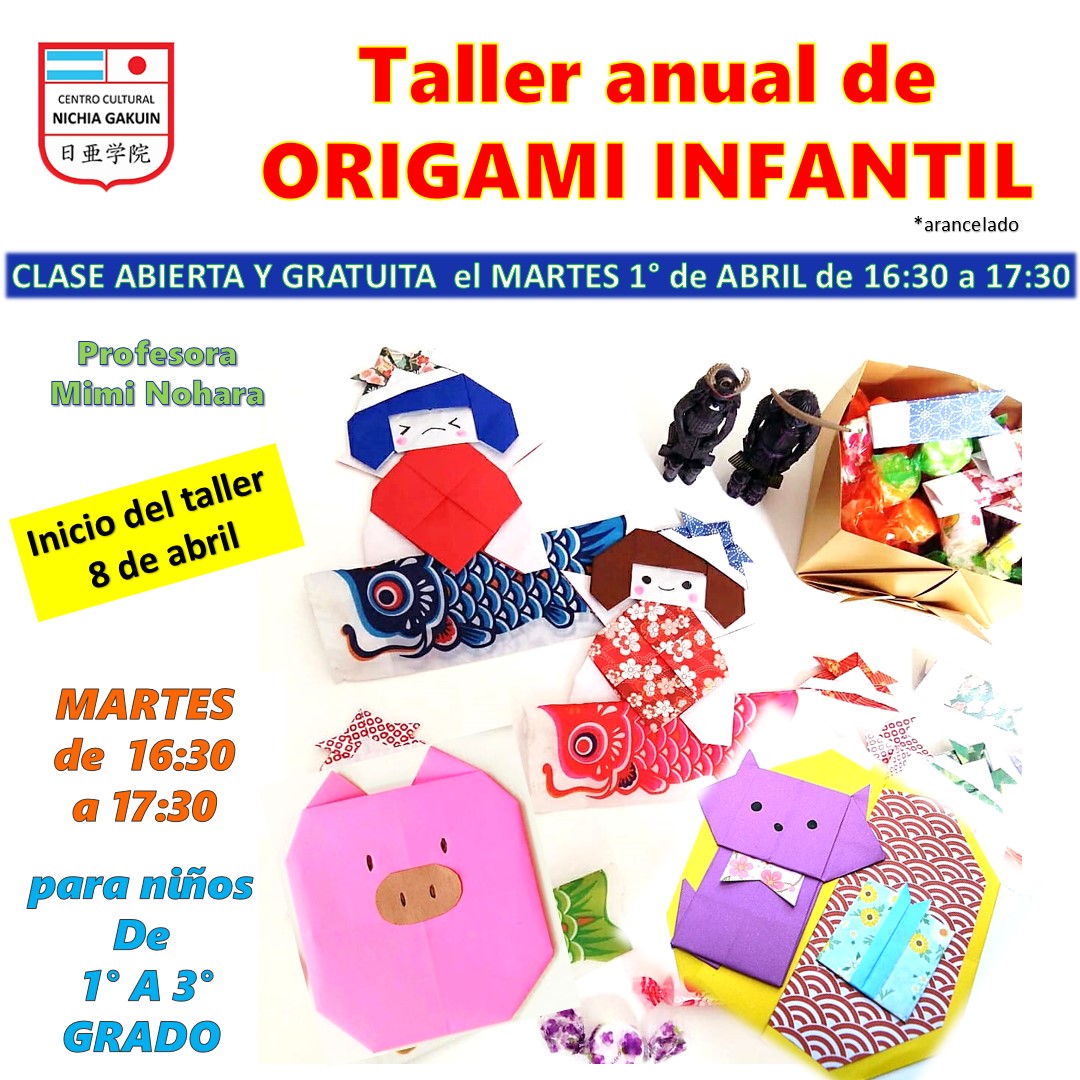
Taller anual de Origami infantil (plegado de papel) Profesora Mimi Nohara
Para niños y niñas de 1° a 3° grado. Clase presencial
CLASE ABIERTA EL MARTES 1° de ABRIL de 16:30 a 17:30
Para anotarse ingresar al sig. enlace: Clase abierta de Origami infantil 1/04/25