Curso virtual: Introducción a la Ciencia de Datos
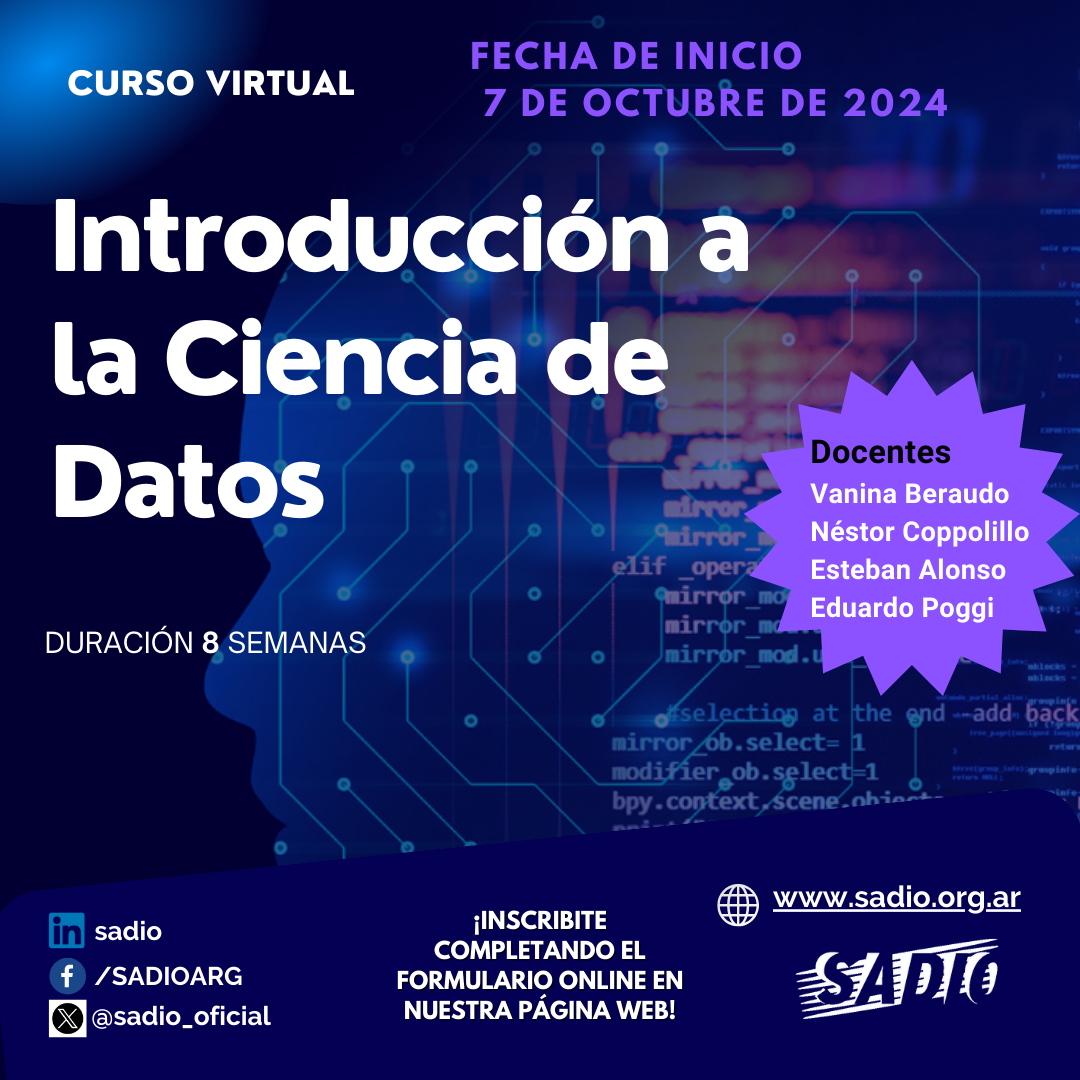
Fecha de inicio: 7 de Octubre de 2024 (sujeto a que se complete el cupo mínimo necesario)
Docentes: Vanina Beraudo, Néstor Coppolillo, Esteban Alonso y Eduardo Poggi
Días y horarios: Las clases sincrónicas se dictarán los lunes de 18.30 a 20.30 hs. y las actividades asincrónicas quedarán disponibles los jueves.
Descripción: Este curso pretende brindar los fundamentos de la Ciencia de Datos para las organizaciones, conocer sus prácticas metodológicas, algunas herramientas básicas, conceptos de visualización de datos, desarrollo de modelos predictivos, la gestión de datos para analítica y el concepto general de Organizaciones Guiadas por Datos.
Objetivo: Que los participantes logren apropiar los conceptos fundamentales, el vocabulario básico, el marco metodológico y la aplicación de herramientas básicas para la gestión corporativa de datos para la toma de decisiones en base a evidencia digital.
Modalidad: Las clases se desarrollarán en modalidad virtual con encuentros sincrónicos y asincrónicos a través del campus de SADIO.
Se utilizarán como recursos, además de las clases sincrónicas guiadas por un profesor, videos, presentaciones, foros, lecturas, ejercicios, etc. que los participantes deberán apropiar con anterioridad y además se aportará bibliografía complementaria para quien quiera profundizar. Todos los recursos quedarán disponibles en la plataforma virtual.
Durante el desarrollo de cada una de las unidades previstas, habrán de combinarse presentaciones de los docentes con una activa participación de los asistentes, quienes tendrán como base bibliográfica el material previsto para cada clase. Las clases sincrónicas se grabarán y quedarán disponibles para los participantes hasta un mes después de la finalización del curso. Las clases grabadas no podrán descargarse, sólo estarán disponibles en la plataforma.
Duración: El curso completo tiene una carga horaria de 32 horas durante ocho semanas con un ritmo semanal de: – una clase sincrónica de dos horas – una clase grabada más un ejercicio y un foro que requerirán otras dos horas. Se espera que los participantes dediquen al menos una carga horaria adicional semejante para el estudio y desarrollo de casos.
Destinatarios: Profesionales con interés y/o necesidades de conocer las prácticas actuales para la gestión no tradicional de datos propia de la Ciencia de Datos como disciplina organizacional. El curso puede ser de interés para una variedad de profesiones: informáticos, ingenieros, economistas, estadísticos, actuarios, matemáticos y toda otra profesión que requiera de manejo de datos como sociólogos o médicos sanitaristas, marketing o negocios digitales, por ejemplo. Además, obviamente, de directivos que requieran del conocimiento base para impulsar la apropiación organizacional de estas prácticas.
Requisitos: Manejo de planillas de cálculo, facilidad para navegar por Internet, lectura básica de textos técnicos en inglés. Es deseable el conocimiento de programación y lenguajes de consulta a base de datos.
Requisitos técnicos:
Software a utilizar:
– Tableau / PB / Qlik / Pentaho o equivalente para el análisis y visualización de datos
– Planilla de cálculo.
– Weka, Orange, Anaconda/Python para las prácticas según los conocimientos y disponibilidad de los participantes.
Fundamentos: Para la toma de decisiones en cualquier organización se cuenta con infinidad de datos de todo tipo, muchos recopilados por los propios sistemas de información, pero muchos más obtenidos de una variedad de fuentes: datos publicados por otras organizaciones públicas y privadas, redes sociales, sensores, fuentes bibliográficas, medios, imágenes, videos; que pueden ser usados conjuntamente para disminuir la incertidumbre de los tomadores de decisiones.
La persistencia, limpieza y procesamiento de estos datos requiere de prácticas y algoritmos diferentes a los de la informática tradicional. Tal es así que las grandes organizaciones han ido transformando en los últimos años el rol del CIO y agregando nuevos perfiles como CDO, CISO, CDxO, etc. Con nuevas lógicas de funcionamiento y nuevas herramientas de alcance corporativo. Estas modificaciones organizacionales tienden al modelo conocido como Organizaciones Guiadas por Datos (Data Driven Organizations, DDO). El núcleo de estas organizaciones está dado por la adopción de la Ciencia de Datos que comprende, en términos generales: la gestión de un reservorio de datos dedicado a la difusión de información en la organización, la generación de tableros de navegación y visualización (conocido como Inteligencia de Negocios) y el área de Analítica Avanzada. Áreas que deben trabajar coordinadamente entre sí junto con el área de TI y las diferentes áreas funcionales de la organización. Este curso pretende brindar los fundamentos de la Ciencia de Datos (incluyendo el esclarecimiento de términos como Ciencia / Analítica / Minería de Datos, Aprendizaje Automático y Big Data); la visión actual de Data Warehousing Analítico y las prácticas y herramientas actuales de la Analítica. Todos estos temas dentro del marco general planteado por DDO.
Contenidos: El curso está dividido en tres módulos como se describen a continuación.
Módulo 1 – Gestión de datos para la toma de decisiones
El objetivo de este módulo es que los participantes apropien el concepto de DDO, sus componentes básicos, los roles necesarios y tengan ejemplos concretos de las herramientas utilizadas y los resultados que se obtienen.
Duración: 3 semanas equivalentes a 12 horas de clase.
Temario:
– Datos 2020. Evolución de los sistemas de información y disponibilidad de datos para la toma de decisiones.
– Inteligencia Artificial y Aprendizaje Automático como herramientas para el descubrimiento de conocimiento en grandes cantidades de datos.
– Visualización y navegación de datos (Inteligencia de Negocios): ejemplo el reporting moderno en las organizaciones.
– Analítica predictiva: ejemplo de modelos basados en evidencia.
– Data Warehousing Analítico: para asegurar la integridad, calidad, seguridad y disponibilidad de datos.
– Organizaciones Guiadas por Datos (DDO), su estructura, roles y herramientas. Evaluación y cierre del módulo.
Módulo 2 – Conceptos básicos de analítica de datos
El objetivo de este módulo es que los participantes apropien la metodología de trabajo y algunas herramientas básicas de la analítica avanzada en las organizaciones.
Duración: 3 semanas equivalentes a 12 horas de clase.
Temario:
– Métodos de predicción basados en reglas. Concepto de sobreajuste.
– Métodos de predicción basados en probabilidades. Validación de modelos.
– Métodos de predicción basados en similitudes. Comparación de métodos.
– Métodos de ensamble y metaalgoritmos. Validación.
– Marco Metodológico para la analítica de datos. – Gestión de datos para analítica.
Módulo 3 – Taller de analítica de datos
El objetivo de este módulo es que los participantes profundicen y apropien los conceptos y herramientas trabajados en los módulos 1 y 2 en el desarrollo de proyectos acotados, pero de su propio interés. Duración: 2 semanas equivalentes a 8 horas de clase.
Temario:
– Asistencia para el desarrollo del caso.
– Métodos de segmentación. Asistencia para el desarrollo del caso.
– Introducción al Text Mining. Asistencia para el desarrollo del caso.
– Presentación de desarrollos y cierre del curso.
Evaluación: Aprobación del trabajo final.
Formulario de inscripción: https://tinyurl.com/ynxvnte2
Aranceles
Inscripción temprana (hasta el 30 de Septiembre de 2024)
* AR$ 140.000.- (para nacionales)
* USD 168.- (para extranjeros)
Inscripción tardía (desde el 1 de Octubre de 2024)
* AR$ 154.000.- (para nacionales)
* USD 185.- (para extranjeros)
50% Descuento para socios de SADIO (con 12 meses de antigüedad)
Los socios de AADECA gozan de los mismos derechos que los socios de SADIO
Medios de pago disponibles:
– Pago por Transferencias Bancarias (solo para residentes en Argentina) a:
SADIO (CUIT 30-64931218-0)
BBVA – Sucursal 330 Tribunales
Cta. Cte. Pesos: 502/7
CBU: 0170330420000000050276
Alias: SOCIEDAD.SADIO
– Pago con Tarjeta de crédito/débito (Visa, Master o Cabal). Solicitar el botón de pago correspondiente a informacion@sadio.org.ar
Es posible pagar en cuotas con interés. Consulte.
– PAYPAL (para extranjeros). Solicite el link de pago.
¡Cupos limitados! Reserva tu vacante con el pago de tu inscripción
Antecedentes de los docentes:
Vanina Beraudo: Integra el equipo de Analítica de Datos de AFIP. También se ha desempeñado como especialista en Minería de Datos en la SDG Sistemas y Telecomunicaciones de la misma institución. Ha realizado diversas presentaciones sobre aspectos de Minería de Datos en el ámbito fiscal, así como docente del curso de Minería de Datos para el personal de AFIP. Es Magister en Explotación de Datos y Descubrimiento del Conocimiento UBA – FCEN. Licenciada en Sistemas de Información por UN Luján.
Néstor Coppolillo: Tiene experiencia profesional en proyectos orientados a la gestión de las bases de datos y Data Mining en el ámbito del sector público. Es docente de posgrado en Ciencia de Datos y trabaja en la generación de contenidos de una especialización en Data Science. Así también participa como docente en distintos cursos de Data Mining ofrecidos en instituciones públicas y privadas. Es Licenciado en Ciencias de la Computación por la UBA (FCEN), especialista en Explotación de Datos y Descubrimiento del Conocimiento por la UBA.
Esteban Alonso: Se desempeña actualmente como Director de Proyectos y Desarrollo de Negocios en SWAP Argentina, firma de la cual es Socio Fundador. Sus principales responsabilidades corresponden a Definir y Conducir Proyectos Profesionales vinculados a Ciencia de Datos y Consultoría Tecnológica para varias industrias. Sus áreas de mayor experiencia son: Business Intelligence y Data Warehousing. Previamente ha conducido y liderado Proyectos de Desarrollo de Aplicaciones y ha sido responsable de equipos de Soporte y Mantenimiento Aplicativo en más de 70 empresas en Argentina, sumadas a algunas en Uruguay, Paraguay, Brasil y USA. Es Computador Científico, ha cursado posgrados vinculados a negocios y tecnología, una maestría en TI aplicada a la Educación y actualmente está doctorando en Ingeniería de Software; también es profesor de grado, posgrados y maestrías en materias vinculadas a la Ciencia de Datos e Ingeniería de Sistemas en Universidad Austral y Universidad Católica Argentina. Anteriormente ha sido docente de grado y/o Posgrado en la Universidad de Buenos Aires y UCEMA.
Eduardo Poggi: Actualmente se desempeña como asesor del CIO de la AFIP de Argentina, docente de posgrado y consultor internacional. Cuenta con 40 años de experiencia profesional en proyectos de Tecnología de la Información en Latinoamérica, fundamentalmente orientados a la gestión de datos públicos: Datos Abiertos, Interoperabilidad y Ciencia de datos. Acredita más de 25 años de docencia de grado y posgrado en: Aprendizaje Automático, Ciencia/Minería de Datos y Gestión de TI Pública en general. Es licenciado en Ciencias de la Computación por la UBA (FCEN), magister en Administración y Políticas Públicas y posee una especialización en Negocios y Tecnología por la Universidad de San Andrés; ambas de Argentina.



 September 20th, 2024
  Daniela Lopez de Luise
 CFP-IATMSI-2025-Extended.pdf