



|
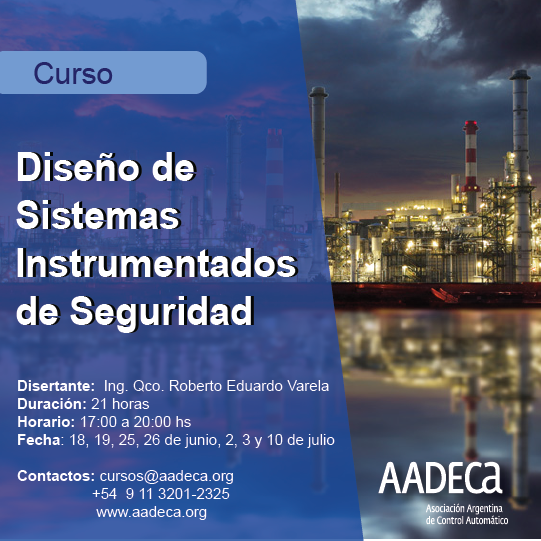
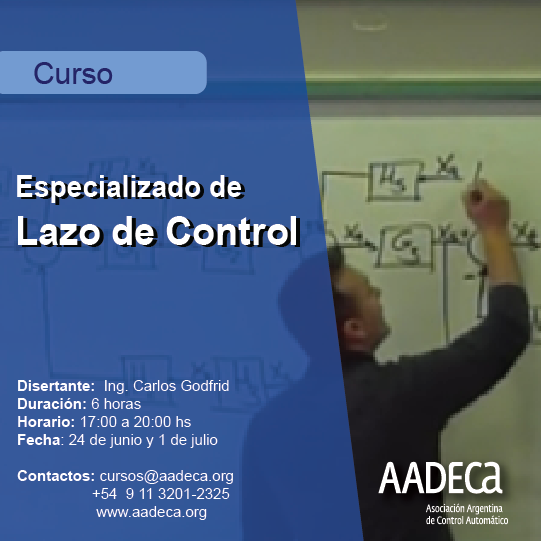
Cursos: Diseño de Sistemas Instrumentados de Seguridad / Especializado de Lazo de Control |
||||||||||||||||||||||||||||||
|
Aquí encontra un listado de Cursos y Webinars programados para los meses de JUNIO y JULIO ofrecidos por AADECA para socios, estudiantes, docentes y profesionales del sector, los mismos se realizan en forma virtual por la plataforma ZOOM
Más información en www.aadeca.org o por mail cursos@aadeca.org
PROGRAMACIÓN COMPLETA DE CURSOS Y WEBINARS AQUÍ
|
Diseño de Sistemas Instrumentados de Seguridad / Lazo de Control – Webinars: Ventosas para Vacío / Válvulas de Seguridad / Presentación cursos API REST / NODE-RED / Introducción a la Seguridad de Maquinarias
 June 18th, 2024
 Daniela Lopez de Luise





DeepLearn 2024: regular registration July 12
June 18th, 2024 Daniela Lopez de Luise (and the Future of Artificial Intelligence)
DeepLearn 2024
Porto – Maia, Portugal
July 15-19, 2024
https://deeplearn.irdta.eu/2024/
******************************************************
Co-organized by:
University of Maia
Institute for Research Development, Training and Advice – IRDTA
Brussels/London
******************************************************
Regular registration: July 12, 2024
******************************************************
SCOPE:
DeepLearn 2024 will be a research training event with a global scope aiming at updating participants on the most recent advances in the critical and fast developing area of deep learning. Previous events were held in Bilbao, Genova, Warsaw, Las Palmas de Gran Canaria, Guimarães, Las Palmas de Gran Canaria, Luleå, Bournemouth, Bari and Las Palmas de Gran Canaria.
Deep learning is a branch of artificial intelligence covering a spectrum of current frontier research and industrial innovation that provides more efficient algorithms to deal with large-scale data in a huge variety of environments: computer vision, neurosciences, speech recognition, language processing, human-computer interaction, drug discovery, health informatics, medical image analysis, recommender systems, advertising, fraud detection, robotics, games, finance, biotechnology, physics experiments, biometrics, communications, climate sciences, geographic information systems, signal processing, genomics, materials design, video technology, social systems, etc. etc.
The field is also raising a number of relevant questions about robustness of the algorithms, explainability, transparency, and important ethical concerns at the frontier of current knowledge that deserve careful multidisciplinary discussion.
Most deep learning subareas will be displayed, and main challenges identified through 16 four-hour and a half courses, 2 keynote lectures, 1 round table and a few hackathon-type competitions among students, which will tackle the most active and promising topics. Renowned academics and industry pioneers will lecture and share their views with the audience. The organizers are convinced that outstanding speakers will attract the brightest and most motivated students. Face to face interaction and networking will be main ingredients of the event. It will be also possible to fully participate in vivo remotely.
ADDRESSED TO:
Graduate students, postgraduate students and industry practitioners will be typical profiles of participants. However, there are no formal pre-requisites for attendance in terms of academic degrees, so people less or more advanced in their career will be welcome as well.
Since there will be a variety of levels, specific knowledge background may be assumed for some of the courses.
Overall, DeepLearn 2024 is addressed to students, researchers and practitioners who want to keep themselves updated about recent developments and future trends. All will surely find it fruitful to listen to and discuss with major researchers, industry leaders and innovators.
VENUE:
DeepLearn 2024 will take place in Porto, the second largest city in Portugal, recognized by UNESCO in 1996 as a World Heritage Site. The venue will be:
University of Maia
Avenida Carlos de Oliveira Campos – Castêlo da Maia
4475-690 Maia
Porto, Portugal
STRUCTURE:
3 courses will run in parallel during the whole event. Participants will be able to freely choose the courses they wish to attend as well as to move from one to another.
All lectures will be videorecorded. Participants will be able to watch them again for 45 days after the event.
An open session will give participants the opportunity to present their own work in progress in 5 minutes. Also companies will be able to present their technical developments for 10 minutes.
This year’s edition of the school will schedule hands-on activities including mini-hackathons, where participants will work in teams to tackle several machine learning challenges.
Full live online participation will be possible. The organizers highlight, however, the importance of face to face interaction and networking in this kind of research training event.
KEYNOTE SPEAKERS:
Jiawei Han (University of Illinois Urbana-Champaign), How Can Large Language Models Contribute to Effective Text Mining?
Katia Sycara (Carnegie Mellon University), Effective Multi Agent Teaming
PROFESSORS AND COURSES:
Luca Benini (Swiss Federal Institute of Technology Zurich), [intermediate/advanced] Open Hardware Platforms for Edge Machine Learning
Gustau Camps-Valls (University of València), [intermediate] AI for Earth, Climate, and Sustainability
Nitesh Chawla (University of Notre Dame), [introductory/intermediate] Introduction to Representation Learning on Graphs
Daniel Cremers (Technical University of Munich), [introductory/advanced] Deep Networks for 3D Computer Vision
Peng Cui (Tsinghua University), [intermediate/advanced] Stable Learning for Out-of-Distribution Generalization: Invariance, Causality and Heterogeneity
Sergei V. Gleyzer (University of Alabama), [introductory/intermediate] Machine Learning Fundamentals and Their Applications to Very Large Scientific Data: Rare Signal and Feature Extraction, End-to-End Deep Learning, Uncertainty Estimation and Realtime Machine Learning Applications in Software and Hardware
Yulan He (King’s College London), [introductory/intermediate] Machine Reading Comprehension with Large Language Models
Frank Hutter (University of Freiburg), [intermediate/advanced] AutoML
George Karypis (University of Minnesota), [intermediate/advanced] Optimizing LLM Inference
Hermann Ney (RWTH Aachen University / AppTek), [intermediate/advanced] Machine Learning and Deep Learning for Speech & Language Technology: A Probabilistic Perspective
Massimiliano Pontil (Italian Institute of Technology), [intermediate/advanced] Operator Learning for Dynamical Systems
Elisa Ricci (University of Trento), [intermediate] Continual and Adaptive Learning in Computer Vision
Wojciech Samek (Fraunhofer Heinrich Hertz Institute / Technical University of Berlin), [introductory/intermediate] From Feature Attributions to Next-Generation Explainable AI
Xinghua Mindy Shi (Temple University), [introductory/intermediate] Trustworthy Machine Learning for Human Health and Medicine
Michalis Vazirgiannis (École Polytechnique), [intermediate/advanced] Graph Machine Learning and Multimodal Graph Generative AI
James Zou (Stanford University), [introductory/intermediate] Large Language Models and Biomedical Applications [videorecorded]
OPEN SESSION:
An open session will collect 5-minute voluntary presentations of work in progress by participants.
They should submit a half-page abstract containing the title, authors, and summary of the research to david@irdta.eu by July 7, 2024.
INDUSTRIAL SESSION:
A session will be devoted to 10-minute demonstrations of practical applications of deep learning in industry.
Companies interested in contributing are welcome to submit a 1-page abstract containing the program of the demonstration and the logistics needed. People in charge of the demonstration must register for the event.
Expressions of interest have to be submitted to david@irdta.eu by July 7, 2024.
HACKATHONS:
Hackathons will take place, where participants will work in teams to tackle several machine learning challenges. They will be coordinated by Professor Sergei V. Gleyzer. The challenges will be released 2 weeks before the beginning of the school. A jury will judge the submissions and the winners of each challenge will be announced on the final day. The winning teams will receive a small prize and the runners-up will get a certificate.
EMPLOYERS:
Organizations searching for personnel well skilled in deep learning will be provided a space for one-to-one contacts.
It is recommended to produce a 1-page .pdf leaflet with a brief description of the organization and the profiles looked for to be circulated among the participants prior to the event. People in charge of the search must register for the event.
Expressions of interest have to be submitted to david@irdta.eu by July 7, 2024.
SPONSORS:
Companies/institutions/organizations willing to be sponsors of the event can download the sponsorship leaflet from
https://deeplearn.irdta.eu/2024/sponsoring/
ORGANIZING COMMITTEE:
José Paulo Marques dos Santos (Maia, local chair)
Carlos Martín-Vide (Tarragona, program chair)
Sara Morales (Brussels)
José Luís Reis (Maia)
Luís Paulo Reis (Porto)
David Silva (London, organization chair)
REGISTRATION:
It has to be done at
https://deeplearn.irdta.eu/2024/registration/
The selection of 8 courses requested in the registration template is only tentative and non-binding. For logistical reasons, it will be helpful to have an estimation of the respective demand for each course.
Since the capacity of the venue is limited, registration requests will be processed on a first come first served basis. The registration period will be closed and the on-line registration tool disabled when the capacity of the venue will have got exhausted. It is highly recommended to register prior to the event.
FEES:
Fees comprise access to all program activities and lunches.
There are several early registration deadlines. Fees depend on the registration deadline.
The fees for on site and for online participation are the same.
ACCOMMODATION:
Accommodation suggestions are available at
https://deeplearn.irdta.eu/2024/accommodation/
CERTIFICATE:
A certificate of successful participation in the event will be delivered indicating the number of hours of lectures. This should be sufficient for those participants who plan to request ECTS recognition from their home university.
QUESTIONS AND FURTHER INFORMATION:
ACKNOWLEDGMENTS:
Universidade da Maia
Universidade do Porto
Universitat Rovira i Virgili
Institute for Research Development, Training and Advice – IRDTA, Brussels/London
Curso de posgrado “Contaminación del Aire”
June 18th, 2024 Daniela Lopez de Luise 
GECON 2024 Extended deadline
June 18th, 2024 Daniela Lopez de Luise ===================================================================
20th International Conference on
Economics of Grids, Clouds, Systems & Services
http://2024.gecon-conference.org
26-27. September 2024, Roma Italy
Springer LNCS Proceedings
Fast Track for several Journals in Computer Systems and E-Commerce
===================================================================
Call for
– full papers,
– short papers (work-in-progress papers),
– special topic sessions,
– tutorials, and for
– poster presentations.
The deadline for GECON has been extended to June 30. If you are going to submit a full or short paper, do not wait until the last day. Submit the title and abstract as soon as possible. This will help us organise the review process more efficiently, and complete it on time.
Paper submissions are managed through EasyChair at https://easychair.org/conferences/?conf=gecon2024.
The proceedings will be published by Springer LNCS.
To build a stronger interdisciplinary community that combines business and economic aspects with engineering and computer science themes, FGCS and GECON are coordinating their efforts. Soon, a CFP for a special issue on the Economics of Computing Services in FGCS will be published. The best papers from GECON will be invited to submit an improved version to the FGCS special issue. By submitting a full paper to GECON, authors can obtain feedback to refine their papers for this special issue. For papers that primarily address business and economic aspects, a special issue of the Springer Electronic Markets Journal, Elsevier Electronic Commerce Research and Applications, and Springer Electronic Commerce Research with up to 15 papers is planned.
More information is available on the website:
http://gecon2024.gecon-conference.org/
=============================================
Submission Guidelines for Tutorial Proposals
=============================================
GECON 2024 looks for tutorial proposals on topics related to the
conference topics. The tutorials are supposed to give
PhD students an overview about existing concepts, challenges, and
future research directions.
Tutorial proposals should provide a title, an abstract, and a
table of content.
===================
/Poster Submissions/
===================
Poster presentations provide a unique opportunity for PhD
students and young researchers to present their ongoing work and
to receive constructive feedback from their peers as well as
experts in the field (including academics and practitioners) at
the GECON conference.
Authors of accepted full papers and short papers
(work-in-progress papers) are also welcome to present their work
in poster sessions, giving them a higher visibility than just giving a talk.
========================
Conference Organization
========================
Jorn Altmann (Seoul National University, South-Korea)
Jose Angel Banares (Zaragoza University, Spain)
Karim Djemame (University of Leeds, UK)
Paolo Fantozzi (Libera Università Maria SS. Assunta (LUMSA), Italy)
Maurizio Naldi (Libera Università Maria SS. Assunta (LUMSA), Italy)
Valerio Rughetti(Libera Università Maria SS. Assunta (LUMSA), Italy)
Vlado Stankovski (University of Ljubljana, Slovenia)
Bruno Tuffin (Inria Rennes, France)
Kostas Tserpes (Harokopio University of Athens, Greece)
Contact for Questions: gecon2024@easychair.org
Contact for tutorial and special topic sessions: K.Djemame@leeds.ac.uk
Springer icSoftComp2024 Thailand December 10-12, 2024 Hybrid Conference
June 18th, 2024 Daniela Lopez de Luise |
============== CALL FOR PAPERS ==============
Springer Sixth International Conference on Soft Computing and its Engineering Applications (icSoftComp2024) Bangkok, Thailand || December 10-12, 2024
Paper submission link: https://equinocs.springernature.com/service/icSoftComp2024
Conference website: https://www.charusat.ac.in/icSoftComp2024/
|
||||||||||||||
|
=========== Important Notes: =========== – icSoftComp2024 follows a double-blind peer review system. – Conference proceedings by Springer CCIS Series (Scopus indexed) – Please follow the Springer CCIS format for paper submission. – The conference will be held in a hybrid mode: in-person and online – Authors of selected papers will be invited to submit extended article versions for a post-conference special issue of peer reviewed Scopus indexed journals.
============== About the conference: ============== 2024 6th International Conference on Soft Computing and its Engineering Applications (icSoftComp2024) aims to provide an excellent international forum to the researchers, academicians, students, and professionals in the areas of computer science and engineering to present their research, knowledge, new ideas and innovations. It will exhibit an exciting technical program. It will also feature high-quality Tutorials and Workshops, Industry Panels and Exhibitions, as well as Keynotes from prominent research and industry leaders.
We are now open for technical paper submission, proposals for workshops/special sessions, and proposals for tutorials.
============ Paper Submission: ============ icSoftComp2024 solicits papers on all aspects of Soft computing and its engineering applications for a smart and better world. The topics of the conference include, but are not limited to the following:
=========== Important Dates: ===========
============ Paper Publication: ============ The accepted and presented papers will be published as proceedings with Springer in their prestigious Communications in Computer and Information Science (CCIS) series. Indexed by Scopus, DBLP, Ei Compendex, Google Scholar, and Springerlink
============= Journal Publication: ============= Authors of selected papers will be invited to submit extended article versions for a post-conference special issue of peer-reviewed journals.
================= Keynotes and invited talks: ================= – Prof. Bharat Bhargava, Purdue University, Indiana, USA – Massimiliano Cannata, SUPSI, Canobbio, Switzerland – Flora Ferreira, University of Minho, Portugal – Katarzyna Turoń, Silesian University of Technology, Poland – Chinthaka Premachandra, Shibaura Institute of Technology, Japan
=============== Organizing Committee: =============== Honorary Chairs – Kalyanmoy Deb, Michigan State University, MI, USA – Witold Pedrycz, University of Alberta, Alberta, Canada – Leszek Rutkowski, Czestochowa University of Technology, Poland – Janusz Kacprzyk, Polish Academy of Sciences, Warsaw, Poland General Chairs – Atul Patel, Charotar University of Science and Technology, India – Dilip Kumar Pratihar, Indian Institute of Technology Kharagpur, India – Pawan Lingras, Saint Mary's University, Canada Technical Program Chairs – K. K. Patel, Charotar University of Science and Technology, India – Ashish Ghosh, Indian Statistical Institute (ISI), Kolkata, India – KC Santosh, The University of South Dakota, SD, USA – Gayatri Doctor, CEPT University, Ahmedabad, India – Gabriel Gomes de Oliveira, University of Campinas (Unicamp), Brazil – Ashis Jalote Parmar, Norwegian University of Science and Technology, Norway
If you have PhD degree and if you want to join as Technical Program Committee (TPC) member then please fill this Google form: https://forms.gle/2T6EwDeUUTWxuX9Q6
|
||||||||||||||
|
Charotar University of Science and Technology (CHARUSAT) (Center of Excellence by Govt. of Gujarat) (Accredited “A+” grade by NAAC, GoI) Changa, India
|