La propuesta tendrá una duración de 5 meses, con un cursado presencial todos los días jueves de 20 a 23hs. Dicha formación estará a cargo de la Cra. Roxana Romañuk. La propuesta también incluye actividades extra áulicas cumplimentando un total 57 horas reloj. Quienes asistan y aprueben la capacitación recibirán una certificación oficial de UTN FRCU.
 Se trata de una propuesta arancelada con una inscripción de $5.000 y una cuota mensual de $10.000 para alumnos UTN, $16.000 para No docentes UTN, $24.000 para docentes y graduados UTN y $30.000 para público en general. Las cuotas se irán ajustando mes a mes según IPC (Índice de Precios del Consumidor).
 Quienes estén interesados pueden inscribirse en el siguiente link: bit.ly/PracticaContable
 Por consultas o informes:
 Oficinas 21 y 22 de UTN FRCU – Ing. Pereira 676 – De 8 a 21hs.
 Whatsapp: 3442465757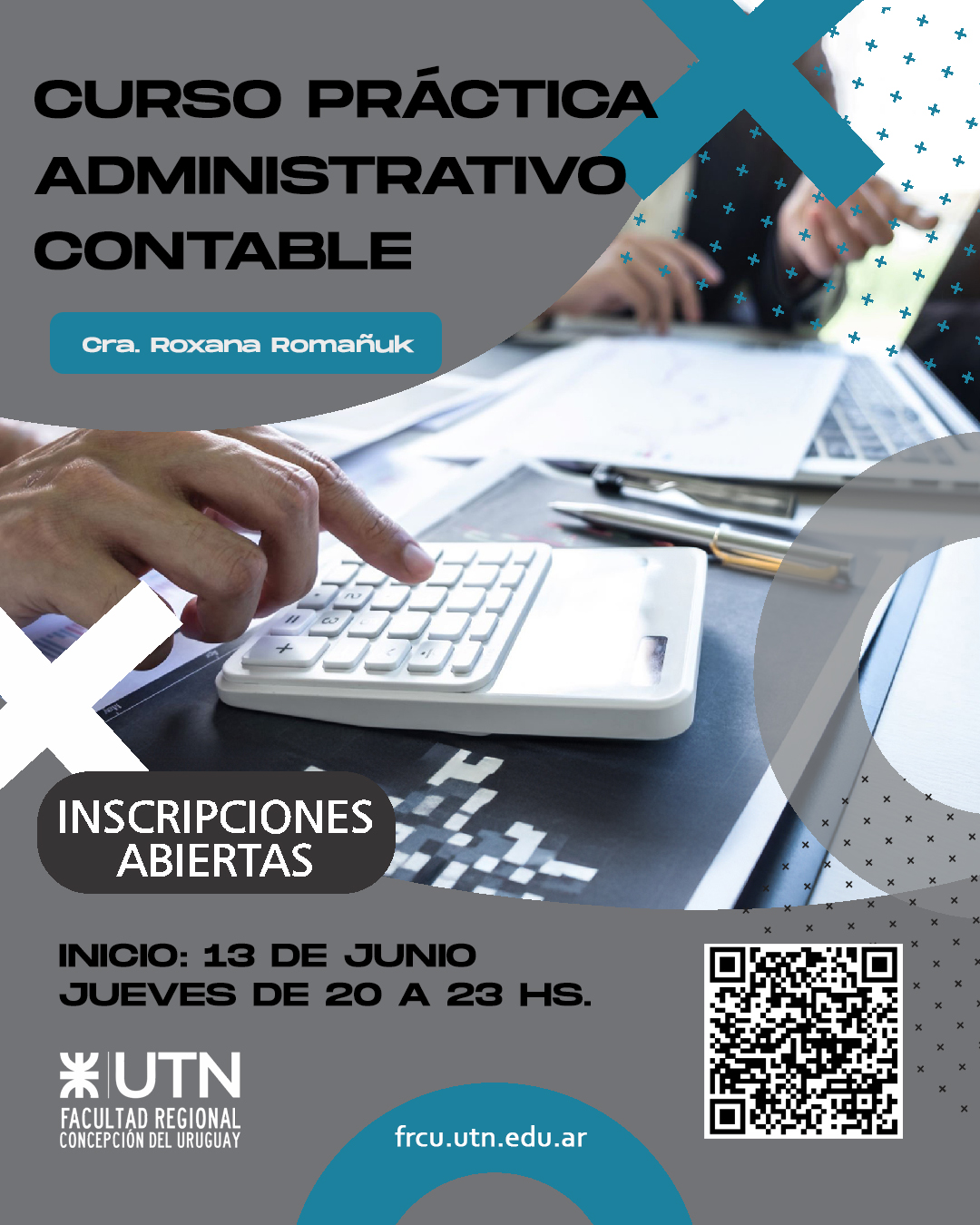
Ciclo de Conferencias | Educación en la Ingeniería: La ANI y la educación en la Ingeniería
 May 20th, 2024
  Daniela Lopez de Luise
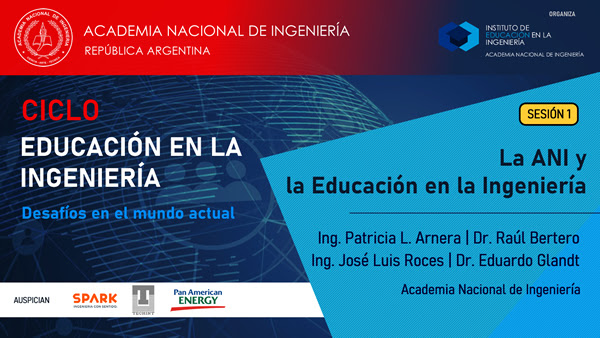
 La ACADEMIA NACIONAL DE INGENIERÍA (ANI) tiene el agrado de invitar a participar de manera gratuita de la primera sesión del Ciclo de Conferencias Educación en la Ingeniería, sobre el tema La ANI y la Educación en la Ingeniería.
Este webinar, dirigido a toda la comunidad de Ingeniería, tiene como objetivo principal proporcionar un espacio de reflexión y análisis sobre los desafíos y oportunidades en el campo de la educación en Ingeniería. Buscamos promover el intercambio de conocimientos y experiencias, así como explorar nuevas tendencias y aplicaciones tecnológicas que puedan mejorar la calidad y efectividad de la enseñanza. A lo largo de las diferentes sesiones, paneles de discusión y presentaciones de casos, aspiramos a enriquecer el panorama educativo de la Ingeniería en nuestro país,
SESIÓN 1: La ANI y la Educación en la Ingeniería
📅 Día: jueves 23 de mayo de 2024
⏰ Hora: 14:30 horas
💻 Modalidad: HÍBRIDA a través de la plataforma Zoom y en la sede de la UTN FR Buenos Aires, Av. Medrano 951 – 5° piso – Aula 512.
✍ INSCRIPCIÓN en el siguiente enlace
PROGRAMA
– Apertura por el presidente de la Academia Nacional de Ingeniería, Ing. Oscar Vignart.
– La ANI y la Educación en la Ingeniería, por los académicos Ing. Patricia Arnera, Dr. Raúl Bertero, Dr. Eduardo Glandt e Ing. José Luis Roces.
Curso de Postgrado “Taller de Metodologías de la Investigación” – JUNIO – Preinscripción
May 20th, 2024 Daniela Lopez de Luise Estimado/a alumno/a:
Se encuentra abierta la inscripción al Curso “Taller de Metodologías de la Investigación”, a dictarse del 28 de junio al 4 de julio de 2024.
Instructivo de inscripción:
- Completá el Formulario de Preinscripción: https://forms.gle/LkwESkLgNUGVxoio7
- Te enviaremos un correo con la información sobre documentación a presentar en caso de que sea necesario, costo y modalidad de Pago.
- Te confirmaremos la inscripción desde este correo electrónico.
Fecha límite de inscripción: viernes 21 de junio.
Taller de Metodologías de la Investigación
Dra. Zulma Cataldi (UNLP – UBA)
Desarrollo: 28 de junio al 4 de julio
Horario: 5 a 18 hs.
Programa: https://postgrado.info.unlp.edu.ar/wp-content/uploads/2024/04/5_Taller-de-Metodolog%C3%ADas-de-Investigaci%C3%B3n.pdf
Modalidad: virtual sincrónico
Importante:
Este curso forma parte del Plan de Estudios de la Maestría en Gestión y Tecnología en Ciudades Inteligentes y equivale al Curso “Metodología de la Investigación” del resto de las Maestrías.
Otorga créditos para el Doctorado en Ciencias Información.
Dudas, consulta y excepciones sobre los Cursos de Postgrado responder este correo (cursospostgrado@lidi.info.unlp.edu.ar)
Saludos.
| 3rd IEEE CVMI 2024: (Int. Conf. on Computer Vision and Machine Intelligence)
May 19th, 2024 Daniela Lopez de Luise Dear Esteemed Colleagues, Academicians, and Research Professionals,
Greetings from Indian Institute of Information Technology Allahabad.
It is a matter of immense pleasure to inform you that the 3rd IEEE International Conference on Computer Vision & Machine Intelligence (IEEE CVMI) 2024 is being organized by Computer Vision and Biometrics Lab, Department of Information Technology, Indian Institute of Information Technology Allahabad, India during October 19-20, 2024. The world-wide leading research labs, including the Applied AI Research Lab, University of South Dakota, USA, Computer Vision Laboratory, Faculty of Computer and Information Science, University of Ljubljana, Slovenia, Sorbonne Center for Artificial Intelligence, Abu Dhabi, UAE, and Multimedia and Computer Vision Laboratory, Department of Computer Science and Information Engineering, National Cheng Kung University, Taiwan, are the organizing knowledge partners.
The 3rd IEEE CVMI 2024 aims to provide an excellent platform for researchers to present their research findings. The IEEE CVMI 2024 conference is financially and technically sponsored by IEEE Uttar Pradesh Section. The conference proceedings will be published at IEEE Xplore. The IEEE CVMI 2024 conference is “Endorsed by International Association for Pattern Recognition (IAPR)” and “Technically Sponsored by IEEE Signal Processing Society Uttar Pradesh Chapter”.
The 3rd IEEE CVMI 2024 conference will feature Expert Talks by Eminent Researchers, Technical Paper Presentation Sessions, and PhD Colloquium. All submitted papers will be double-blind peer-reviewed. Paper acceptance will be based on originality, significance, technical soundness, and clarity of presentation. The IAPR Best Paper Award and the CVMI 2024 Best Paper Awards will be given to the outstanding papers. The Best PhD Dissertation Awards will be also given in the PhD Colloquium during IEEE CVMI 2024.
IEEE CVMI 2024 Attractions:
- Successfully presented papers will be submitted to IEEE Xplore for publication.
- Sponsored by IEEE Uttar Pradesh Section.
- Endorsed by IAPR.
- Indexed by Scopus and DBLP.
- Technically Sponsored by IEEE SPS UP Chapter.
- IAPR Best Paper Award and CVMI 2024 Best Paper Awards.
- Best PhD Dissertation Awards.
We request you to please submit your work and kindly encourage your colleagues and research scholars to share their research findings at 3rd IEEE CVMI 2024 Conference.
The conference website is here: https://cvmi2024.iiita.ac.in/. The deadline for paper submission in Round 2 is June 15, 2024 @11.59 PM. Fresh papers in Round 2 can also be submitted directly.
The details related to paper submission, IEEE conference paper template, double blind review policy, page length, etc. can be found at https://cvmi2024.iiita.ac.in/submission.php. Submission portal: https://cmt3.research.microsoft.com/CVMI2024.
Recently graduated PhD students can participate in the PhD Colloquium, IEEE CVMI 2024 for Best PhD Award. Please visit https://cvmi2024.iiita.ac.in/phd_colloquium.php for more information.
We look forward to your participation and support.
Thanks and Regards
WEBINARS GRATUITOS Válvulas de Control para Servicios Severos / Conceptos Básicos del Control del Movimiento en la Industria / Digitalización de señales con CMTK / Ventosas para Vacío / API REST / Taller NODE RED / Impresión 3D
May 18th, 2024 Daniela Lopez de Luise |
WEBINARS GRATUITOS 2024 Se realizan por la plataforma
Válvulas de Control para Servicios Severos ¡Acompáñanos en este exclusivo webinar GRATUITO donde abordaremos desafíos críticos en aplicaciones severas! ¿Te enfrentas a problemas de cavitación, flashing, ruido, vibración, corrosión o erosión en tus procesos? ¡No te preocupes más! En este evento, exploraremos a fondo estos desafíos y te proporcionaremos criterios de selección y soluciones efectivas para servicios severos. Con más de 40 años de experiencia en la industria, CV Control es líder en soluciones de control de flujo, presión y temperatura para procesos críticos. Con una línea integral de válvulas de control, instrumentación y accesorios para resolver incluso los problemas de control de procesos más complejos de manera rápida, eficiente y económica. ¡No te pierdas esta oportunidad de aprender y mejorar tus operaciones!
Conceptos Básicos del Control del Movimiento en la Industria
– Incluye ejemplos de aplicaciones prácticas en la industria. ¡Únete a nosotros para este enriquecedor viaje de aprendizaje!
Digitalización de señales con CMTK En esta oportunidad presentaremos nuestro CMTK (Condition Monitoring Tool Kit) para la digitalización de las señales en planta, el almacenamiento y la visualización de estas en modernos panales gráficos, todo en un mismo producto simple y fácil de utilizar. La digitalización y el Internet industrial de las cosas (IIoT) representan el siguiente nivel de la automatización industrial. El sector industrial exige cada vez mayor productividad, mayor eficiencia y transparencia en su producción. Para satisfacer estas crecientes demandas es necesario fusionar la tecnología de automatización tradicional (OT) y la tecnología de la información (IT). La IIoT es exactamente lo que hace esto posible. Cuando se trata de generar y transportar datos, la experiencia de Balluff ofrece una cartera de dispositivos inteligentes en constante crecimiento y mediante el uso de software generamos un verdadero valor añadido en los entornos de producción
Webinar de nuestro socio Adherente MICRO AUTOMACION Ventosas para Vacío Principio de funcionamiento y definición de partes / necesidades energéticas / factores de seguridad / aceleración y desaceleración / objetos a manipular / ahorro de energía y costos en el sistema / clasificación de las ventosas / válvulas de control de doble caudal / elección y configuración de las ventosas / condiciones de uso / material de las ventosas / superficie de las ventosas / tipos de ventosas / ventosas planas / ventosas con fuelles / ventosas ovaladas / dimensionamiento de ventosas / coeficiente fricción / cálculo de la fuerza de retención / diámetro de la ventosa / capacidad de aspiración / recomendaciones para la elección de ventosas / materiales de ventosas: resumen de características / sistemas de agarre especiales / ventosas magnéticas: definición / ventajas de las ventosas magnéticas / posibilidades de montaje / campos típicos de aplicación / sistemas agarradores de aguja / posibilidades de uso / campos típicos de aplicación.
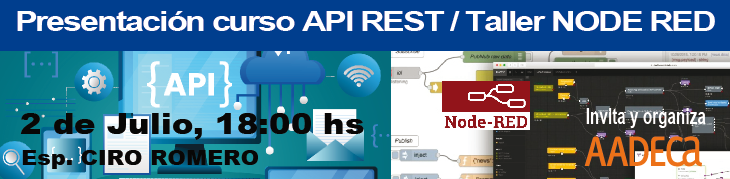
Presentación cursos API REST / Taller NODE RED Una forma de potencializar una solución tecnológica, es brindarle una interfaz amigable para los potenciales usuarios. En un marco de desarrollo de aplicación web, utilizar lenguajes de desarrollo de alto nivel pueden potenciar la integración con aplicaciones industriales. Este tipo de aplicaciones se pueden lograr con interfaces de integración, conocidas como API-REST. En este conector, Python y Node-RED, son tecnologías de código abierto para el desarrollo de flujos de trabajo, son herramientas esenciales para la creación de aplicaciones robustas y la integración de sistemas en entornos industriales. ¿Qué podemos aprender?
Introducción a la Impresión 3D
PROGRAMACIÓN COMPLETA DE CURSOS Y WEBINARS AQUÍ Consultas a cursos@aadeca.org o por whatsapp 011 3201-2325 |

.png)