



The 4th International Advanced Course & Symposium on Artificial Intelligence & Neuroscience,
September 22-25, 2024, Riva del Sole Resort & SPA, Castiglione della Pescaia (Grosseto) Tuscany, Italy
W: https://acain2024.icas.events
E: acain@icas.cc
FB: https://www.facebook.com/ACAIN.LakeDistrict/
Symposium Deadlines
Paper Submission (Symposium): by Saturday March 23, 2024 (AoE).
https://acain2024.icas.events/symposium-call-for-papers/
https://easychair.org/conferences/?conf=acain2024
Notification of Decision for Papers (Symposium): by Wednesday July 10, 2024.
Camera Ready Submission (Symposium): by Monday July 20, 2024.
Author Registration (Symposium): by July 20, 2024.
Regular Registration (Symposium): by Saturday March 23, 2024.
Late Registration (Symposium): from Sunday March 24, 2024.
Course Deadlines
Regular Registration (Course): by Saturday March 23, 2024.
https://acain2024.icas.events/registration/
Late Registration (Course): from Sunday March 24, 2024.
Oral Presentation Submission (Course): by Saturday March 23, 2024.
Notification of Decision for Oral Presentation (Course): by August 31, 2024.
SCOPE & MOTIVATION:
ACAIN 2024: AI meets Computational Neuroscience and Cognitive Science
The ACAIN 2024 symposium and course is an interdisciplinary event featuring leading scientists from AI and Neuroscience, providing a special opportunity to learn about cutting-edge research in the fields of AI, Neuroscience, Neuroscience-Inspired AI, Human-Level AI, and Cognitive Science.
The 4th Advanced Course and Symposium on Artificial Intelligence & Neuroscience (ACAIN) is a full-immersion four-day Course and Symposium in Tuscany on cutting-edge advances in Artificial Intelligence and Neuroscience with lectures delivered by world-renowned experts. The Course provides a stimulating environment for academics, early career researchers, Post-Docs, PhD students and industry leaders. Participants will also have the chance to present their results with oral talks or posters, and to interact with their colleagues, in a convivial and productive environment.
Two days of keynote talks and oral presentations, the ACAIN Symposium, (September 24-25), will be preceded by lectures of leading scientists, the ACAIN Course, (September 22-23).
Bringing together AI and neuroscience promises to yield benefits for both fields. The future impact and progress in both AI and Neuroscience will strongly depend on continuous synergy, exchange, collaboration and efficient cooperation between the two research communities. These are the goals of the International Course and Symposium – ACAIN 2024, which is aimed both at AI experts with interests in Neuroscience and at neuroscientists with an interest in AI. ACAIN 2024 accepts rigorous research that promotes and fosters multidisciplinary interactions between artificial intelligence and neuroscience.
The Advanced Course is suited for scholars, academics, early career researchers, Post-Docs, PhD students and industry leaders.
The Event (Course and Symposium) will involve a total of 36-40 hours of lectures.
Academically, this will be equivalent to 8 ECTS points for the PhD Students and
the Master Students attending the Event.
LECTURERS
https://acain2024.icas.events/course-lecturers/
* Maria Eckstein, Google DeepMind, London, UK
* Auke Jan Ijspeert, EPFL, Switzerland
* Zeb Kurth-Nelson, Google DeepMind & UCL, London, UK
* Loic Matthey, Google DeepMind, London, UK
* Kevin J. Miller, DeepMind & UCL, London, UK
* Thomas Parr, Oxford University, UK
* Melika Payvand, Institute of Neuroinformatics, University of Zurich & ETH Zurich, Switzerland
* Alessandro Treves, International School for Advanced Studies, Italy
More Lecturers TBA
COURSE DESCRIPTION:
https://acain2024.icas.events/course-description/
SYMPOSIUM CALL FOR PAPERS:
https://acain2024.icas.events/symposium-call-for-papers/
SYMPOSIUM PROGRAM COMMITTEE (partial list, confirmed members):
https://acain2024.icas.events/program-committee/
ORGANIZING COMMITTEE:
https://acain2024.icas.events/symposium-committee/
VENUE & ACCOMMODATION:
https://acain2024.icas.events/venue/
ACAIN 2024 is a *Residential Conference*, all participants (invited speakers, authors, organizers, chairs, participants)
must book and stay at the Riva del Sole Resort and Spa. No exceptions are allowed.
https://lod2024.icas.events/lod-2024-a-residential-conference/
Riva del Sole Resort & SPA
a: Località Riva del Sole – Castiglione della Pescaia (Grosseto) CAP 58043, Tuscany – Italy
p: +39-0564-928111
f: +39-0564-935607
e: booking.events@rivadelsole.it
w: www.rivadelsole.it/en
ACTIVITIES:
https://acain2024.icas.events/activities/
REGISTRATION:
https://acain2024.icas.events/registration/
See you in Tuscany in September!
ACAIN 2024 Organizing Committee.
E: acain@icas.cc
W: https://acain2024.icas.events
FB: https://www.facebook.com/ACAIN.LakeDistrict
ACDL 2024, 7th Advanced Course on Data Science & Machine Learning – From Deep Learning to Generative AI | June 10-14 | Riva del Sole Resort & SPA > Early Registration: by 23 March
 March 5th, 2024
  Daniela Lopez de Luise
 ACDL 2024 is a full-immersion 5-day course in Tuscany on cutting-edge advances in AI, Deep Learning, LLMs, Data Sc. & Generative AI with lectures delivered by world-renowned experts.
If
you want to learn
NLP, Generative AI
Transformers, Diffusion Models,
Large language models,
Vision – Large-scale vision models,
Vision and language,
Beyond vision and language,
Multimodal Foundation Models
and much more
then
take part in ACDL 2024! 😉
Riva del Sole Resort & SPA – Tuscany, Italy, June 10-14
https://acdl2024.icas.events
acdl@icas.cc
EARLY REGISTRATION: by March 23 (AoE)
https://acdl2024.icas.events/registration/
Oral Presentation Submission Deadline: by March 23 (AoE)
LECTURERS:
Each Lecturer will hold up to four lectures on one or more research topics.
https://acdl2024.icas.events/lecturers/
* Joseph Sifakis, Verimag Laboratory, Grenoble, France *Turing Award*
Lectures “Artificial Intelligence: Where We Are, Where We Are Going?”
* Gabriel Barth-Maron, DeepMind, London, UK
4 Lessons on “Multimodal Foundation Models”
* Sven Giesselbach, Fraunhofer Institute – IAIS, Germany
5 Lessons on “Introduction on Foundation Models”
* Ramin Hasani, MIT, USA
4 Lessons on “Continuous Neural Networks / Liquid Neural Networks”
* Nora Kassner, DeepMind, London, UK
“Large Language Models: Life after Pre-training”
“Large Language Models: Evaluation”
“Large Language Models: Reasoning and Factuality”
“Large Language Models: Retrieval augmentation and Tool-use”
* Petros Koumoutsakos, Harvard University, USA
“Machine Learning for Modeling and Control of Complex Systems” 1/2
“Machine Learning for Modeling and Control of Complex Systems” 2/2
“Solving forward and inverse problems with and without neural networks”
“Bayesian Uncertainty Quantification”
* Maria Liakata, The Alan Turing Institute, UK
4 Lessons on “Longitudinal Language Processing with User Generated Content”
* Panos Pardalos, University of Florida, USA
Lectures 1-2 TBA
Topics: Data Science, Application to Neuroscience
* Jakub M. Tomczak, Eindhoven University of Technology, The Netherlands
4 Lessons on “Deep Generative Modelling”
* Rianne van den Berg, Microsoft Research Amsterdam, The Netherlands
3 Lessons on “Diffusion Models”
* Pascal Van Hentenryck, Georgia Institute of Technology, USA
3 Lessons on “Fusing Machine Learning and Optimization for Engineering”
* Max Welling, University of Amsterdam, The Netherlands
3 Lessons on “Generalized Belief Propagation Algorithms for Tensor Network Contractions”
More Lecturers TBA
TUTORIAL SPEAKERS: TBA
Each Tutorial Speaker will hold more than four lessons on one or more research topics.
PAST LECTURERS: https://acdl2024.icas.events/past-lecturers/
ACDL 2024 VENUE:
Riva del Sole Resort & SPA
Località Riva del Sole‚ Castiglione della Pescaia (Grosseto)
CAP 58043‚ Tuscany‚ Italy
p: +39-0564-928111
e: booking.events@rivadelsole.it
w: https://www.rivadelsole.it/en/
https://acdl2024.icas.events/venue/
PAST EDITIONS: https://acdl2024.icas.events/past-editions/
REGISTRATION: https://acdl2024.icas.events/registration/
CERTIFICATE & 8 ECTS:
PhD students, Postdocs, Industry Practitioners, Junior and Senior Academics, and will be typical profiles of the ACDL attendants. The Course will involve a total of 36-40 hours of lectures, according to the academic system the final achievement will be equivalent to 8 ECTS points for the PhD Students (and some strongly motivated master student) attending the Course. At the end of the course, a formal certificate will be delivered indicating the 8 ECTS points.
TO PARTICIPATE IN ACDL 2024, all attendants must
(1/2) register for the course (by March 23, 2024) and
(2/2) book accommodation at the course venue, Riva del Sole Resort & SPA‚ (by April 23, 2024); all attendants must stay at the Riva del Sole Resort & SPA.
Once accommodation has been booked at Riva del Sole Resort & SPA‚ the participant must send this information (including the Booking Number) to the ACDL organizing committee (acdl@icas.cc).
ACDL is a residential course, so all lecturers and participants must reside in the same Hotel (Riva del Sole Resort & SPA). No exceptions are made.
For privacy reasons, the Hotel cannot match people. If you have someone to share the apartment with, please send to the Hotel (booking.events@rivadelsole.it) the name, surname and email address. Otherwise the solution is to book an apartment in single use.
Anyone interested in participating in ACDL 2024 should register as soon as possible.
See you in Riva del Sole in June!
Giuseppe Nicosia & Panos Pardalos – ACDL 2024 Directors.
ACDL 2024 Scientific & Organizing Committees.
Call for Papers for 2nd Edition of CRUM 2024
March 5th, 2024 Daniela Lopez de Luise This is the First call for papers (CfP) of the second edition of the workshop on Context Representation in User Modelling (CRUM) co-located with the ACM Conference on User Modeling, Adaptation, and Personalisation (UMAP), which is taking place on 1st July 2024 in Cagliari, Sardinia, Italy.
Website: https://crum-workshop.github.io/
Submission deadline: 17 April 2024 AoE
Submission: https://easychair.org/conferences/?conf=umap24 – select the track “UMAP 24 Workshop CRUM”
For further information: crum.workshop@gmail.com
*** Abstract ***
The evolving landscapes of user modelling, adaptation, and personalisation necessitate a nuanced exploration of context and its impact on human-computer interaction. This evolution represents a paradigm shift towards placing the user at the centre of context representation, acknowledging the multifaceted nature of context as it intertwines with user needs, environmental changes, and technological advancements. The second edition of the Context Representation in User Modeling (CRUM) workshop, themed “Human-Centric Context,” seeks to foster a comprehensive understanding of context by focusing on the dynamic interplay between subjective and objective contexts in enhancing user experience. We welcome submissions that explore the nuances of human-centric context across various domains, aiming to standardise context modelling practices that enhance user engagement, privacy, and trust in multi-stakeholder environments.
** Topics ***
Evolving from last year's workshop, CRUM 2024 invites multiple submission types. We welcome long papers (up to 7 pages) and provocation/opinion papers (up to 2 pages). Details on the content expectation for both submission types are given here.
Topics considered relevant to the theme of this workshop include, but are not limited to:
- Capturing and storing contextual information;
- Situation-aware user modelling and adaptive system;
- Algorithmic relevance of situational, temporal, location, and hypermedia context;
- Context representation for personalisation;
- Adaptation of user models based on spatial, temporal, or situational context;
- Capturing and ranking application-specific context in hypermedia user applications;
- Context as relevance of static and dynamic external characteristics within recommendation systems;
- Contextualising proactive behaviour;
- Context-aware personalised pervasive computing;
- The role of context for user modelling in recommender systems;
- Evaluation frameworks for capturing, representing, and using contextual information in agent decision-making;
- Role of context and context representation within explainable adaptation;
- Scrutability of contextual representation in personalised systems; and
Additionally, topics considered relevant to the theme of this workshop include, but are not limited to:
- Representing human-specific context information;
- Examining human- and domain-specific context, including similarities and differences in how it is captured, stored, or represented;
- Privacy and context;
- User control and management of context-aware systems;
- Evaluation frameworks for human-centred context;
- Impact on performance, efficiency, and usability based on context; and
- Role of context information in natural language processing, information retrieval, human-agent interaction, and robotics.
** Submission, presentation, and publication ***
CRUM 2024 accepts two types of submissions – long papers (up to 7 pages excluding references and appendices) and provocation/opinion papers (up to 2 pages excluding references and appendices).
All submissions to the workshop should use the same ACM template (single-column format) and formatting adopted by the main UMAP conference. The templates and instructions are available here.
We encourage authors to submit works in progress, negative results, insights, position papers, and case studies on context and its role in user modelling and adaptive systems.
CRUM follows a rigorous double-blind peer review policy. Please ensure that all workshop submissions are anonymised.
At least one author is expected to personally attend the conference and present the paper for it to be published. In line with the UMAP 2024 policy, hybrid activities cannot be supported.
ACM publishes accepted papers in the UMAP adjunct proceedings.
*** Organisation ***
The workshop is co-chaired by:
- Owen Conlan, ADAPT Centre, Trinity College Dublin, owen.conlan@tcd.ie
- Judy Kay, University of Sydney
The workshop is co-organised by Dipto Barman (barmand@tcd.ie), Jovan Jeromela, Alok Debnath, Anouk Van Kasteren and Marloes Vredenborg.
*** Important Dates ***
Submission deadline: 17 April 2024
Notification: 8 May 2024
Camera-Ready (TAPS System): 18 May 2024
Workshop date: 1 July 2024 (Cagliari, Sardinia, Italy)
CfP 50 CLEI 2024/53 JAIIO
March 4th, 2024 Daniela Lopez de Luise Disculpas si recibe múltiples copias de este correo..
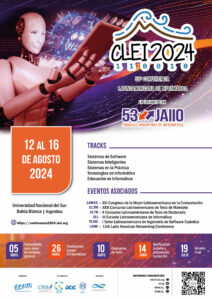
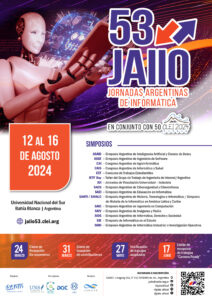
Del 12 al 16 de agosto de 2024 se desarrollará la 50 Conferencia Latinoamericana de Informática (CLEI 2024) en la Universidad Nacional del Sur, Bahía Blanca, Argentina.
En esta edición los tracks serán: Sistemas Inteligentes, Sistemas de Software, Sistemas en la Práctica, Tecnología Informática, Educación en Informática.
Además habrá eventos asociados tales como: Concursos Latinoamericanos de Tesis de Maestría y Doctorado, Congreso de la Mujer Latinoamericana en Computación, Taller Latinoamericano de Ingeniería de Software Cuántico y la Escuela Latinoamericana de Informática.
La información completa la encuentra en:
https://conferencia2024.clei.org
Para enviar los trabajos se debe acceder a: https://cmt3.research.microsoft.com/CLEI2024.
Los trabajos podrán ser completos (10 páginas) o en progreso (4 páginas) escritos en formato IEEE. Los trabajos aceptados y presentados en los tracks principales de la conferencia serán publicados por IEEExplore, una selección de los mismos serán invitados a un número especial de CLEI Journal.
FECHAS IMPORTANTES
– Envío de trabajos general: 5 de abril.
– Postulación cursos ELI temáticos. 26 de abril.
– Concursos de Tesis: 10 de mayo.
– Notificación a autores y propuestas cursos ELI: 14 de junio.
– Versión final: 19 de julio.
Inteligencia Artificial para la Gestión Agropecuaria Sustentable. 🌾
March 4th, 2024 Daniela Lopez de Luise
|

