We would like to remind you that the submission deadline for the Invited Session Proposal titled “Aerial Robotics in Inspection and Maintenance Operations – From Design to Deployment,” to be presented at ICUAS24 in Chania, Crete, is drawing near and is set for January 19th, 2024.
Important Dates
=======================
Interested authors looking to submit a paper for the upcoming conference and session should prepare a document containing:
– List of authors, proposed paper title, and a brief abstract, and send it by January 19th, 2024, through the email address icuas24session@googlegroups.com.
Authors will be notified about the decision and provided with further submission instructions by January 31st, 2024.
Abstract and Scope
=======================
Aerial robots are becoming increasingly vital in inspection and maintenance operations, demonstrating advanced maneuverability for complex airborne tasks. These include visually examining electrical power line components, searching for cracks in pipelines at oil and gas facilities, and inspecting leading-edge erosion in wind turbine maintenance operations. Aerial robot technologies are revolutionizing high-altitude inspections and maintenance by utilizing onboard AI systems for detailed visual analysis and defect identification. They play a crucial role in high-risk environments, monitoring personnel safety with advanced sensors and enabling safe contactless interactions between humans and drones. Additionally, these robots are capable of performing direct physical tasks, such as delivering tools and conducting automated replacement operations. Despite their numerous advantages, they encounter challenges in development and control, necessitating precise navigation and operation within tight, unstructured spaces. A key focus is on ensuring safety, reliability, and autonomy, with designs that enable independent control of position and orientation in hard-to-access areas.
This special session is dedicated to highlighting state-of-the-art research in the field of aerial robotics, particularly as it pertains to inspection and maintenance operations. We are seeking contributions that explore a wide range of topics within this domain. Key areas of interest include innovative design, advanced control systems, autonomous navigation, direct physical interaction, safety monitoring in high-risk environments, and human-robot interaction, among others.
Topics
=======================
The primary list of topics of interest includes, but is not limited to:
* Innovative Design and Engineering of Aerial Robots
* Advanced Dynamics and Control Systems
* Autonomous Navigation and Path Planning
* AI and Machine Learning in Aerial Robotics
* Sensor Fusion and Data Processing
* Human-Robot Interaction and Collaboration
* Physical Interaction and Aerial Manipulation
* Energy Efficiency and Sustainability
General Information
=======================
Authors should follow the submission guidelines for regular papers at the 2024 Internal Conference on Unmanned Aircraft Systems (ICUAS2024). The deadline for paper submission is the same as for regular papers. Papers submitted to special sessions will undergo the same review process as the regular papers and will appear in the main conference proceedings. At least 4 papers are expected for the Special Session. In the case fewer papers are received for a Special Session, they will be moved to the main track and the Special Session will be canceled. If the amount of accepted papers is more than 8, multiple session slots will be organized.
Papers must be submitted electronically for peer review through PaperCept by February 4, 2024: https://ras.papercept.net/conferences/scripts/start.pl.
Please note that the deadline for submitting a contribution may be subject to extension. Since this website is not directly linked with the portal, always refer to the dates listed on PaperCept or the conference website at https://uasconferences.com/2024_icuas/ for the most accurate and current information.
In PaperCept, click on the ICUAS 2024 link “Submit a Contribution to ICUAS 2024”, then under “Type of Submission” choose “Special Session paper”. Finally, enter the code provided by the organizers in the “Code” field. All papers must be written in English and should describe original work. For the initial submission, a manuscript can be 6-8 pages including references. For the final submission, a manuscript should be of 6 pages, With 2 additional pages allowed with an extra charge (TBA). All papers are reviewed using a single-blind review process.
=======================
The conference is under the auspices of the Technical University of Crete (TUC), and it is technically co-sponsored by, the IEEE Control Systems Society, the IEEE Robotics and Automation Society, and the Mediterranean Control Association. The conference is financially supported and sponsored by the ICUAS Association, Inc., a non-profit organization.
Organizing Committee
=======================
* Chiara Gabellieri, University of Twente, Enschede, The Netherlands, https://www.ram.eemcs.utwente.nl/about-us/staff/chiara-gabellieri.
* Giuseppe Silano, Czech Technical University in Prague, Prague, Czech Republic, https://giuseppesilano.net
* Mario Selvaggio, University of Naples Federico II, Naples, Italy, http://wpage.unina.it/mario.selvaggio/.
HRI Workshop on Human – Large Language Model Interaction
 January 18th, 2024
  Daniela Lopez de Luise
 Call for Submissions to the “Human – Large Language Model Interaction: The dawn of a new era or the end of it all?” Workshop at HRI 2024
The Human – Large Language Model Interaction workshop aims at bringing together researchers and industry experts across all disciplines in the fields of Human-Robot Interaction and Artificial Intelligence for an interactive and interdisciplinary discussion around the enormous opportunities and challenges that emerge from integrating Large Language Models (including multimodal Vision-and-Language models) in the interactive, conversational and reasoning abilities of robots.
The workshop aims to provide an important venue to encourage debate around issues concerning the deployment of Large Language Model / Large Multimodal Model empowered solutions for human-robot interaction. This will be an opportunity to share and discuss ideas, methods, worries, strategies, insights, and findings around the application of LLMs in interaction scenarios.
Date: March 11, 2024 (Half-day workshop)
Location: Boulder, Colorado (USA) during the 19th ACM/IEEE International Conference on Human-Robot Interaction (HRI 2024)
Manuscript submission site: https://easychair.org/conferences/?conf=hllmi24
IMPORTANT DATES
Submission deadline: February 2, 2024
Notification of acceptance: February 23, 2024
Camera-ready deadline: March 1, 2024
Workshop: March 11, 2024
All deadlines are at 23:59 Anywhere on Earth time.
=====================================================================================
TOPICS OF INTEREST
Topics of interest include, but are not limited to:
-
Applications of LLMs in HRI
-
Multimodal social interaction research with LLMs
-
Planning and decision making with LLMs for HRI
-
Reasoning and knowledge representation using LLMs
-
Situated interactions and grounding using LLMs
-
Multiparty interactions using LLMs
-
Explainability of LLM-powered interactive robots
-
Reliability and Safety of LLM-powered interactive robots
-
Trustworthiness of LLM-powered interactive robots
SUBMISSION GUIDELINES
Participants are invited to submit 2-pages extended abstracts on research related to the topics described above using EasyChair. We explicitly encourage the submission of position papers to discuss with the community or papers describing work in progress, novel ideas or new approaches related to the use of LLMs in HRI.
All manuscripts must be submitted in PDF format and will be peer-reviewed based on relevance to the workshop. Authors are asked to adhere to the submission guidelines outlined by HRI2024. Submissions should be made using the ACM template; Overleaf provides an appropriate template that may be used.
The authors of the accepted papers will present their work in the format of lightning talks or posters during the workshop. The accepted papers will be published on the workshop website.
ORGANISERS
-
Daniel Hernández García (Heriot-Watt University, UK)
-
Marta Romeo (Heriot-Watt University, UK)
-
Christian Dondrup (Heriot-Watt University, UK)
-
Nancie Gunson (Heriot-Watt University, UK)
-
Angus Addlesee (Heriot-Watt University, UK)
-
Weronika Sieińska (Heriot-Watt University, UK)
-
Oliver Lemon (Heriot-Watt University, UK)
-
Alessandro Suglia (Heriot-Watt University, UK)
-
Matthew Aylett (Heriot-Watt University, UK)
CONTACT
16th IEEE INTERNATIONAL WORKSHOP ON INFORMATION FORENSICS AND SECURITY (WIFS) 2024
January 18th, 2024 Daniela Lopez de Luise (WIFS) 2024
ROME, ITALY, DECEMBER 2-5, 2024
AIMS AND SCOPE
The IEEE International Workshop on Information Forensics and Security
(WIFS) 2024 will be the 16th edition of the major annual event organized
by the IEEE Information Forensics and Security Technical Committee
(IFS-TC) of the IEEE Signal Processing Society (SPS). The major goal of
WIFS is to bring together researchers working in the different areas of
information forensics and security to discuss challenges, exchange
ideas, and share state-of-the-art results and technical expertise, with
the aim of building a community capable of providing adequate tools and
solutions to face the challenges of tomorrow.
WIFS 2024 will be held in Rome, Italy, from December 2 to December 5,
hosted by Roma Tre University, and it will see the participation of
researchers from all over the world, who will allow to have a high-level
technical program, also thanks to the expertise of the program committee
involved, and who will have the opportunity to exploit an interesting
social program taking advantage of the charm of the Eternal City.
CALL FOR TUTORIALS
The organizing committee invites proposals for Tutorials on relevant and
emerging topics in the area of Information Forensics and Security.
Tutorials will be given during the first day of the conference, on
Monday December 2, 2024.
CALL FOR SPECIAL SESSIONS
The organizing committee invites proposals for innovative and
high-quality special sessions on emerging topics, which complement the
regular program of the conference. Special sessions should both provide
an overview of the state of the art in the proposed field, and highlight
the most promising research directions, trends and issues. Special
session proposals will be evaluated based on the proposed topic, the
expected impact, the expected quality of the contributed papers, and the
session organizers and contributing authors. Special session paper
submissions will be reviewed via the same process used for the regular
program, and papers are expected to meet the same quality standards.
Accepted and presented papers will be submitted for inclusion into IEEE
Xplore.
CALL FOR DEMOS
The organizing committee invites proposals for demonstrations of
applications in information forensics and security topics. Demos are
intended as real, practical, and interactive proof of the presenters'
research ideas and scientific or engineering contributions, with the
goal of providing researchers and practitioners with the opportunity to
discuss working systems, applications, prototypes, or proof-of-concepts.
Accepted and presented demos will be described in short papers that will
be submitted for inclusion into IEEE Xplore.
CALL FOR CHALLENGES
The organizing committee invites proposals for challenges addressing
problems that will engage and excite the information forensics and
security research community. Challenge organizers should provide a
dataset to participating teams, including data to train and test the
proposed algorithm. They are also in charge of checking the submitted
results/models. The organizers will be asked to summarize the challenge
outcomes in a paper that will be presented during the workshop and
submitted for inclusion into IEEE Xplore.
CALL FOR PAPERS
Prospective authors are invited to submit research papers be up to 6
double-column pages, including references and figures, presenting
original works and addressing Information Forensics and Security aspects
in a broad sense. The review process will be single-blind (author’s
names can be reported in the submitted papers). Accepted and presented
papers will be submitted for inclusion into IEEE Xplore. It is planned
to organize a special issue with invitations for a selection of the best
presented papers.
Topics of interest include, but are not limited to, the following areas:
• Anonymization and Data Privacy
• Applied Cryptography
• Biometrics
• Communication and Physical-Layer Security
• Cybersecurity
• Forensic Analysis
• Hardware Security
• Multimedia Content Hash
• Network Security
• Surveillance
• Usability and Human Factors
• Watermarking and Data Hiding
• Adversarial Machine Learning
• Steganography and Covert Communications
• Information Theoretic Security
• Security of Large Networked Systems
IMPORTANT DATES
• Special Session proposal: March 18, 2024
• Special Session notification: March 29, 2024
• Challenge proposal: April 15, 2024
• Challenge notification: April 19, 2024
• Tutorial proposal: June 2, 2024
• Tutorial notification: June 7, 2024
• Paper/Demo submission: June 30, 2024
• Reviews notification: September 2, 2024
• Rebuttal deadline: September 6, 2024
• Acceptance notification: September 13, 2024
• Camera-ready submission: September 27, 2024
• Early registration: October 4, 2024
• Workshop: December 2 – 5, 2024
CONTACTS
For further information, please visit https://wifs2024.uniroma3.it or
send an email to wifs2024.contacts@uniroma3.it.
Call for papers of IEEE CBMS 2024 Special track on Multimodal Learning in Biomedical Applications
January 18th, 2024 Daniela Lopez de Luise
|
|
|||
|
|
|||
|
Call for papers: Special Track on Multimodal Learning in Biomedical Applications (MLBA) Exciting advancements in biomedical research and healthcare are emerging through the fusion of AI and multimodal data analysis. The “Multimodal Learning in Biomedical Applications” special track aims to bring together the latest research and developments in this dynamic field. |
|||
|
|
|||
|
Paper submission deadline: 31-03-2024 |
|||
|
Topics Topics include but are not limited to:
|
|||
|
Important Dates The special track will take place in parallel with the general conference track. Submission deadlines are as follows:
|
|||
|
Organizers |
|||
|
|
|||
|
|
|||
|


Una firma per la ricerca contro le patologie dell’invecchiamento.
Devolvi il tuo 5×1000 all’Università Campus Bio-Medico di Roma.
Codice fiscale: 97087620585
*****************
Le informazioni contenute in questo messaggio di posta elettronica e in ogni eventuale documento allegato sono riservate, potrebbero essere coperte dal segreto professionale e possono essere utilizzate esclusivamente dai destinatari autentici del messaggio. Se ricevete questa mail per errore siete pregati di comunicarlo tempestivamente al mittente con un messaggio di risposta e, a seguire, di distruggere ogni copia della mail ricevuta per errore e del vostro stesso messaggio di risposta, se esso replica parti del messaggio originale.
Vi informiamo inoltre che la nostra Istituzione compie ogni sforzo per proteggere dai virus informatici la propria rete e i propri sistemi; pertanto essa non si assume alcuna responsabilità in ordine alla presente mail e a possibili virus con essa trasferiti.
Grazie.
*****************
The information contained in this e-mail and in any file attached to it is confidential and may be privileged for the sole use of the designated addressee. If you have received this message in error, please notify the sender immediately by replying to this email and by deleting from your computer both this message and your own reply, if it contains parts of the original message. We inform you that our Institution puts in place every effort to keep our network and information system free from viruses and consequently we reject any responsibility for any computer virus which might be transferred by means of this e-mail.
Thank you.
IEEE TEMSCON 2024: Call for Papers
January 18th, 2024 Daniela Lopez de Luise 
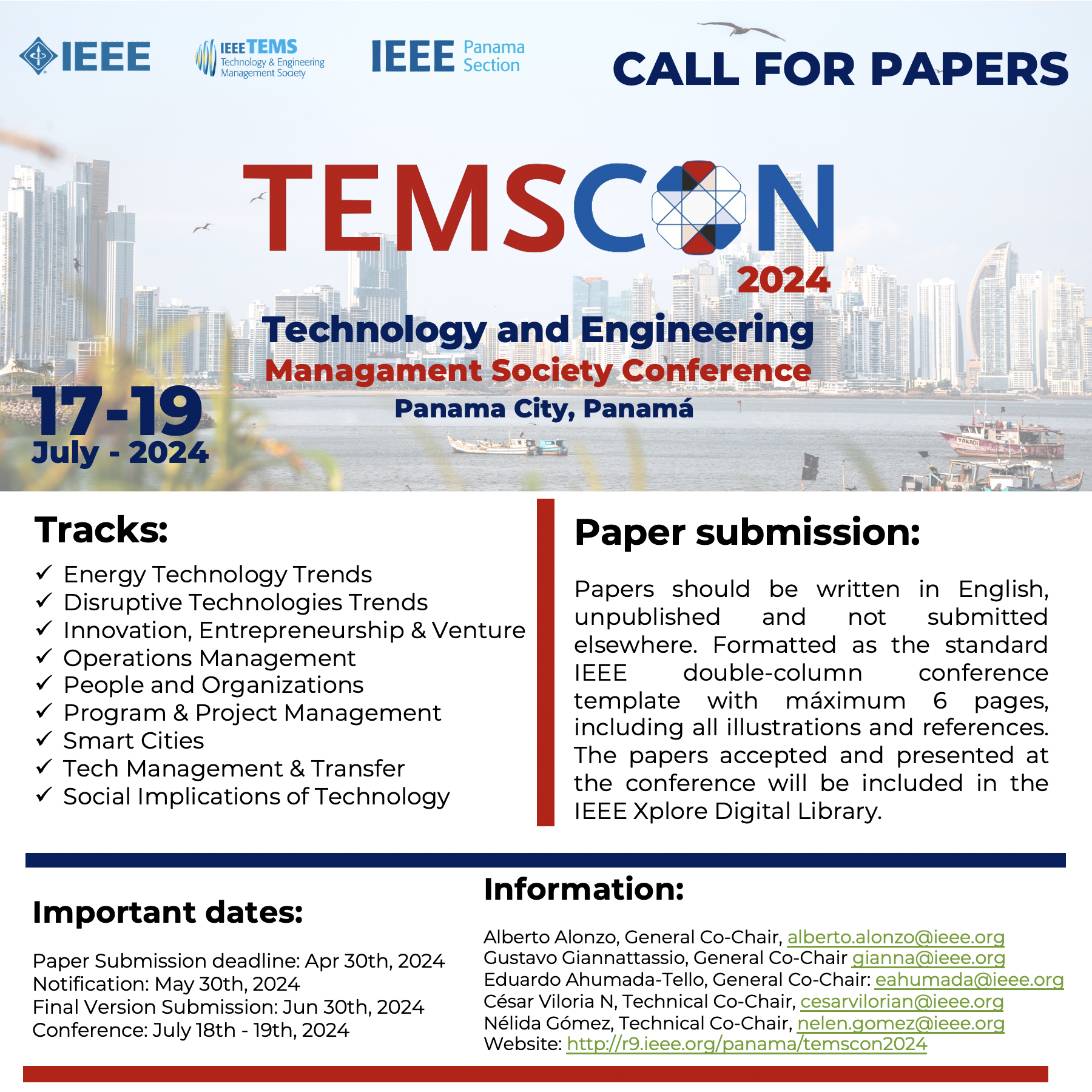
Technology and Engineering Management Society Conference, TEMSCON 2024“Technology and Engineering Management for Sustainable Societies”Call for PapersWe are pleased to announce the 2024 edition of the IEEE Technology and Engineering Management Society Conference – TEMSCON LATAM, organized by the IEEE Technology and Engineering Management Society, IEEE TEMS Panama Chapter, and IEEE Panama Section. IEEE TEMSCON LATAM offers a unique opportunity for academics, practitioners, researchers, and industrialists to present their developments and technological advances in person during the month of July 2024 in Panama City, Panama. Paper SubmissionSubmit your best work to IEEE TEMSCON LATAM 2024 and share your technological advances with the community! To participate, send your paper in digital format (PDF) through the submission portal, in English, and IEEE conference format. Remember that the maximum length is six (6) pages, including illustrations and references. In addition, each article must be original and be correctly labeled with its subject area. The papers accepted and presented at the conference could be included in the IEEE Xplore Digital Library.
Our review committee will ensure that each article submitted is rigorously reviewed through a double-blind process.
Authors must submit their work without including information that would reveal their identity. If your paper is accepted, at least one of the authors must register and present their paper during the conference. Don't miss this opportunity to stand out as a leader in your field and share your knowledge and progress with others – download our IEEE templates in Microsoft Word or Overleaf and submit your paper today!
Important Dates: Paper Submission deadline: Apr 30th, 2024 Notification: May 30th, 2024 Final Version Submission: Jun 30th, 2024 Conference: July 17th – 19th, 2024
Contact: URL: r9.ieee.org/panama/temscon2024 Conference General Chair: Conference General Co-Chairs: Technical Program Co-Chair: Technical Program Co-Chair: |