



 “en la senda de Sadosky”
¡Reservá tu vacante!
Estimados/as,
Saludos cordiales.



CURSOS VIRTUALES 2023
FEBRERO
- Protección de Intangibles para la industria del software – Comienza el 27 de febrero
MARZO
- Introducción al Análisis Forense de Evidencias Digitales e Incidentes de Ciberseguridad – Comienza el 6 de marzo
- Regulación de las inteligencias artificiales: alcances éticos, jurídicos, políticos, económicos y sociales – Comienza el 13 de marzo
- Introducción a la Programación con R – Comienza el 13 de marzo
ABRIL
- Accesibilidad Web – Comienza el 3 de Abril
- Introduccion a la Ciencia de Datos – Comienza el 11 de Abril
- Herramientas Informáticas para la Revisión Bibliográfica – Comienza el 17 de Abril
 |
 |
 |
 |
 |
 |
 |
INSCRIPCIONES ABIERTAS PARA EL DIPLOMADO EN GESTIÓN EFICIENTE DE ALMACENES – 3RA EDICIÓN – FCE-UNCUYO
 February 17th, 2023
  Daniela Lopez de Luise
 En MARZO inicia el
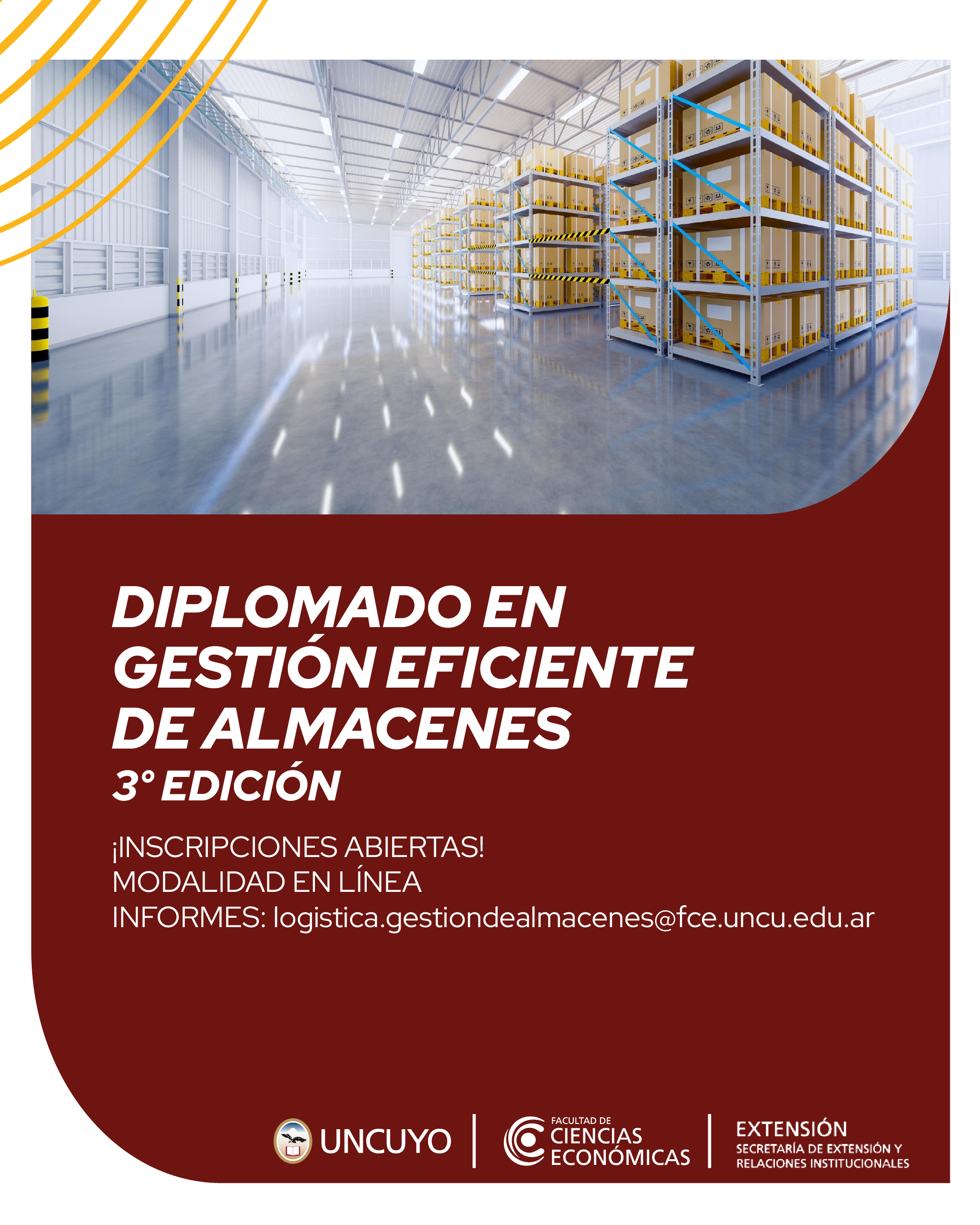
Diplomado en Gestión Eficientes de Almacenes – 3ra Edición
En el interior de las organizaciones, las personas dedicadas a la gestión de almacenes, deben aplicar soluciones logísticas en forma dinámica, eficiente y sostenible.
Dictado
El Diplomado tiene carácter virtual. El participante accederá a un aula virtual para completar evaluaciones, obligaciones o trabajos requeridos por cada profesor, así como consultar materiales y participar en foros de análisis y debate, entre otras tareas.
Inicia: 14 de marzo de 2023
Finalización: 4 de julio de 2023
Para quienes
Dirigido a todas las personas interesadas en adquirir herramientas logísticas, integrantes de todo tipo de organizaciones, profesionales, técnicos y emprendedores, que acrediten como mínimo título secundario.
Take Away
- Actualizar conocimientos e interiorizarte en soluciones logísticas aplicables en la mejora de la cadena de abastecimiento.
- Obtener las herramientas adecuadas para facilitar la competitividad y sostenibilidad organizacional.
- Aprender a aplicar soluciones logísticas en forma dinámica, eficiente y sostenible.
Programa Certificado
Los participantes obtendrán un certificado otorgado por la Facultad de Ciencias Económicas de la Universidad Nacional de Cuyo. Propuesta aprobada por el Consejo Directivo de la Facultad a través de la resolución Nº 404/2021.
Equipo de docentes profesionales expertos
Consultá el PROGRAMA COMPLETO con más detalle aquí
Duración
4 meses.
Dedicación
Total: noventa y seis (96) horas.
Modalidad: 100% EN LÍNEA, por videoconferencia. Una vez por semana
Días Martes de 18:30 a 21:30 hs
Inversión y formas de pago:
Valor total: $45.000
Forma de pago
Inscripción: $13.000
cuatro (4) cuotas $8.000 (se abonan a partir de marzo)
Descuentos Institucionales
- 50% Profesor de la FCE – UNCUYO (Inscripción $13.000 y 4 cuotas de $2.750)
- 20% Egresado y Estudiantes de la FCE-UNCUYO (Inscripción $13.000 y 4 cuotas de $5.750)
- 20% Personal No docente UNCUYO (Inscripción $13.000 y 4 cuotas de $5.750)
- 10% Egresado, Profesor o Estudiante de la UNCUYO (Inscripción $13.000 y 4 cuotas de $6.875)
- 20% Matriculado en el CPCE de Mza (Inscripción $13.000 y 4 cuotas de $5.750)
- 20% Matriculado en CLAM de Mza (Inscripción $13.000 y 4 cuotas de $5.750)
Grupos de Afinidad
- 5% 2 participantes de la misma institución
- 10% 3 – 5 participantes
- 15% 6 – 10 participantes
- 20% 10 o más participantes
Los descuentos y tarifas corporativas NO SON ACUMULABLES.
Formas de Pago
- Transferencia o depósito bancario total o mensual
- Tarjeta de Crédito o Débito (3 cuotas sin interés)
Los pasos para completar el proceso de inscripción y efectivamente reservar un lugar son:
1. Llenar la ficha de inscripción
https://forms.gle/xemgD5cmupmxy2RL7
2. En el cuerpo de un mail que debe enviar a logistica.gestiondealmacenes@fce.uncu.edu.ar, los siguientes datos, para que nosotros generemos la factura correspondiente:
NOMBRE COMPLETO o RAZÓN SOCIAL:
CUIT o CUIL:
Dirección:
Condición frente al IVA
3. Y en adjunto del mail
-foto del DNI (anverso y reverso)
-comprobante de pago de la inscripción
Transferencia Bancaria a la siguiente cuenta:
Asociación Cooperadora FCE UNCUYO (IVA EXENTO)
Cuenta Corriente Nº267-664825311-000
CUIT 30-64825311-3
C.B.U. 0340267400664825311004
ALIAS: FCE.COOP.UNCUYO
Banco Patagonia
Con tarjeta de crédito o débito a través de Mercado Pago
link de pago valor total del curso ($45.000)(3 cuotas sin interés)
link de pago inscripción al curso ($13.000)
Esperamos tu inscripción
Saludos cordiales
Paper Submission – 3rd International Conference… was uploaded by International Journal on Natural Language Computing (IJNLC)
February 16th, 2023 Daniela Lopez de Luise
|

 International Journal on Natural Language…
AI4Media: Dissemination of Special Session on Computational Memorability of Imagery
February 16th, 2023 Daniela Lopez de Luise Computational Memorability of Imagery
Special Session at CBMI 2023
20-22 September 2023
Orleans, France
https://cbmi2023.org
The subject of memorability has seen an influx in interest since the likelihood of images being recognised upon subsequent viewing was found to be consistent across individuals. Driven primarily by the MediaEval Media Memorability tasks which has just completed its 5th annual iteration, recent research has extended beyond static images, pivoting to the more dynamic and multi-modal medium of video memorability.
The memorability of a video or an image is an abstract concept and like other features such as aesthetics and beauty, is an intrinsic feature of imagery. There are many applications for predicting image and video memorability including marketing where some part of a video advertisement should strive to be the most memorable, in education where key parts of educational content should be memorable, in other areas of content creation such as video summaries of longer events like movies or wedding photography, and in cinematography where a director may want to make some parts of a movie or TV program more, or less, memorable than the rest.
For computing video memorability, researchers have used a variety of approaches including video vision transformers as well as more conventional machine learning, text features from text captions, a range of ensemble approaches, and even generating surrogate videos using stable diffusion methods. The performance of these approaches tells us that we are now close to the best performance for memorability prediction for video and for images that we could get using current techniques and that there are many research groups who can achieve such a level of performance.
We believe that image and video memorability is now ready for the spotlight and for researchers to be drawn to using video memorability prediction in creative ways. We invite submissions from researchers who wish to extend their reported techniques and/or apply those techniques to real-world applications like marketing, education, or other areas of content production. We hope that the output from this special session will be a community-wide realization of the potential for video memorability prediction and uptake in research into, and applications of, the topic.
The topics of the special session include, but are not limited to:
- Development and interpretation of single- or multi-modal models for Computational Memorability
- Transfer learning and transferability for Computational Memorability
- Computational Memorability applications
- Extending work from MediaEval Predicting Media Memorability task
- Cross- and multilingual aspects in Computational Memorability
- Evaluation and resources for Computational Memorability
- Computational memorability prediction based on physiological data (e.g.: EEG data)
The contributions to this special session are regular short papers (only) as 4 pages, plus additional pages for the list of references. The review process is single-blind, meaning authors do not have to anonymise their submissions.
Important dates:
Paper submission: April 12, 2023
Notification of acceptance: June 1, 2023
Camera ready paper: June 15, 2023
Conference dates: September 20-22, 2023
Organisers:
- Alba García Seco de Herrera, University of Essex (alba.garcia@essex.ac.uk)
- Mihai Gabriel Constantin, University Politehnica of Bucharest (mihai.constantin84@upb.ro)
- Alan Smeaton, Dublin City University (alan.smeaton@dcu.ie)
AIDA Spring Semester Courses by Aristotle University of Thessaloniki
February 16th, 2023 Daniela Lopez de Luise Aristotle University of Thessaloniki offers the following two semester courses to AIDA students:
Autonomous Systems Perception : https://www.i-aida.org/course/autonomous-systems-perception-3/
Pattern Recognition – Statistical Learning : https://www.i-aida.org/course/pattern-recognition-statistical-learning-3/
You are welcomed to enroll using the above links till Wednesday 25/02/2023. Out of these enrollment applications we shall accept up to 5 AIDA students.
Both courses start on 20/02/2023 (for AUTH students), but AIDA students can start with small delay, as their participation will be remote and asynchronous.
Both courses involve lecture material (ppt) study, obligatory bibliography/programming projects and a final exam. They are quite demanding, but provide excellent knowledge of the entire domain.
Therefore, I would appreciate receiving only serious applications. I strongly discourage future dropouts for any reason.
Best regards
Ioannis Pitas