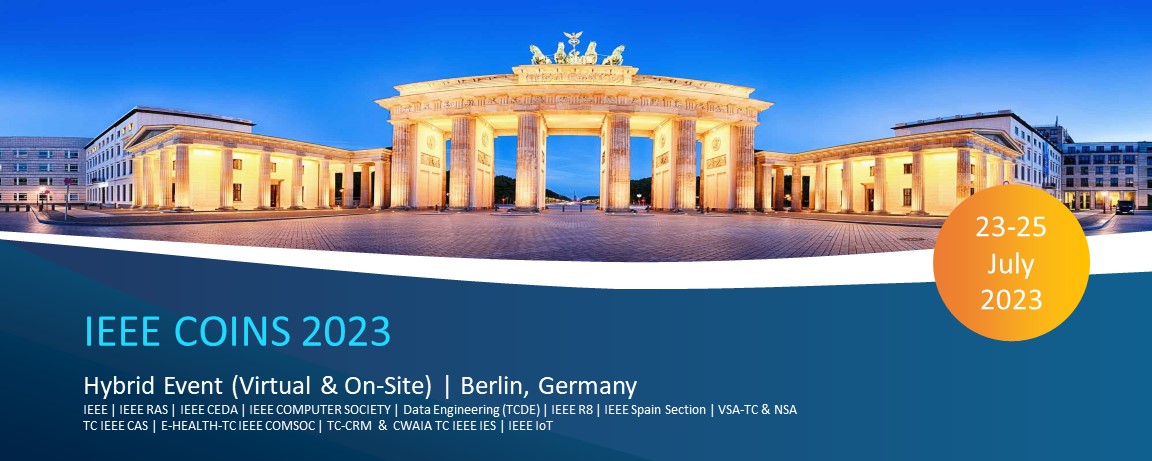
IEEE COINS 2023: IEEE International Conference on Omni-Layer Intelligent Systems
23-25 July, 2023 | Berlin, Germany | Hybrid Event: In-Person and Virtual Presentations
IEEE | IEEE RAS | IEEE CEDA | IEEE COMPUTER SOCIETY | Data Engineering (TCDE) | IEEE R8 | IEEE Germany Section | NSA TC IEEE CAS |
E-HEALTH-TC IEEE COMSOC | TC-CRM TC IEEE IES | IEEE IoT
Submission Deadline: 15 March, 2023 (AOE)
http://coinsconf.com
Are you interested in taking part in shaping and adding new dimensions to the future IoT and AI ecosystem? are you seeking to harness the opportunities afforded by the tsunami of new technologies? Do you want to stay ahead and learn about the biggest digital technologies that are radically shifting the paradigm? Or just curious about what IoT, AI, and Big Data are all about and how they impact every aspect of our life, society, and business? IEEE COINS ( https://coinsconf.com/) is the right place to be. IEEE COINS brings together experts in Digital Transformation (from AI and IoT to Cloud, Blockchain, Cybersecurity, and Robotics) from around the globe. IEEE COINS includes a multi-disciplinary program from technical research papers to panels, workshops, tutorials, demos, and exhibitions on the latest technology developments and innovations addressing all important aspects of the IoT/AI ecosystem.
*********************************
Call for Papers
*********************************
IEEE COINS solicits papers and proposals accompanying submissions for presentations in the Vertical and Topical Tracks.
Topical Area Tracks:
1) Internet of Things: From Device to Edge, and Cloud
2) Sensors and Sensing Systems
3) Circuits and Systems for Artificial Intelligence, and Internet of Things
4) Communications, Connectivity, and Networking
5) Big Data, Data Engineering, and Data Analytics
6) Artificial Intelligence, Machine Learning, and Cognitive Computing
7) Distributed Ledger Technologies and Blockchain
8) Design Automation in AI & IoT Era: From Chips to Systems
9) Security and Privacy
10) Intelligent Robots and Systems
11) Applications, Processes, and Services
Vertical Tracks:
1) Smart City
2) Industry 4.0
3) e-Health and Wearable IoT
4) Agriculture
5) Smart Energy
6) Mobility and Smart Transportation
Special Tracks:
1) Critical System Design
2) European Projects on Intelligent Systems
3) Emerging Technologies on intelligent systems
4) Cyber-physical system
Demo and Exhibition:
1) Artificial Intelligence
2) Internet of Things (IoT)
3) Embedded Systems
4) Big Data, Data Engineering, and Data Analytics
5) Communications, Connectivity, and Networking
6) Distributed Ledger Technologies and Blockchain
IEEE COINS will publish accepted papers in the conference proceedings, and the proceedings will be submitted to the IEEE Xplore Digital library and indexing services. Submissions should follow the IEEE formatting guidelines. Your submission must not include information that serves to identify the authors of the manuscript, such as name(s) or affiliation(s) of the author(s), anywhere in the manuscript, abstract, or in the embedded PDF data. References and bibliographic citations to the author(s) own published works or affiliations should be made in the third person.
Note: Each paper must be no more than six pages (including the abstract, figures, tables, and references), double-columned, 10pt font. Accepted papers are allowed six pages in the conference proceedings free of charge. Each additional page beyond six pages is subject to the page charge of 150.00 EUR per page up to the eight-page limit.
*********************************
Call for Speakers & Panels
*********************************
Are you an executive, strategist, or professional working in the field of IoT, Big Data, AI/ML, Blockchain, Cloud Computing, or Robotics? The purpose of the COINS Pavilion is to present content that is interesting to both the technical and business audiences that attend COINS. There are three options when submitting a proposal:
1. Panels (45 minutes long). The topic of each panel should be interesting, timely, and relevant to multiple segments of COINS attendees. Controversy is appropriate and encouraged.
2. Individual (Technical or Demo) oral presentations (20 minutes long) without any paper submission. If any presenters would also like to submit a technical research paper for publication, then that option is available, if desired. All submitted papers will be peer-reviewed for acceptance in IEEE Xplore, and there is no guarantee that papers submitted by invited presenters will be accepted.
3. Mini-keynotes (each 10 minutes presentation | ideally C-level speakers).
If you are interested in being a speaker and/or recommending a speaker, demo a product/service, or submitting a panel proposal, please, provide the following information to Farshad Firouzi ( farshad.firouzi@duke.edu):
• Organizer(s) name, affiliation, bio, and email address
• Presenter(s) name, affiliation, bio, and email address
• Title and abstract (max 500 words)
*********************************
Ph.D. Forum – Call for Submissions
*********************************
The Ph.D. forum will be hosted by the IEEE Council on Electronic Design Automation (CEDA) and will be organized as a poster session with 1-minute 1-slide oral introductions from the students to get the attention of the audience. The forum will provide an opportunity for graduate students to explore their research interests in an interdisciplinary workshop under the guidance of a panel of distinguished experts in the field of Computer-aided design and Circuit and Systems for the Internet of Things (IoT), Artificial Intelligence (AI), Big Data and Security/Privacy. The Ph.D. forum aims at bringing together young Ph.D. students to exchange their research, ideas, and experiences.
The following two classes of students are eligible:
• Students who have finished their Ph.D. thesis within the last 12 months
• Students who are close to completing their thesis work.
Submission: A 2-page extended abstract describing the novelties and advantages of the thesis work as a single PDF file via the submission website. The abstract should also include name and affiliation.
*********************************
Call for Special Sessions, Workshops, and Tutorials
*********************************
IEEE COINS seeks proposals for i) Special Sessions consisting of peer-reviewed papers focused on in-depth treatment on a topic of timely interest to the IEEE COINS audience. Special session papers will undergo the same intense review process as regular conference papers, and submission is not a guarantee of acceptance. The selected papers will be published as part of the IEEE COINS Proceedings; ii) Tutorial Sessions consisting of discussions and summary results about advanced topics relevant to the conference. Tutorials intend to highlight innovative ideas positioned on each field's frontiers covered by the conference. Tutorials provide participants the chance to explore innovative trends or innovative applications, learn new techniques from experts in the field, and gain knowledge and insights. Typical tutorials run 1.5-2 hours, although longer half-day tutorials (two-session blocks of 1.5-2 hours each) may be considered; iii) Workshops are half- or one-day events that aim to foster active discussion on issues related to specific fields. The typical structure of a workshop will include a number of papers (peer-reviewed) presentations and/or invited talks (without paper submission). Accepted manuscripts will be included in the COINS conference proceedings as workshop papers and will be indexed in the IEEE Xplore Digital Library.
All proposals (1 to 2 pages) should be submitted via email to Jan Haase ( jan.haase@ieee.de), Farshad Firouzi ( farshad.firouzi@duke.edu), Alessandro Savino ( alessandro.savino@polito.it), Azin Ebrahimi ( mebr@kth.se), Hussam Amrouch ( amrouch@iti.uni-stuttgart.de), and Khelil Abdelmajid ( Abdelmajid.Khelil@haw-landshut.de). Please include the required information indicated below:
• Title and abstract of the workshop/tutorial/special session
• Organizers and their affiliations (including short bios)
• Structure, format, and the expected duration of the tutorial/workshop (for a tutorial/workshop proposal)
• Planned invited speakers (if any) for workshop/tutorial proposals (it is not necessary, nor a requirement)
• Provide a sample call for papers (if any) for a workshop and Special Session proposals, the number of published papers (if any), and, if available, a list of prospective authors and contributions
• CFP Dissemination plan (workshop and special session proposals)
• Provide the abstract of the tutorial/workshop (for a tutorial/workshop proposal)
• If the workshop/tutorial was previously held, provide the location (i.e., which conference), date, number of published papers (if any), and number of attendees at the last event
*********************************
Call for Demos and Exhibition
*********************************
IEEE COINS has many opportunities to showcase your company and products, including exhibit/suite space, special promotional opportunities, customer meetings, and social functions. The Demo/Exhibition of IEEE COINS is for companies who want to promote their brand and gain better exposure to the community. The combination of both the presentation theater and the dedicated exhibit aisle will maximize the learning and brand exposure. All requests should be submitted via email to Farshad Firouzi ( farshad.firouzi@duke.edu), Lucian Vasile Stoica ( lstoica2007@gmail.com), and Shaun Kaplan ( kaplans@ieee.org).
*********************************
Call for Sponsorship
*********************************
On behalf of the Organizing Committee of the IEEE COINS, we invite your sponsorship of the conference. As a sponsor of this conference, you will enjoy the opportunities to interact closely with worldwide researchers in academia and industry and the top-notch postgraduate students and practitioners in the field. Your participation will increase your visibility in the community and industry. It will also provide you with an unrivaled opportunity to network with key players and demonstrate your innovative services and products. Your financial support will ensure that the costs of the conference remain accessible for students and will improve the quality of the conference experience for all attendees worldwide.
We offer five levels of sponsorship. We also welcome any customized sponsorship proposals to best suit your needs. If you have any creative or interactive ideas of activity, we would be interested to talk to you about how we can incorporate them into a personalized package.
Please do not hesitate to get in touch with us ( farshad.firouzi@duke.edu) if you have any questions or suggestions for the conference and the engagement of attendees with the sponsors. Thank you very much in advance for your attention and your support!



 January 3rd, 2023
  Daniela Lopez de Luise

 ISCMI2023-CFP.pdf