ICDAM-2023 Theme: Data Analytics with Computer Networks




 January 30th, 2023
 Daniela Lopez de Luise
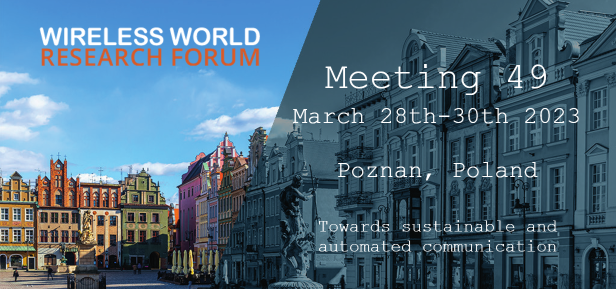
January 30th, 2023 Daniela Lopez de Luise WIRELESS WORLD RESEARCH FORUM 49 (WWRF49)
28-30 March 2023
Poznan, Poland
Towards Sustainable and Automated Communication
CALL FOR PAPERS
Over the past two decades, wireless communications have fundamentally transformed our daily life and created an almost fully connected society, linking billions of people and devices to reap the benefits of today’s digital economy. Every sector of the world economy now relies on wireless technologies in fundamental ways, from banking and agriculture to transportation and healthcare. In addition, powerful cutting-edge technologies that rely on robust wireless communications networks – such as 5G, artificial intelligence, the Internet of Things, and Industry 4.0 – hold great potential for improving lives at an unprecedented pace and scale.
However, the rapid development of advanced telecommunications networks, in response to the continuously growing global demand for data transmission and access to information, also entails a very large increase in the resources used. The telecommunications of the future must face new challenges, including a significant reduction in energy consumption while maintaining the same quality parameters, and ensuring sustainable development through the responsible use of available resources.
At the same time, the complexity of telecommunications systems is increasing so significantly that the processes of design, maintenance and development have to be considered holistically. There is a strong need for making the network not only resource sustainable, but also autonomous and automated.
There is also room for societal and technological improvements to address the digital divide that continues to exist in the world. Tackling uneven global distribution and ensuring a better world requires super-connecting the already connected and connecting the unconnected, while guaranteeing an impressive quality of experience worldwide. Future wireless communication systems must also effectively support a universal and ubiquitous cyber physical infrastructure.
The huge variety of intelligent applications envisaged for a wireless future will require a novel network structure, spectrum access schemes, and resource allocation solutions, while factoring in energy efficiency and security/privacy considerations. Thus, highly innovative wireless solutions with varied quality specifications when it comes to service requirements have become paramount in ensuring a greener world. Examples of some technological breakthroughs include intelligent surfaces, semantic communications, and digital twin technology, to name a few.
Under the theme “Towards sustainable and automated communications”, the 49th Wireless World Research Forum (WWRF) will take place at Poznan University of Technology, Poland, from 28-30 March 2023. You are invited to be part of designing the wireless future by joining us for three days of insightful discussions, presentations, innovative brainstorming, and expert-level networking.
Authors are invited to submit original manuscripts aligned with the theme of the event, on one or more of the following topics, or on any relevant aspect of wireless innovation for a better world:
• Autonomous communications
• Towards automated wireless communications
• Resource sustainability in future communications
• Cutting Edge Solutions for Sustainable Communications
• Openness, Disaggregation, Modularity and Programmability
• Intelligent Applications for Vertical Industries
• Data Analytics, AI, and Machine Learning for Sustainability and Network Automation
• Software-Defined Infrastructure
• Advanced Radio Technologies
• Tactile Internet
• Green Communications and Networking
• THz Communications
• Bridging the Digital Divide Beyond 5G
• Beyond 5G Technologies
• Innovations in Business Models for Wireless Networks
• Cyber-Physical Systems and Networks
• Privacy and Security
• Connected Vehicles
• Holographic MIMO & Reconfigurable Intelligent Surfaces
• Applications and impact of quantum-based technologies
• Semantic Communications
• Spectrum Issues and Regulatory Principles
• Social Network-Aware Wireless
• Internet of Things and Wearable Technologies
Authors are expected to be physically present in Poznan to present their contribution.
Why Attend WWRF 49?
WWRF is a unique forum which brings together the wireless community to tackle key research challenges. As an attendee, you will be able to: (i) define your future wireless strategies by leveraging the insights of industry leaders, (ii) ease future standardization by harmonizing research views at the research stage, (iii) identify new trends and ideas in wireless communications, and (iv) share insights on research directions and visions for the Wireless World.
Submission Instructions
Contributors should submit an extended abstract by 14th February 2023 to contributions@wwrf.ch for review. Extended abstracts should be preferably at least two pages in length, either in plain ASCII text, MS Word or Adobe PDF. A template for abstracts or papers is available at the link below. Full papers must be prepared using the WWRF template, which is also available below. The following list shows the different working groups (WGs) and Vertical Industry Platforms (VIPs) to one of which the contributions should be directed:
• Working Group,A/B – User Needs & Requirements, Services and Devices in a Wireless World
• Working Group C – New Directions in Communication Architectures and Technologies, including SDN, NFV and MEC
• Working Group D – Radio Communication Technologies: Air Interfaces for 6G, advance wireless access techniques, MIMO, Reconfigurable Intelligent Surfaces, Radio Resource Management, SDR and Spectrum Sharing
• WG BM – Future Business Models supported and enabled by 5G and Beyond wireless technologies
• WG High-Frequency Technologies: mm Wave and THz Communications and Sensing
• VIP WG 5G e/m-Health and Wearables
• VIP WG Connected Vehicles
• VIP WG Track-to-Train communications
• WG Cybersecurity
• WG 6G
IMPORTANT DATES
ABSTRACT DEADLINE 14th February 2023
NOTIFICATION OF ACCEPTANCE 21st February 2023
EARLY REGISTRATION 21th February 2023
FINAL PAPER AND COPYRIGHT LICENCE SUBMISSION 21st March 2023
EVENT 28-30th March 2023
COPYRIGHT LICENCE
Please note that, by disclosing information to WWRF, it is deemed non-confidential, in accordance with Section 8 of the WWRF Articles of Association, and authors grant WWRF permission to use such information as described in the WWRF copyright licence.
Authors must complete and submit a copyright licence along with their full paper.
Contributions submitted without a completed and signed copyright licence cannot be published in the meeting proceedings or in WWRF’s other publications. Abstracts do not require a copyright licence.
STUDENT GRANTS
Funding is available to support a number of students travelling to and presenting papers at the meeting. Application for student funding must be provided with paper submission. The level of grant will depend on available funds and the student's country of residence (up to €500 for students in Europe, and €800 for those resident elsewhere). Priority will be given to students from member organizations.
IMPORTANT DOCS
TEMPLATE ABSTRACT
https://wwrf.ch/wp-content/uploads/2022/10/WWRF-Abtract-TEMPLATE-July22-5.docx
TEMPLATE FULL PAPERS
https://wwrf.ch/wp-content/uploads/2022/10/WWRF_template_full-papers.docx
COPYRIGHT LICENCE
https://wwrf.ch/wp-content/uploads/2022/10/WWRF-CopyrightLicenseMaster-October20-1.docx
Dr Nigel Jefferies
WWRF Chairman
E-mail: nigel.jefferies@wwrf.ch | Mobile: +44 7768 670282
Website: www.wwrf.ch | Twitter @WWRF
January 30th, 2023 Daniela Lopez de Luise ******************************************
CfP – Apologies for cross-postings
******************************************
Special Thematic Session on Privacy-aware and acceptable video-based assistive technologies
As part of the 17h International Conference of the Association for the Advancement of Assistive Technology in Europe (AAATE 2023) – https://aaate2023.eu/
30 August – 1 September 2023, Paris, France
Paper submission deadline: 5 March 2023
One major concern in the development of assistive technologies lies in the claim for responsible research and the consideration of ethical, legal and social implications of technology development. At a time in which technology developments – fostered by the huge and tremendously fast-evolving innovations through modern information and communication technologies – enter private spheres and come into close contact with individual, private, and intimate activities, it is a mandatory claim that any technology development should be carefully developed and balanced within societal, cultural and individual values, and norms.
Assistive technologies based on computer vision, multimedia data processing and understanding, and machine intelligence present several advantages in terms of unobtrusiveness and information richness. Indeed, camera sensors are far less obtrusive with respect to the hindrance that other wearable sensors may cause to people’s activities. Currently, video-based applications are effective in recognising and monitoring activities, movements, and overall conditions of the assisted individuals as well as to assess their vital parameters (e.g., heart rate, respiratory rate). However, cameras are often perceived as the most intrusive technologies from the viewpoint of the privacy of the monitored individuals. This is due to the richness of the information that this technology conveys and the intimate setting where it may be deployed in. Therefore, solutions able to ensure privacy preservation by context and design as well as to ensure high legal and ethical standards are in high demand.
This Special Thematic Session (STS) aims to give forum for contributions presenting and discussing image- and video-based AAL applications, projects and research as well as initiatives proposing ethical and privacy-aware solutions.
This STS is supported by the visuAAL Marie Skłodowska-Curie Innovative Training Network (https://www.visuaal-itn.eu) and the GoodBrother COST Action (https://goodbrother.eu). The aim of these projects is to bridge the knowledge gap between users’ requirements and the appropriate and secure use of video-based AAL technologies to deliver effective and supportive care to older adults managing their health and wellbeing. They seek to increase awareness and understanding of the context-specific ethical, legal, privacy and societal issues necessary to implement visual system across hospital, home and community settings, in a manner that protects and reassures users; outputs will stimulate the development of a new research perspective for constructively addressing privacy-aware video-based working solutions for assisted living.
Topics
We seek contributions that include, but are not limited to:
Submission guidelines
Information for authors is available at the conference website.
Important dates
Organising committee
|
Francisco Florez-Revuelta Professor Coordinator of visuAAL Marie-Skłodowska-Curie ITN Chair of GoodBrother COST Action
|
Dept. of Computing Technology Research Group on Domotics and Ambient Intelligence University of Alicante Ctra. San Vicente del Raspeig s/n, 03690 San Vicente del Raspeig, Spain
|
January 30th, 2023 Daniela Lopez de Luise Special Session on Artificial Intelligence and Deep Learning Applied to Smart Environments
@ IEEE Splitech Int. Conf. on Smart and Sustainable technologies, 20-23 June 2023
Location: Bol Croatia, Hotel Elaphusa
January 30th, 2023 Daniela Lopez de Luise Ashu M. G. Solo [2011], “The New Fields of Public Policy Engineering, Political Engineering, Computational Public Policy, and Computational Politics,” Proceedings of the 2011 International Conference on e-Learning, e-Business, Enterprise Information Systems, and e-Government (EEE'11), Las Vegas, July 18-21, 2011, CSREA Press, pp. 431-434.
URL: http://worldcomp-proceedings.com/proc/p2011/EEE5211.pdf
Ashu M. G. Solo [2014], “The New Interdisciplinary Fields of Political Engineering and Computational Politics,” Political Campaigning in the Information Age, Solo, A. M. G., editor, IGI Global, pp. 226-232.
URL: http://www.igi-global.com/chapter/the-new-interdisciplinary-fields-of-political-engineering-and-computational-politics/109123
Ashu M. G. Solo [2014], “The New Interdisciplinary Fields of Public Policy Engineering and Computational Public Policy,” Political Campaigning in the Information Age, Solo, A. M. G., editor, IGI Global, pp. 233-238.
URL: http://www.igi-global.com/chapter/the-new-interdisciplinary-fields-of-public-policy-engineering-and-computational-public-policy/109124
Ashu M. G. Solo [2019], “The Interdisciplinary Fields of Political Engineering, Public Policy Engineering, Computational Politics, and Computational Public Policy,” Handbook of Research on Politics in the Computer Age, Solo, A. M. G., editor, IGI Global, pp. 1-16.
URL: https://www.igi-global.com/chapter/the-interdisciplinary-fields-of-political-engineering-public-policy-engineering-computational-politics-and-computational-public-policy/238214
Here are definitions I wrote on computational politics, computational public policy, political engineering, and public policy engineering for the InfoSci-Dicionary:
Ashu M. G. Solo [2020], definition of public policy engineering, InfoSci-Dictionary, IGI Global.
URL: https://www.igi-global.com/dictionary/the-interdisciplinary-fields-of-political-engineering-public-policy-engineering-computational-politics-and-computational-public-policy/78080
Ashu M. G. Solo [2020], definition of political engineering, InfoSci-Dictionary, IGI Global.
URL: https://www.igi-global.com/dictionary/the-interdisciplinary-fields-of-political-engineering-public-policy-engineering-computational-politics-and-computational-public-policy/78079
Ashu M. G. Solo [2020], definition of computational public policy, InfoSci-Dictionary, IGI Global.
URL: https://www.igi-global.com/dictionary/the-interdisciplinary-fields-of-political-engineering-public-policy-engineering-computational-politics-and-computational-public-policy/78074
Ashu M. G. Solo [2020], definition of computational politics, InfoSci-Dictionary, IGI Global.
URL: https://www.igi-global.com/dictionary/the-interdisciplinary-fields-of-political-engineering-public-policy-engineering-computational-politics-and-computational-public-policy/78073
Also, follow these webpages I created on computational politics, computational public policy, political engineering, and public policy engineering:
Ashu M. G. Solo, “Political and Public Policy Engineering and Computational Politics and Public Policy,”
URL: https://pe-ppe-cp-cpp.blogspot.com/
Ashu M. G. Solo, “Research on Public Policy Engineering, Political Engineering, Computational Public Policy, and Computational Politics,” URL:
https://www.researchgate.net/project/Research-on-Public-Policy-Engineering-Political-Engineering-Computational-Public-Policy-and-Computational-Politics
Ashu M. G. Solo, “Political and Public Policy Engineering,”
URL: https://www.facebook.com/Political-and-Public-Policy-Engineering-952908691520425/
Ashu M. G. Solo, “Computational Politics and Computational Public Policy,”
URL: https://www.facebook.com/Computational-Politics-and-Computational-Public-Policy-467834106930977/
Also, I wrote many research papers describing research within the domain of political engineering, computational politics, public policy engineering, and computational public policy. Here are four of them:
Ashu M. G. Solo [2012], “Warren, McCain, and Obama Needed Fuzzy Sets at a Presidential Forum,” Special Issue on Real Life Applications of Fuzzy Logic, Advances in Fuzzy Systems, Hindawi.
URL: http://www.hindawi.com/journals/afs/2012/319718/
Ashu M. G. Solo [2012], “Fuzzy Sets for Defining 'Rich' at a Presidential Forum,” Proceedings of the International Conference on 2012 Information Society (i-Society 2012), London, June 25-28, 2012, IEEE Press, pp. 484-485.
URL: https://ieeexplore.ieee.org/document/6285027
Ashu M. G. Solo [2016], “Interval Type-Two Fuzzy Sets for Defining ‘Rich’ at a Presidential Forum,” Proceedings of the 2016 International Conference on e-Learning, e-Business, Enterprise Information Systems, and e-Government, Las Vegas, July 25-28, 2016, CSREA Press, pp. 181-182.
URL: http://www.worldcomp-proceedings.com/proc/proc2016/EEE16_Final_Edition/EEE16_Papers.pdf
Ashu M. G. Solo [2019], “Type-One and Interval Type-Two Fuzzy Logic for Quantitatively Defining Imprecise Linguistic Terms in Politics and Public Policy,” Handbook of Research on Politics in the Computer Age, Solo, A. M. G., editor, IGI Global, pp. 17-44.
URL: https://www.igi-global.com/chapter/type-one-and-interval-type-two-fuzzy-logic-for-quantitatively-defining-imprecise-linguistic-terms-in-politics-and-public-policy/238215
Regards,
Ashu M. G. Solo