2nd ACM International Workshop on Multimedia AI against Disinformation (MAD’23) – Call for papers

MAD'23
2nd ACM International Workshop on Multimedia AI against Disinformation (MAD’23)
@ ACM International Conference on Multimedia Retrieval (ACM ICMR 2023)
Thessaloniki, Greece, June 12-15, 2023
https://mad2023.idmt.fraunhofer.de/
https://easychair.org/conferences/?conf=icmr20230

*** Call for papers ***
* Paper submission due: February 28, 2023
* Acceptance notification: March 31, 2023
* Camera-ready papers due: April 20, 2023
* Workshop @ACM ICMR 2023: June 12, 2023 (to be confirmed)

Modern communication does not rely anymore solely on classic media like newspapers or television, but rather takes place over social networks, in real-time, and with live interactions among users. The speedup in the amount of information available, however, also led to an increased amount and quality of misleading content, disinformation and propaganda Conversely, the fight against disinformation, in which news agencies and NGOs (among others) take part on a daily basis to avoid the risk of citizens' opinions being distorted, became even more crucial and demanding, especially for what concerns sensitive topics such as politics, health and religion.

Disinformation campaigns are leveraging, among others, market-ready AI-based tools for content creation and modification: hyper-realistic visual, speech, textual and video content have emerged under the collective name of “deepfakes”, undermining the perceived credibility of media content. It is, therefore, even more crucial to counter these advances by devising new analysis tools able to detect the presence of synthetic and manipulated content, accessible to journalists and fact-checkers, robust and trustworthy, and possibly based on AI to reach greater performance.

Future multimedia disinformation detection research relies on the combination of different modalities and on the adoption of the latest advances of deep learning approaches and architectures. These  raise new challenges and questions that need to be addressed in order to reduce the effects of disinformation campaigns. The workshop, in its second edition,  welcomes contributions related to different aspects of AI-powered disinformation detection, analysis and mitigation.

Topics of interest include but are not limited to:

– Disinformation detection in multimedia content (e.g., video, audio, texts, images)
– Multimodal verification methods
– Synthetic and manipulated media detection
– Multimedia forensics
– Disinformation spread and effects in social media
– Analysis of disinformation campaigns in societally-sensitive domains
– Robustness of media verification against adversarial attacks and real-world complexities
– Fairness and non-discrimination of disinformation detection in multimedia content
– Explaining disinformation /disinformation detection technologies for non-expert users
– Temporal and cultural aspects of disinformation
– Dataset sharing and governance in AI for disinformation
– Datasets for disinformation detection and multimedia verification
– Open resources, e.g., datasets, software tools
– Multimedia verification systems and applications
– System fusion, ensembling and late fusion techniques
– Benchmarking and evaluation frameworks

*** Submission guidelines ***
When preparing your submission, please adhere strictly to the ACM ICMR 2023 instructions, to ensure the appropriateness of the reviewing process and inclusion in the ACM Digital Library proceedings. The instructions are available here https://icmr2023.org/paper-submissions/.

*** Organizing committee ***
Luca Cuccovillo, Fraunhofer IDMT, Germany
Bogdan Ionescu, Politehnica University of Bucharest, Romania
Giorgos Kordopatis-Zilos, Centre for Research and Technology Hellas, Thessaloniki, Greece
Symeon Papadopoulos, Centre for Research and Technology Hellas, Thessaloniki, Greece
Adrian Popescu, CEA LIST, Saclay, France
 

Urgent:Call for Paper SNSFAIT-2023 International Symposium( CSE,MAIT) on Securing Next-Generation Systems using Future Artificial Intelligence Technologies, 12th May 2023

Department of Computer Science & Engineering, Maharaja Agrasen Institute of Technology, Delhi (affiliated to Guru Gobind Singh Indraprastha University Delhi) in association with IEEE ComSoc Delhi Chapter is organizing an International Symposium on Securing Next-Generation Systems using Future Artificial Intelligence Technologies (SNSFAIT-2023) on 12th May 2023.


All the accepted papers of SNSFAIT 2023 will be published as a proceedings of SNSFAIT by CEUR Workshop Proceedings indexed by Scopus (
https://www.scopus.com/sourceid/21100218356 ) and other leading databases.

Some of the high-quality accepted papers of SNSFAIT 2023 will be published in the scopus indexed book by Elsevier titled “Securing Next-Generation Healthcare Systems using Future Artificial Intelligence Technologies”.

Papers can be submitted via microsoft cmt
https://cmt3.research.microsoft.com/SNSFAIT2023

Deadline for paper submission – 30th January 2023

For details visit our webpage – https://cse.mait.ac.in/index.php/cse/international-symposium/9-pages/958-international-symposium-on-securing-next-generation-systems-using-future-artificial-intelligence-technologies-2023

Contact Details
All questions about submissions should be emailed to symposium.cse@mait.ac.in

Looking forward to your submissions.


Thanks and regards,


Team SNSFAIT-2023

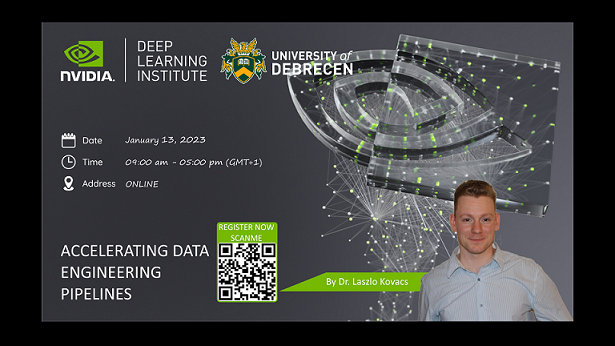
AIDA Short Course: “Nvidia DLI – Accelerating Data Engineering Pipelines”, 13th January 2023


Nvidia DLI and University Debrecen organize an online AIDA short course on “Accelerating Data Engineering Pipelines” offered through the International Artificial Intelligence Doctoral Academy (AIDA). 

The purpose of this course is to overview the foundations and the current state of the art in GPU-accelerated data science in python.

This short course will cover the following topics:

  • Data on the Hardware Level (60 mins),
  • ETL with NVTabular (120), Data Visualization (120 mins),
  • Final Project: Data Detective (60 mins)

The targeted applications will be in GPU-accelerated ETL data process.


LECTURER: 

– Dr. Laszlo Kovacs, Assistant Professor

Nvidia Deep Learning Institute Certified Instructor and Ambassador, email: kovacs.laszlo@inf.unideb.hu


HOST INSTITUTION/ORGANIZER: Nvidia Deep Learning Institute, Faculty of Informatics, University of Debrecen, Hungary


REGISTRATION: Free of charge for university students and staff


WHEN: January 13, 2022 from 09:00 to 17:00 CET


WHERE: Online


HOW TO REGISTER and ENROLL: 

Both AIDA and non-AIDA students are encouraged to participate in this short course.


If you are an AIDA Student* already, please:

Step (a) register in the course by following the Course Link: Nvidia Deep Learning Institute | University of Debrecen (unideb.hu) AND

Step (b) enroll in the same course in the AIDA system using the enrollment button in the AIDA course page Nvidia DLI – Accelerating Data Engineering Pipelines – AIDA – AI Doctoral Academy (i-aida.org), so that this course enter your AIDA Course Attendance Certificate.


If you are not an AIDA Student do only step (a).


*AIDA Students should have been registered in the AIDA system already (they are PhD students or PostDocs that belong only to the AIDA Members listed in this page: https://www.i-aida.org/about/members/)


Dr. Laszlo Kovacs, Assistant Professor

Nvidia Deep Learning Institute Certified Instructor and Ambassador

Email kovacs.laszlo@inf.unideb.hu\

CVPR 2023 Workshop on Event-based Vision – Call for papers and contributions

Full day workshop at CVPR 2023. June 19th, Vancouver, Canada.

Website: https://tub-rip.github.io/eventvision2023/

**************
Important Dates
**************
Paper submission deadline: March 20, 2023.
Submission website: https://cmt3.research.microsoft.com/EVENTVISION2023
Demo abstract submission: March 20, 2023
Notification to authors: April 3, 2023
Camera-ready paper: April 8, 2023 (firm deadline by IEEE)
Workshop day: June 19, 2023. 2nd day of CVPR. Full day workshop.

**************
Objective
**************
This workshop is dedicated to event-based cameras, smart cameras, and algorithms processing data from these sensors. Event-based cameras are bio-inspired sensors with the key advantages of microsecond temporal resolution, low latency, very high dynamic range, and low power consumption. Because of these advantages, event-based cameras open frontiers that are unthinkable with standard frame-based cameras (which have been the main sensing technology for the past 60 years). These revolutionary sensors enable the design of a new class of algorithms to track a baseball in the moonlight, build a flying robot with the agility of a bee, and perform structure from motion in challenging lighting conditions and at remarkable speeds. These sensors became commercially available in 2008 and are slowly being adopted in computer vision and robotics. In recent years they have received attention from large companies, e.g., Sony, Samsung, and Omnivision are now producing event sensors. The workshop also considers novel vision sensors, such as pixel processor arrays (PPAs), that perform massively parallel processing near the image plane. Because early vision computations are carried out on-sensor, the resulting systems have high speed and low-power consumption, enabling new embedded vision applications in areas such as robotics, AR/VR, automotive, gaming, surveillance, etc. This workshop will cover the sensing hardware, as well as the processing and learning methods needed to take advantage of the above-mentioned novel cameras.

**************
Call for Papers:
**************
Research papers and demos are solicited in, but not limited to, the following topics:
 – Event-based / neuromorphic vision.
 – Algorithms: motion estimation, visual odometry, SLAM, 3D reconstruction, image intensity reconstruction, optical flow estimation, recognition, feature/object detection, visual tracking, calibration, sensor fusion (video synthesis, visual-inertial odometry, etc.).
 – Model-based, embedded, or learning-based approaches.
 – Event-based signal processing, representation, control, bandwidth control.
 – Event-based active vision, event-based sensorimotor integration.
 – Event camera datasets and/or simulators.
 – Applications in: robotics (navigation, manipulation, drones…), automotive, IoT, AR/VR, space science, inspection, surveillance, crowd counting, physics, biology.
 – Biologically-inspired vision and smart cameras.
 – Near-focal plane processing, such as pixel processor arrays (PPAs).
 – Novel hardware (cameras, neuromorphic processors, etc.) and/or software platforms, such as fully event-based systems (end-to-end).
 – New trends and challenges in event-based and/or biologically-inspired vision (SNNs, etc.).
 – Event-based vision for computational photography.

**************
Paper/Demo Submission
**************
Research papers and demos are solicited in, but not limited to, the topics listed above. Paper submissions must adhere to the CVPR 2023 paper submission style, format and length restrictions. See the author guidelines and template provided by the CVPR 2023 main conference. See also the policy of Dual/Double Submissions of concurrently-reviewed conferences, such as ICCV. Authors may want to limit the submission to four pages (excluding references) if that is their case.

A double blind peer-review process of the submissions received is carried out via CMT. Accepted papers will be published open access through the Computer Vision Foundation (CVF) (see examples from CVPR Workshop 2019 and 2021). For the accepted papers we encourage authors to write a paragraph about ethical considerations and impact of their work.

**************
Courtesy Presentations
**************
We also invite courtesy presentations of papers relevant to the workshop that are accepted at CVPR main conference or at other peer-reviewed conferences or journals. These presentations provide visibility to your work and help build a community around the topics of the workshop. These contributions will be checked for relevance to the workshop, but will not undergo a complete review, and will not be published in the workshop proceedings. Please contact the organizers to make arrangements to showcase your work at the workshop.

Organizers:
– Guillermo Gallego, TU Berlin, ECDF and SCIoI, Germany.
– Davide Scaramuzza, University of Zurich, Switzerland.
– Kostas Daniilidis, University of Pennsylvania, USA.
– Cornelia Fermüller, University of Maryland, USA.
– Davide Migliore, Prophesee, France.

Workshop on Signal processing and machine learning to foster accessibility in cultural environments (SPACE)

Dear colleagues

We cordially invite you to the workshop:

Signal processing and machine learning to foster accessibility in cultural environments (SPACE)

Organized in Conjunction with the 2023 IEEE International Conference on Acoustics, Speech and Signal Processing (ICASSP 2023),

taking place in the island of Rhodes – Greece, held on one of the following dates: June 4th, 5th, or 10th, 2023

https://sites.google.com/view/space-workshop


The main topics covered are related to

Perception signals: tracking of human motion for signing or HCI, visual object recognition, localization in cultural spaces

Actions: Navigation in cultural spaces

Processing for content presentation such as: retrieval of cultural or educational content, graphics for sign language avatars, VR for the blind, content-based recommendation, content summarization

Processing for interfaces: speech interfaces, sign language interpretation, gaze tracking

Audio/speech processing: techniques for improving the accessibility of audio/speech content for people with hearing impairments, such as speech-to-text or audio captioning

Natural language processing: techniques for improving the accessibility of text content for people with visual impairments, such as text-to-speech or text magnification

Accessibility for virtual and augmented reality: techniques for making virtual and augmented reality experiences more accessible for people with disabilities, such as haptic feedback or audio-based navigation

Machine learning for accessibility: techniques for using machine learning to improve the accessibility of cultural content and spaces, such as personalized recommendations,  automatic summarization, or automatic audio description of visual content

Human-computer interaction: techniques for improving the usability of cultural content and spaces for people with disabilities, such as gesture-based interfaces or touch-based interfaces

Assistive technology: techniques for developing and evaluating assistive technology for people with disabilities, such as wearable devices or mobile apps

Ethical considerations: discussions of the ethical implications of using signal processing and machine learning for accessibility in cultural environments, such as issues of privacy and security

Relevant datasets

These topics are indicative, feel free to contact us if you are working on related topics that might be within the broad area of the workshop but are not listed here.


Review Process

All submissions will be reviewed by the workshop's program committee, which is composed of experts in the relevant fields. The review process is single-blind. The criteria for evaluating submissions will include originality, significance, and relevance to the workshop themes. In addition, reviewers may consider the quality of the writing, the clarity of the presentation, and the potential of the research to make a meaningful contribution to the field.


Submissions will be reviewed and evaluated according to the announced time schedule (see Important Dates below), and authors will be notified of the outcome of the review process via email. We are aiming to release decisions to authors on April 10, 2023. Authors of accepted submissions will be required to revise their papers based on the feedback provided by the reviewers and to submit a final version for inclusion in the conference proceedings. The camera ready submission deadline is April 28, 2023.


Accepted submissions will be invited to present at the workshop as a poster presentation and a short spotlight presentation. Please note that, in order for a paper to be included in the conference proceedings, at least one author of each accepted paper must register for the conference and present it. Details on special workshop registration rates can be found at the main conference website.


Important Dates

Submission: 10 March 2023, 23:59 Pacific Time

Decision: 10 April 2023

Camera-ready: 28 April 2023


Design by 2b Consult