



https://sbgames.org/sbgames2026/
Sep 29th to Oct 2nd, 2026
Goiânia, Goiás, Brazil
The Computing Track of SBGames 2026 is now accepting submissions of original research papers and innovative applications in the field of Games and Digital Entertainment. This track aims to foster research, development, and the sharing of innovative ideas, models, and practices regarding computational applications in the field.
We encourage research, development, and sharing of innovative ideas, models, methods, tools, and practices on Computing for Games and Digital Entertainment. Topics can include, but are not limited to:
- Artificial Intelligence for Games
- Game Development
- Game Design
- Game Graphics
- Algorithmic Game Theory
- Immersive Games
- Serious Games
- Game Technology
- Game Art
- Game Culture
- Game-based Learning
- Gamification
- Game Industry
- Human-Computer Interaction
- Software Engineering for Games
- Others
ATTENTION: if your manuscript only explores shallow aspects of computing, then you should consider submitting it to other SBGames tracks. Therefore, papers addressing game design, specific-style games, soundtracks, and digital art should be submitted to SBGames Arts & Design Track. Papers on any cultural or social aspect of digital games should be submitted to the SBGames Culture Track. Papers on education should be submitted to SBGames Education Track. Papers addressing the game and digital entertainment industry’s management, business, organizational, and operational aspects should be submitted to the SBGames Industry Track. In case of questions about the appropriate track to submit your manuscript, please email the respective Program Committee Chairs.
There are two categories for submissions:
– Full papers must be written only in ENGLISH (title, abstract, and full text), 6 to 10 pages long, including references (manuscripts with more than 10 pages will be liable to desk rejection). We invite solid contributions that present original, unpublished research on any aspect of Computing for Games and Digital Entertainment;
– Short papers must also be written only in ENGLISH, 3 to 5 pages long (manuscripts with more than 5 pages will be liable to desk rejection). We invite technical contributions that present ongoing innovative research (under development), from laboratories to industrial applications, on any aspect of Computing for Games and Digital Entertainment. Particularly, undergraduate and graduate students are encouraged to submit their research projects. Additionally, free and creative ideas are welcome because they represent future disruptive innovations. Finally, authors of short papers must summarize and present their work for up to 5 minutes in English or Portuguese in a technical session.
We run a double anonymous review process. Therefore, authors must prepare their manuscripts WITH no data on their identities, previous published papers or products, or institutional affiliations. The authors’ identities will be tracked only by the submission system and will be visible only to the Program Committee Chairs. The Program Committee Members and external reviewers will not know the authors’ identities. Authors are responsible for doing their best to ensure anonymity. Submissions that do not follow this track's guidelines and potentially reveal the authors’ identities are subject to immediate rejection (even in the review process). You must also be careful when referring to and citing your previous works. For example, avoid mentions of your work as “In our previous work [X]…” and prefer third-person referencing as “In previous work [X]…”. In addition, the reference at the end of the paper can be presented as “[X] Anonymous authors”.
Manuscripts must be submitted electronically through the JEMS 3 (https://jems3.sbc.org.br/events/571). All submissions must follow the Brazilian Computer Society Template for Papers (https://www.sbc.org.br/wp-content/uploads/2024/07/modelosparapublicaodeartigos.zip), and an Overleaf Project of this template is also available at: https://www.overleaf.com/latex/templates/template-artigos-sbgames-sol-sbc/fxzgpzwkvmxy. Any deviation from the formatting rules will be liable to desk rejection because inadequate formats (even with minor variations) compromise the entire publishing process.
IMPORTANT DATES:
– Submission deadline: April 2nd, 2026
– First author notification: June 15th, 2026
– Rebuttal submission: June 22nd, 2026
– Second author notification: July 13rd, 2026
– Camera-ready submission: July 27th, 2026
Please notice that at least one author must register for SBGames and present the paper in Goiânia IN PERSON. Moreover, a publication fee must be included and paid for each accepted paper. Accepted and presented papers will receive an individual DOI and will be published in the SBGames Proceedings (full papers) or Companion/Extended Proceedings (short papers), via SBC-OpenLib (SOL) repository.
Three best full papers and best short papers will receive a certificate of special recognition at the event.
Follow us on social media:
https://www.facebook.com/SBGames
https://www.instagram.com/sbgames_oficial/
https://sbgames.org/sbgames2026/
Sincerely,
André Brandão (UFABC)
Rodrigo Santos (UNIRIO)
Computing Track Chairs SBGames 2026
Brazilian Symposium on Games and Digital Entertainment
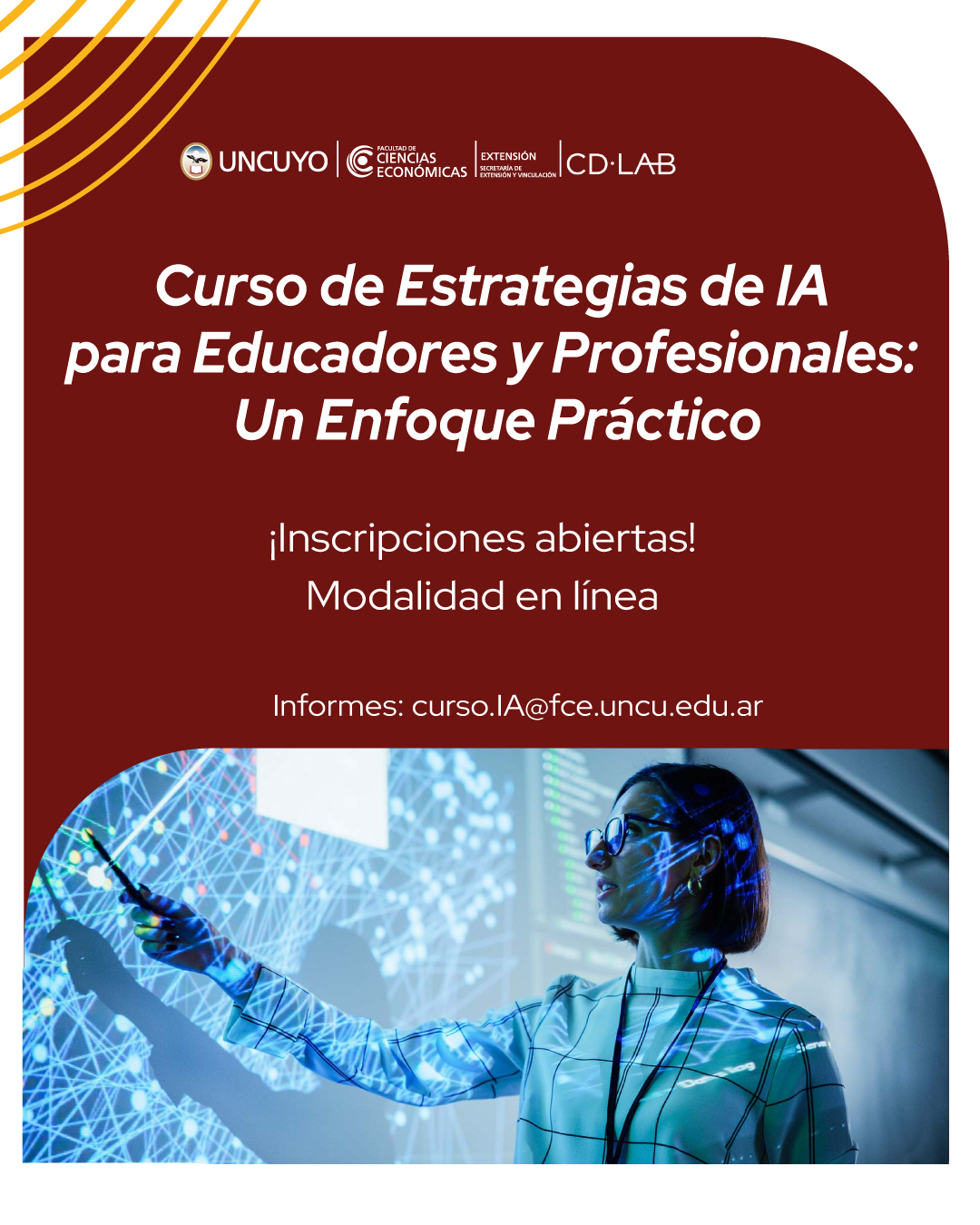
Inscripciones abiertas para el Curso: Estrategias de Inteligencia Artificial para Profesionales y Educadores: Un enfoque Práctico FCE – UNCUYO
 March 12th, 2026
  Daniela Lopez de Luise
 el Curso Estrategias de Inteligencia Artificial para Profesionales y Educadores:
Un enfoque Práctico – 5ta Edición
Ofrece un enfoque práctico, pensado para incorporar la IA como una aliada en el trabajo y en el ámbito educativo, sin necesidad de conocimientos técnicos previos.
Dictado
El curso se desarrolla en línea por videoconferencia con periodicidad semanal. Además el participante accederá a un aula virtual para completar evaluaciones, obligaciones o trabajos requeridos por cada profesor, así como consultar materiales y participar en foros de análisis y debate, entre otras tareas.
Inicia en abril
Para quienes
Esta capacitación está destinada principalmente para docentes universitarios y profesionales de Ciencias Económicas. Sin embargo, es importante destacar que los conocimientos y habilidades que se adquieren pueden ser aplicados para otros niveles educativos y por otras profesiones, ya que lo que se orienta al público específico son los ejemplos de aplicación, pero los mismos principios se pueden aplicar para otros casos de uso. Durante el curso se propone que cada participante oriente su práctica a temas propios de su actividad.
¿Qué te llevarás de esta capacitación?
- Comprender los Fundamentos de la Inteligencia Artificial
- Aplicar la IA en la Educación y las Ciencias Económicas
- Desarrollar Habilidades de Prompting Avanzadas
- Innovar en la Creación de Materiales Educativos y Profesionales
- Desarrollar habilidades críticas de Aplicaciones de IA
- Integración efectiva de la IA en Herramientas de Oficina y Productividad
- Desarrollar una mentalidad abierta y adaptable para incorporar constantemente nuevas tecnologías de IA en la práctica profesional y educativa
- Comprender y aplicar principios éticos en el uso de la IA
Programa Certificado
Al término del cursado, el participante que cumpla con todos los requisitos recibirá un certificado de aprobación del curso: “Estrategias de IA para educadores y Profesionales: Un Enfoque Práctico”, otorgado por la Facultad de Ciencias Económicas de la Universidad Nacional de Cuyo mediante la Res. N°75/24 D. En caso de no cumplir los requisitos de aprobación. *
Duración
2 meses – 8 clases
sincrónicas (16h) – asincrónicas (8h)
Modalidad: 100% EN LÍNEA, por meet. 1 vez por semana.
Días Jueves de 19 a 21 hs.
Todas las clases se graban
- 50% Profesor y Personal de Apoyo de la FCE-UNCUYO
- 20% Egresados y Estudiantes de la FCE-UNCUYO
- 20% Personal No docente UNCUYO
- 20% Matriculado en el CPCE de Mza
- 20% Matriculado en CLAM
- 20% Personal de Fecovita
- 20% Personal de Familia Zuccardi
- 20% Personal de Andes Growers
- 20% Miembro Asociación de Ejecutivos de Mendoza
- 20% Afiliado a La Bancaria
- 20% Matriculado Cokimen
- 20% Empresas asociadas a Pilt Villa María
- 20% Personal Banco Nación Argentina
- 20% Asociados en SIPES
- 20% Personal Cámara de Senadores de Mendoza
- 20% Empresas Asociadas a Fundación PROMENDOZA
- 20% Personal Ministerio de Seguridad Nacional
- 10% Docentes, Egresados y Estudiantes de la UNCUYO
Grupos de Afinidad
-
5% 2 participantes de la misma institución
-
10% 3 – 5 participantes
-
15% 6 – 10 participantes
-
20% 10 o más participantes
Los descuentos y tarifas corporativas NO SON ACUMULABLES.
Formas de Pago
- Transferencia o depósito bancario total o mensual
- Tarjetas de Crédito o Débito
👉 Conocé el contenido del curso y cómo participar: https://forms.gle/atyNphVSyzMsHfBp8
Quedamos a disposición por cualquier consulta.

Q1 | SCOPUS Indexed Journal – Accepting Submissions
March 12th, 2026 Daniela Lopez de Luise
|



Q1 | SCOPUS Indexed Journal – Accepting Submissions
March 12th, 2026 Daniela Lopez de Luise
|

D. Lopez De Luise, Warm Follow-Up: Invitation to Speak at GCKE 2026 in Helsinki
March 12th, 2026 Daniela Lopez de Luise The 11th Annual Global Congress of Knowledge Economy (GCKE 2026)
July 22-24, 2026 Helsinki, Finland
Dear Dr. D. Lopez De Luise,
We hope this message finds you thriving. This is Bonnie from the GCKE 2026 Organizing Committee, following up on our earlier invitation – we wanted to ensure it reached you, as your participation would be truly valued.
It is with great enthusiasm that we formally invite you to join the 11th Annual Global Congress of Knowledge Economy (GCKE 2026), taking place July 22-24, 2026, in the vibrant, innovation-driven city of Helsinki, Finland.
Your exceptional contributions in your leading field have made a profound impact, and we would be honored to feature you as an Oral Speaker. We kindly request a 20-25 minute presentation sharing your latest research-a perspective that would undoubtedly inspire our audience.
GCKE 2026 will gather a distinguished community of global researchers, industry leaders, and innovators, uniting to explore critical themes such as:
Green Economy & Sustainable Practices
Fintech, Knowledge Finance, and Digital Commerce
AI, Automation, and Converging Technologies (Blockchain, 5G/6G, Big Data)
Smart Cities, Telemedicine, and Future Networks
Education, Energy, Climate Action, and Beyond
Helsinki, a city where historic charm meets cutting-edge progress, offers the perfect backdrop for meaningful knowledge exchange and cross-border collaboration. We are confident your insights will ignite lively discussions and foster new connections.
To confirm your participation, please reply at your earliest convenience with:
A tentative speech title
A brief abstract (if available)
We deeply hope you can join us in Helsinki
this year. Your presence would make GCKE 2026 an even more remarkable event.
Thank you for considering our invitation, and we look forward to your positive response.
Warm regards,
Ms. Bonnie Tan
Coordinator, 11th Annual Global Congress of Knowledge Economy (GCKE 2026)