



============== ICAS 2023 | Call for Papers ===============
CALL FOR PAPERS, TUTORIALS, PANELS
ICAS 2023, The Nineteenth International Conference on Autonomic and Autonomous Systems
General page: https://www.iaria.org/conferences2023/ICAS23.html
Submission page: https://www.iaria.org/conferences2023/SubmitICAS23.html
Event schedule: March 22 – 26, 2023
Contributions:
– regular papers [in the proceedings, digital library]
– short papers (work in progress) [in the proceedings, digital library]
– ideas: two pages [in the proceedings, digital library]
– extended abstracts: two pages [in the proceedings, digital library]
– posters: two pages [in the proceedings, digital library]
– posters: slide only [slide-deck posted at www.iaria.org]
– presentations: slide only [slide-deck posted at www.iaria.org]
– demos: two pages [posted at www.iaria.org]
Submission deadline: December 1, 2022.
Extended versions of selected papers will be published in IARIA Journals: https://www.iariajournals.org
Print proceedings will be available via Curran Associates, Inc.: https://www.proceedings.com/9769.html
Articles will be archived in the free access ThinkMind Digital Library: https://www.thinkmind.org
The topics suggested by the conference can be discussed in term of concepts, state of the art, research, standards, implementations, running experiments, applications, and industrial case studies. Authors are invited to submit complete unpublished papers, which are not under review in any other conference or journal in the following, but not limited to, topic areas.
All tracks are open to both research and industry contributions.
Before submission, please check and comply with the editorial rules: https://www.iaria.org/editorialrules.html
ICAS 2023 Topics (for topics and submission details: see CfP on the site)
Call for Papers: https://www.iaria.org/conferences2023/CfPICAS23.html
============================================================
ICAS 2023 Tracks (topics and submission details: see CfP on the site)
SELFTRENDS: Toward brain-like autonomic and autonomous systems
ROBOTRENDS: Robot-related trends
SOCIAL ROBOTS: Social robots and cognition
MACHINE LEARNING: Advanced topics in Deep/Machine learning
SYSAT: Advances in system automation
UNMANNED: Driver-less cars and unmanned vehicles
AUTSY: Theory and Practice of Autonomous Systems
AWARE: Design and Deployment of Context-awareness Networks, Services and Applications
AUTONOMIC: Autonomic Computing: Design and Management of Self-behavioral Networks and Services
CLOUD: Cloud computing and Virtualization
MCMAC: Monitoring, Control, and Management of Autonomous Self-aware and Context-aware Systems
CASES: Automation in specialized mobile environments
ALCOC: Algorithms and theory for control and computation
MODEL: Modeling, virtualization, any-on-demand, MDA, SOA
SELF: Self-adaptability and self-management of context-aware systems
KUI: Knowledge-based user interface
AMMO: Adaptive management and mobility
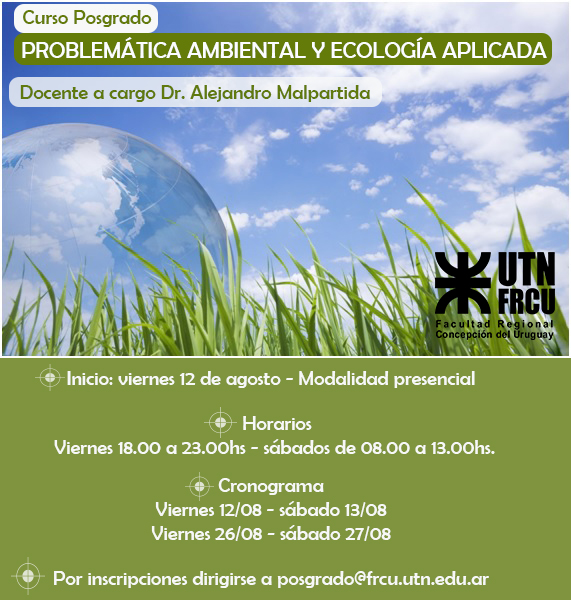
INSCRIPCIONES Curso de Posgrado: Problemática Ambiental y Ecología Aplicada
 August 3rd, 2022
  Daniela Lopez de Luise
 Docente a cargo: Dr. Alejandro Malpartida
· Licenciado en Ecología y Conservación de recursos naturales renovables facultad de ciencias naturales y museo (unlp-fcnym), Universidad Nacional de la Plata.
· Doctor en Ciencias Naturales con orientación en ecología Facultad de Ciencias Naturales y Museo (unlp-fcnym), Universidad Nacional de la plata.
· Especialista en Ingeniería Ambiental Universidad Tecnológica Nacional, Regional la Plata.
· Docente Universitario autorizado Facultad de Humanidades y Ciencias de la Educación y Facultad de Ciencias Naturales y Museo (unlp-fcnym), Universidad Nacional de la Plata.
Se ha desempeñado tanto en el ámbito público como privado, participando en diversas consultorías referidas a estudios de evaluación planeamiento ambiental estratégico y estudios de impacto ambiental de medianas y grandes obras desde el año 1995, tanto en la Argentina como en el extranjero. Ha sido responsable de proyectos específicos del BID y coordinador técnico en proyectos GEF referidos a prevención de la contaminación dependiente del BIRF y la SAyDS. Participó y formuló planes y programas referidos a cuencas así como evaluaciones de estado actual de las mismas, siendo Asesor Científico del Defensor del Pueblo de la Nación. Se ha desempeñado como responsable de la Gerencia de la Calidad, Ambiente y Seguridad en el ámbito de la energía en general y de la energía eléctrica en particular.
Carga horaria: 20 horas
Objetivos
Introducir en la especialidad de la ingeniería ambiental desarrollando una visión global de la problemática.
Promover y estimular el debate sobre el significado del desarrollo sustentable y los diferentes enfoques sobre el cuidado del medio ambiente.
Inicio: viernes 12/08
Cronograma:
Viernes 12/08 – sábado 13/08
Viernes 26/08 – sábado 27/08
Modalidad: Presencial
Horarios
Viernes 18.00 a 23.00hs – sábados de 08.00 a 13.00hs.
Costos:
*Consultar valores docentes y no docentes UTN FRCU
IMPORTANTE: Este seminario otorga créditos a la carrera Especialización en Ingeniería Ambiental
Por inscripciones dirigirse a posgrado@frcu.utn.edu.ar
Call for Paper 📄 IJCACI 2022 📚 Proceedings in Springer book series AIS
August 3rd, 2022 Daniela Lopez de Luise Greetings from SAU Center for Research and Innovative Learning (SCRIL), South Asian University, India and Jahangirnagar University, Bangladesh.
We are pleased to inform you that SAU Center for Research and Innovative Learning (SCRIL), South Asian University, India and Jahangirnagar University, Bangladesh are organizing the 6th International Joint Conference on Advances in Computational Intelligence (IJCACI 2022). The details of the IJCACI 2022 are as follows:
Title of the conference:
6th International Joint Conference on Advances in Computational Intelligence (IJCACI 2022)Notification of acceptance: September 25, 2022
Registration and final paper submission of accepted Paper: October 05, 2022
(General Chairs, IJCACI 2022)
1st CfP: ICAS 2023 || March 13 – 17, 2023 – Barcelona, Spain
August 3rd, 2022 Daniela Lopez de Luise – ICAS 2023, The Nineteenth International Conference on Autonomic and Autonomous Systems
ICAS 2023 is scheduled to be March 13 – 17, 2023 in Barcelona, Spain under the InfoSys 2023 umbrella.
The submission deadline is December 1, 2022.
Authors of selected papers will be invited to submit extended article versions to one of the IARIA Journals: https://www.iariajournals.org
All events will be held in a hybrid mode: on site, online, prerecorded videos, voiced presentation slides, pdf slides.
=================
============== ICAS 2023 | Call for Papers ===============
CALL FOR PAPERS, TUTORIALS, PANELS
ICAS 2023, The Nineteenth International Conference on Autonomic and Autonomous Systems
General page: https://www.iaria.org/conferences2023/ICAS23.html
Submission page: https://www.iaria.org/conferences2023/SubmitICAS23.html
Event schedule: March 22 – 26, 2023
Contributions:
– regular papers [in the proceedings, digital library]
– short papers (work in progress) [in the proceedings, digital library]
– ideas: two pages [in the proceedings, digital library]
– extended abstracts: two pages [in the proceedings, digital library]
– posters: two pages [in the proceedings, digital library]
– posters: slide only [slide-deck posted at www.iaria.org]
– presentations: slide only [slide-deck posted at www.iaria.org]
– demos: two pages [posted at www.iaria.org]
Submission deadline: December 1, 2022.
Extended versions of selected papers will be published in IARIA Journals: https://www.iariajournals.org
Print proceedings will be available via Curran Associates, Inc.: https://www.proceedings.com/9769.html
Articles will be archived in the free access ThinkMind Digital Library: https://www.thinkmind.org
The topics suggested by the conference can be discussed in term of concepts, state of the art, research, standards, implementations, running experiments, applications, and industrial case studies. Authors are invited to submit complete unpublished papers, which are not under review in any other conference or journal in the following, but not limited to, topic areas.
All tracks are open to both research and industry contributions.
Before submission, please check and comply with the editorial rules: https://www.iaria.org/editorialrules.html
ICAS 2023 Topics (for topics and submission details: see CfP on the site)
Call for Papers: https://www.iaria.org/conferences2023/CfPICAS23.html
============================================================
ICAS 2023 Tracks (topics and submission details: see CfP on the site)
SELFTRENDS: Toward brain-like autonomic and autonomous systems
ROBOTRENDS: Robot-related trends
SOCIAL ROBOTS: Social robots and cognition
MACHINE LEARNING: Advanced topics in Deep/Machine learning
SYSAT: Advances in system automation
UNMANNED: Driver-less cars and unmanned vehicles
AUTSY: Theory and Practice of Autonomous Systems
AWARE: Design and Deployment of Context-awareness Networks, Services and Applications
AUTONOMIC: Autonomic Computing: Design and Management of Self-behavioral Networks and Services
CLOUD: Cloud computing and Virtualization
MCMAC: Monitoring, Control, and Management of Autonomous Self-aware and Context-aware Systems
CASES: Automation in specialized mobile environments
ALCOC: Algorithms and theory for control and computation
MODEL: Modeling, virtualization, any-on-demand, MDA, SOA
SELF: Self-adaptability and self-management of context-aware systems
KUI: Knowledge-based user interface
AMMO: Adaptive management and mobility
3rd International Conference [ICSES 2022 – Proceedings by Springer LNNS] Invitation: 09-10 September 2022, Nepal.
August 2nd, 2022 Daniela Lopez de Luise
|
|

|
Dear Researcher As a part of Sustainable Expert Systems Series publication, 3rd ICSES 2022 Proceedings by
LINK: https://www.springer.com/series/15179
|