CDCEO 2022 @ IJCAI-ECAI – Call for Papers

CALL FOR PARTICIPANTS & PAPERS
 
2nd workshop on Complex Data Challenges in Earth Observation (CDCEO)
in conjunction with IJCAI-ECAI 2022, July 23-29, 2022
Vienna, Austria

Website: http://www.iarai.ac.at/cdceo22

About CDCEO
The Big Data accumulating from remote sensing technology in-ground, aerial, and satellite-based Earth Observation (EO) has radically changed how we monitor the state of our planet. The ever-growing availability of high-resolution remote sensing data increasingly confronts researchers with the unique machine learning challenges posed by characteristic heterogeneity and correlation structures in these data.

In this workshop, we will bring together leading researchers from both academia and industry across diverse domains of AI, including experts from AI, big data, remote sensing, computer vision, spatio-temporal data processing, geographic information systems, and weather and climate modeling, as well as other scientists or engineers with a general interest in the application of modern data analysis methods within the EO domain.

This workshop is organized as a physical meeting and is part of IJCAI-ECAI 2022, the 31st International Joint Conference on Artificial Intelligence, and the 25th European Conference on Artificial Intelligence.

Workshop Topics
The workshop invites advanced applications and method development in image and signal processing, data fusion, feature extraction, meta-learning, and many more. The topics covered by the workshop theme include but are not limited to:
– Trustworthy AI for Earth observation
– Physics-informed machine learning for Earth observation
– Human-in-the-loop Earth observation data analysis
– Edge AI for Earth observation
– Vision and language for Earth observation
– Fairness and accountability in Earth observation data analysis
– Spatio-temporal data processing and analysis
– Multi-resolution, multi-temporal, multi-sensor, and multi-modal Earth observation data fusion
– Machine learning for weather and climate research
– Deep learning and its applications to, e.g., semantic segmentation, scene classification, and feature extraction
– Meta learning, including transfer learning, few-shot learning, and active learning
– Integration and aggregation of complementary remote sensing measurements
– Benchmark datasets with applications to Earth Observation

Important Dates
Submission starts: April 1st, 2022
Workshop paper submission deadline: May 31st, 2022
Notification of paper acceptance: June 15th, 2022
Camera-ready paper submission deadline: June 30th, 2022
Workshop date: July 23-25th, 2022 (exact date TBD)

Submission Information
Authors are invited to submit original papers presenting research, position papers, or papers presenting research in progress that have not been previously published, and are not being considered for publication elsewhere. A blind reviewing process performed by members of the Program Committee will be applied to select papers based on their novelty, technical quality, potential impact, clarity, and reproducibility.

Workshop papers will be included in a Workshop Proceedings published by http://ceur-ws.org/. Papers must be formatted in CEUR style guidelines. The page limit is 4 – 6 pages plus references.  

At least one of the authors of the accepted papers must register for the workshop for the paper to be included in the workshop proceedings. A link to the submission site will be provided later.

Landslide4Sense Competition
A special session of the workshop will present the winning solutions and highlights from a unique Landslide4Sense competition.

Realistic data for training and testing machine learning models has become vitally important for many branches of cutting-edge research in EO. The aim of Landslide4Sense is to promote innovative algorithms for automatic landslide detection using globally distributed remotely sensed images, as well as to provide objective and fair comparisons among different methods. discloses a unique large-scale multi-modal globally distributed benchmark dataset consisting of satellite images with more than 5000 patches on landslide detection.

The first three participants with the highest F1 scores will be introduced as winners. In addition, allowing competition participants to provide innovative ideas more freely without being limited to a clear numerical metric, two more selected submissions will be awarded the special prizes. The ranking of these two submissions is based on the evaluation of the methodological descriptions of the introduced method by the Landslide4Sense competition committee as well as international expert reviewers.

Please check our workshop website for the link to the competition website where you can find more information on the dataset and the competition deadlines.

Workshop Venue
The workshop is a part of the IJCAI-ECAI 2022 conference. The conference venue is Messe Wien Exhibition and Congress Center, which is one of the most modern exhibitions and conference centers.
Messe Wien
Hall B, entrance Congress Center
Messeplatz 1
A-1020 Vienna
Metro stop U2 “Messe Prater”

Please find more information about the conference venue here: https://ijcai-22.org/venue/

Organizing Committee
– Pedram Ghamisi, Helmholtz-Zentrum Dresden-Rossendorf, Germany and Institute of Advanced Research in Artificial Intelligence, Austria
– Aleksandra Gruca, Silesian University of Technology, Poland
– Naoto Yokoya, University of Tokyo, Japan; RIKEN Center for Advanced Intelligence Project, Japan
– Jun Zhou, Griffith University, Australia
– Caleb Robinson, Microsoft AI for Good Research Lab, Redmond, USA
– Fabio Pacifici, Maxar Technologies
– Pierre-Philippe Mathieu, European Space Agency Φ-lab, Italy
– Sepp Hochreiter, Institute of Advanced Research in Artificial Intelligence, Austria

ICPR 2022 Workshop: 3rd International Workshop on Pattern Recognition for Cultural Heritage (PatReCH 2022)

;text-indent:0px;text-transform:none;white-space:normal;word-spacing:0px;text-decoration-style:initial;text-decoration-color:initial”>

===================================================
Call For Papers (apologies for multiple copies)
===================================================


II International Workshop on Pattern Recognition for Cultural Heritage (PatReCH 2020)

The enormous amount of artefacts and information that come from the past is increasingly and rapidly being digitized. However, the useful information contained in these data is not easy to exploit and some kind of analysis is needed. On the other hand, the digital representations of real objects require some kind of manipulation.

Recent machine learning and pattern recognition algorithms give the opportunity to analyze and manipulate the acquired data in order to better exploit the contained information and generate the best digital representation.

The aim of this workshop is to present recent advances in Pattern Recognition (PR) techniques for data analysis and representation in the cultural heritage field. Bringing together the work of many experts in this multidisciplinary subject to highlight these advances from a wide-angle perspective, as well as to stimulate new theoretical and applied research for better characterizing the state of the art in this subject.

The workshop will be held on 21 August 2022 (to be confirmed), in conjunction with the 26th International Conference on Pattern Recognition (ICPR2022), that will be held from 21 to 25 August 2022 in Montréal, Québec.


Topics include, but are not limited to the following:


·        Ancient document analysis

·        Digital artifact capture, representation and manipulation

·        Automatic annotation of tangible and intangible heritage

·        Interactive software tools for cultural heritage applications

·        Multimedia music classification and reconstruction

·        Augmented and Virtual Reality applications

·        Image processing, classification and retrieval

·        Machine Learning for Cultural Heritage

·        Semantic segmentation

·        Serious Game for Cultural Heritage

·        Robotic applications

·        Ontology Learning for cultural heritage domain


Important Dates


Submission deadline:

May 15th, 2022

Author notification:

June 15th, 2022

Camera-ready Submission:

July 1st, 2022

Finalized workshop program:

August 1st, 2022

Workshop day:

August 21st, 2022 (to be confirmed)


Proceedings and Special Issue


Accepted papers will be included in the ICPR 2022 Workshop Proceedings, which will be published according to the publication rules of ICPR2022 conference.


Authors of selected high-quality papers will be invited to submit substantially extended versions for a Special Issue on an international journal with whom we are negotiating


Contact Information


Dario Allegra, Università degli Studi di Catania, allegra@unict.it

Mario Molinara, Università di Cassino e del Lazio meridionale, m.molinara@unicas.it

Alessandra Scotto di Freca, Università di Cassino e del Lazio meridionale, a.scotto@unicas.it

Filippo Stanco, Università degli Studi di Catania, filippo.stanco@unict.it


Workshop website: http://aida.unicas.it/patrech2022


Dario Allegra, PhD
Postdoctoral researcher
Adjunct professor
University of Catania

IPLab@CTiplab.dmi.unict.it
Dipartimento di Matematica e Informatica
University of Catania
Viale A. Doria, 6 – 95125, Catania, Italy

email: allegra@unict.it
tel: +39 095 738 3202

https://www.researchgate.net/profile/Dario_Allegra
https://scholar.google.it/citations?user=ua6QhmQAAAAJ&hl=it

Final Call for Papers: RO-MAN 2022 Special Session on “Nonverbal Communication Skills in Humans and Robots”


We would like to cordially invite you to submit a paper to our special session on “Nonverbal Communication Skills in Humans and Robots” for the 31st IEEE International Conference on Robot and Human Interactive Communication (RO-MAN 2022). Please find the description below: 


============================================================== 

CALL FOR PAPERS

Special Session on Nonverbal Communication Skills in Humans and Robots 


within the 31st IEEE International Conference on Robot and Human Interactive Communication (RO-MAN 2022) 

Napoli, Italy, August 28- September 2, 2022 

http://ro-man2022.org/ 


Submission code: ujcjj 

Special session website: https://nonverbal-communication-skills.github.io/ 

============================================================== 


*AIM AND SCOPE* 


We are approaching a future where social robots will progressively become widespread in many aspects of our daily lives, including education, healthcare, work, and personal use. All such practical applications require that humans and robots collaborate in human environments, where social interaction is unavoidable. Along with verbal communication, successful social interaction is closely coupled with nonverbal communication. Humans perform nonverbal communication in an instinctive and adaptive way, with no effort. For robots to be successful in our social landscape, they should therefore engage in social interactions in a human-like manner, with increasing levels of autonomy. Understanding human-human interaction is therefore the most natural guide to designing human-robot interaction interfaces that can be usable and understandable by everyone. The key aim of this special session is to bring forth efforts to understand mechanisms underlying human-human nonverbal communication and introduce novel approaches to the design, development, and evaluation of robotic platforms inspired and driven by those mechanisms. This special session will bring together researchers with diverse backgrounds, ranging from social psychology, cognitive science, machine learning, computer vision, and human-robot interaction, to share innovative ideas, findings, and challenges related to nonverbal communication skills in humans and robots. The special session will foster multidisciplinary discussions among academic and industrial researchers towards improving robots’ nonverbal communication skills and enhancing human trust and acceptance of robots. 


*TOPICS* 


Topics of interest include, but are not limited to, the following: 

– Analysis and synthesis of multimodal nonverbal cues, including facial expressions, paralinguistics, eye gaze, head movements, body postures, and hand gestures within an interaction context. 

– Analysis and synthesis of affective states, such as emotions, empathy, personality, and engagement. 

– Co-modelling of nonverbal and verbal cues. 

– Co-speech gesture generation. 

– Machine learning approaches to nonverbal communication analysis and synthesis. 

– Societal and ethical considerations of cognitive and social robots, including transparency, bias, fairness, and privacy. 

– Applications of cognitive and social robots in healthcare, education, workplace, or entertainment. 

– Databases and tools for nonverbal communication analysis and synthesis. 


*SUBMISSION PROCEDURE* 


Manuscripts submitted to this special session should be done through the paper submission website of the main conference: http://ras.papercept.net/conferences/scripts/start.pl


All papers submitted to special sessions will be subject to the same peer-review procedure as the regular papers. The accepted papers will be included in the conference proceeding published in the IEEE Xplore. Please refer to the main conference website to have additional details. 


Authors should adhere the following steps for submitting a paper to this special session: 


1. Create an account: go to https://ras.papercept.net/, to create a PIN and fill out the form. Ask all your co-authors to do the same if they do not have an account on the system yet, write down the authors' PINs (this information is needed for manuscript processing purposes). 

2. Go to Support Menu (http://ras.papercept.net/conferences/support/support.php) and depending on how you are preparing your paper, download a template: LaTeX or MS-Word, use these templates/style files to create the paper and save in PDF format. 

3. Upload the paper: go to https://ras.papercept.net/ and click on “submit a contribution to Ro-Man 2022”. 

4. Submit special session paper. 

5. Make sure to insert the code of this special session: ujcjj 

6. Fill in the form presented on the next page (make sure to enter all author PINs created in Step 1). 


*SPECIAL SESSION ORGANISERS:* 


Oya Celiktutan, King’s College London, United Kingdom   

Nguyen Tan Viet Tuyen, King’s College London, United Kingdom   

Marine Chamoux, SoftBank Robotics Europe, France 

Alexandra Georgescu, King’s College London, United Kingdom   

Mutlu Cukurova, University College London, United Kingdom   

Pierre Lison, Norwegian Computing Center, Norway   

Ho Seok Ahn, University of Auckland, New Zealand   


==============================================================


On behalf of the Organisers,

Nguyen Tan Viet Tuyen

RLive e-Lecture by Prof. Jens Kober: “Robots Learning (Through) Interactions”, 5th April 2022 17:00-18:00 CET. Upcoming AIDA AI excellence lectures

Prof. Jens Kober (TU Delft, Netherlands), a prominent AI & Robotics researcher internationally, will deliver the e-lecture:

‘Robots Learning (Through) Interactions’, on Tuesday 5th April 2022 17:00-18:00 CET (8:00-9:00 am PST), (12:00 am-1:00am CST),

see details in: http://www.i-aida.org/ai-lectures/

You can join for free using the zoom link: https://authgr.zoom.us/s/92075053612 & Passcode: 148148


The International AI Doctoral Academy (AIDA), a joint initiative of the European R&D projects AI4Media, ELISE, Humane AI Net, TAILOR, VISION, currently in the process of formation,

is very pleased to offer you top quality scientific lectures on several current hot AI topics.


Lectures will be offered alternatingly by:

Top highly-cited senior AI scientists internationally or

Young AI scientists with promise of excellence (AI sprint lectures)


Lectures are typically held once per week, Tuesdays 17:00-18:00 CET (8:00-9:00 am PST), (12:00 am-1:00am CST).  Attendance is free.


Other upcoming lectures:

1. Prof. Jan Peters (Technische Universitaet Darmstadt, Germany), “Robot Learning”, 10th May 2022 17:00 – 18:00 CET.

2. Prof. Luc De Raedt (KU Leuven, Belgium), “Probabilistic Logics to Neuro-Symbolic Artificial Intelligence”, 7th June 2022 17:00 – 18:00 CET.

More lecture infos in: http://www.i-aida.org/ai-lectures/


These lectures are disseminated through multiple channels and email lists (we apologize if you received it through various channels).

If you want to stay informed on future lectures, you can register in the email lists AIDA email list and CVML email list.


Best regards

Profs. M. Chetouani, P. Flach, B. O’Sullivan, I. Pitas, N. Sebe, J. Stefanowski

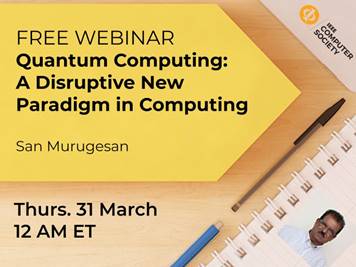
IEEE Computer Society Webinar – Quantum Computing; San Murugesan, 31st march 2022


Free IEEE Computer Society Distinguished Lecturer Webinars
QUANTUM COMPUTING: A DISRUPTIVE NEW PARADIGM IN COMPUTING

SAN MURUGESAN

31 March 2022, Thursday

India: 9.30AM; Malaysia: 12 PM; Singapore: 12 PM

Tokyo: 1 PM; Sydney: 3 PM; USA: 12 AM EDT


Register at: https://bit.ly/3tJwQZJ

Choose this and other webinar(s) of your interest


Design by 2b Consult