



The participation at DAGM German Conference on Pattern Recognition (DAGM GCPR) 2021 will be free of charge. It will be held from
September 28 – October 1, 2021
as a virtual conference. The program features:
Keynote Speakers:
-
David Forsyth (University of Illinois at Urbana-Champaign)
-
Kristen Grauman (University of Texas at Austin, Facebook AI Research)
-
Thorsten Joachims (Cornell University)
-
Jiri Matas (Czech Technical University, Prague)
Discuss with our speakers Unsolved Problems in Pattern Recognition:
-
Thomas Brox (University of Freiburg)
-
Joachim M. Buhmann (ETH Zurich)
-
David Forsyth (University of Illinois at Urbana-Champaign)
-
Kristian Kersting (TU Darmstadt)
-
Anna Khoreva (Bosch Center for Artificial Intelligence)
-
Laura Leal-Taixé (TU Munich)
-
Jiri Matas (Czech Technical University, Prague)
- Eckart Michaelsen (Fraunhofer IOSB)
Tutorial:
-
Tutorial on Geometric Deep Learning by Emanuele Rodolà (Sapienza University of Rome)
Workshop:
-
Scene Understanding in Unstructured Environments
Organizers:
-
Juergen Gall (University of Bonn)
-
Christian Bauckhage (University of Bonn)
-
Alexander Schwing (University of Illinois at Urbana-Champaign)
-
Michael Möller (University of Siegen)
-
Wolfgang Förstner (University of Bonn)
AIJ Special Issue on Risk-Aware Autonomous Systems: Theory and Practice
 September 22nd, 2021
 Daniela Lopez de Luise
Artificial Intelligence’s Special Issue on “Risk-Aware Autonomous Systems: Theory and Practice” is now open for submissions. The special issue is co-edited by Prof. Sara Bernardini (Royal Holloway University of London), Prof. Luca Carlone (MIT), Dr Ashkan Jasour (MIT), Prof. Andreas Krause (ETH Zurich), Prof. George Pappas (University of Pennsylvania), Prof. Brian Williams (MIT) and Prof. Yisong Yue (Caltech). Submissions will close on October 15th, 2021 and the publication of the special issue is expected for August 15th, 2022. Artificial Intelligence is a world-leading journal in AI with an Impact Factor of 6,628 and CiteScore of 7.7.
Aims and Scope
This special issue focuses on the theory and practice of risk-aware autonomous systems that reason about uncertainty and risk online to achieve safety, and that combine machine learning and decision making to accomplish real world tasks.
The topic of risk-aware autonomous systems has seen a dramatic increase in importance over the last few years, as autonomous systems are being deployed almost daily within safety-critical applications, including self-driving vehicles, autonomous undersea and aerospace systems, service robotics, and collaborative manufacturing. This broad adoption is a testament to the fast-paced progress of the research community across multiple areas, including planning, learning, perception, decision making, and control. At the same time, today’s widely used AI algorithms for autonomy are beginning to showcase fundamental limits and practical shortcomings. In particular, excessive risk taken by these algorithms can lead to catastrophic failure of the overall system and may put human life in danger. Many AI methods used today do not attempt to quantify uncertainty; they do not assess the risks that uncertainty imposes on system safety and success; they do not guarantee bounds on this risk and they do not perform these assessments in real-time.
To push the envelope of autonomous systems’ safety, this special issue will present ground-breaking research on the theory and practice of designing the next generation of risk-aware AI algorithms and autonomous systems. Key to our envisioned methods is their ability to account for uncertainty and risk of failure during their online execution, their capabilities for proactively quantifying and mitigating risks against task goals and safety constraints, and their ability to offer formal guarantees, such as bounds on the risk of failure. Emerging risk-bounded methods often operate on models of uncertainty, specifications of intended outcomes, and specifications of acceptable risks regarding these outcomes. These models and specifications are diverse. Uncertainty models may be probabilistic, set bounded, or interval based. Intended outcomes include goals achieved, deadlines met, safety constraints respected, required accuracy in model estimation and perception, and rate of false positives. Specifications of acceptable risk include risk bounds and acceptable costs of failure. These intended outcomes and acceptable risks can apply to individual AI components, such as policy and action learners, image classifiers and planners, and the aggregate systems as a whole.
This special issue is intended to represent this diversity. It aims to cover a broad set of topics related to risk-aware autonomous systems, including but not limited to:
● risk-aware task and motion planning;
● robust and adversarial learning;
● certifiable and risk-aware perception, localization and mapping;
● robust task monitoring and execution under uncertainty;
● formal methods for monitoring and verifying uncertain systems;
● constraint and mathematical programming with chance constraints;
● robust control of intelligent systems;
● system-level monitoring and risk quantification.
Submission Instructions
We welcome high quality original (unpublished) articles. Each submission will be peer-reviewed.
All submissions should be formatted following the AI journal instructions for authors (https://www.elsevier.com/journals/artificial-intelligence/0004-3702/guide-for-authors) and submitted to: https://www.editorialmanager.com/artint/default.aspx
To ensure that all manuscripts are correctly identified for inclusion into the special issue, please select “VSI:Risk-Aware Autonomy” when you reach the “Article Type” step in the submission process.
Authors can share their research in a variety of different ways and Elsevier has a number of green open access options available: https://www.elsevier.com/open-access
Important Dates
● Submissions open: 15 May 2021
● Submissions close: 15 October 2021
● Publication of the special issue: 15 August 2022
Guest Editors
● Prof. Sara Bernardini (Royal Holloway University of London, sara.bernardini@rhul.ac.uk)
● Prof. Luca Carlone (Massachusetts Institute of Technology, lcarlone@mit.edu)
● Dr. Ashkan Jasour (Massachusetts Institute of Technology, jasour@mit.edu)
● Prof. Andreas Krause (ETH Zurich, krausea@ethz.ch)
● Prof. George Pappas (University of Pennsylvania, pappasg@seas.upenn.edu)
● Prof Brian Williams (Massachusetts Institute of Technology, williams@mit.edu)
● Prof. Yisong Yue (California Institute of Technology, yyue@caltech.edu)
For more information, please contact the editors and visit: https://www.journals.elsevier.com/artificial-intelligence/call-for-papers/risk-aware-autonomous-systems-theory-and-practice
IEEE Computational Intelligence Society – Argentina
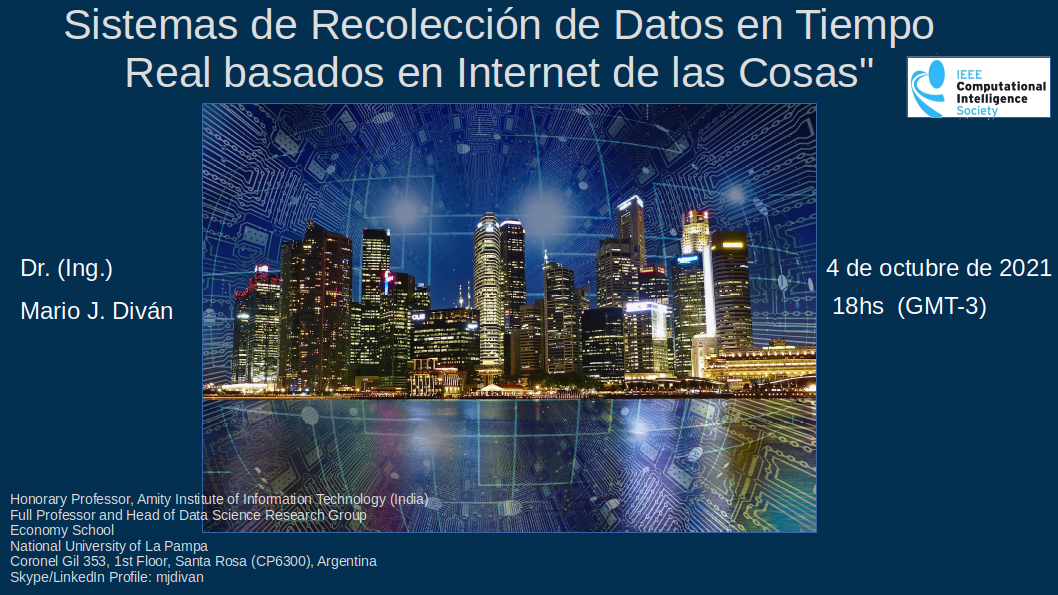
September 21st, 2021 Daniela Lopez de Luise FECHA: 4 de octubre de 2021, 18hs (GMT-3)
Dr. (Ing.) Mario José Diván
Profesor honorario de Amity Institute of Information Technology (India)
Profesor y director del Data Science Research Group – Dep. Economía (Universidad Nacional de La Pampa)
Registrese gratis en Formulario
Register for Free – IEEE Cybersecurity Live Stream
September 21st, 2021 Daniela Lopez de Luise 
23 September, 11:30 am EDT
Speaker: Scott Schober
- How to spot a ‘phishing’ attack
- Importance of proper regular data backups
- Security is achieved in layers…enable two-factor authentication
- Only use trusted/secure networks- do not use public Wi-Fi networks
- Install a secure VPN
- Question & Answer period to follow the presentation
- October – Demystifying the Dark Web
- November – Wireless Threats
Scott Schober is the author of three best-selling security books: Senior Cyber, Hacked Again, and Cybersecurity is Everybody’s Business. He has dedicated himself to educating as many people as possible by telling his own stories of being hacked with the hope that others can learn from his mistakes. In addition to his writing prowess, Scott is a highly sought-after author and expert for live security events, media appearances, and commentary on the topics of ransomware, wireless threats, drone surveillance and hacking, cybersecurity for consumers, and small business. He is often seen on ABC News, Bloomberg TV, Al Jazeera America, CBS This Morning News, CNN, Fox Business, and many more networks.
ABIERTA LA INSCRIPCIÓN ‼ Taller Práctico sobre Protección de Datos y Módulo 12 de Pacientes a Ciudadanos Sanitarios 📲 POSGRADO EN SALUD DIGITAL
September 21st, 2021 Daniela Lopez de Luise
|


