
2nd International Workshop on Video Retrieval Methods and Their Limits at ICCV 2021

2nd International Workshop on Video Retrieval Methods and Their Limits
at ICCV 2021, 16 October 2021, online
Paper submission: July 27, 2021 (Anywhere on Earth)
======================================================================

With the vastly increasing amount of video data being created, searching in video is a common task in many application areas, such as media and entertainment, surveillance or medicine. Video search is a way to address a user’s information need, that is expressed as a query in textual or visual form, which is often only an approximation of the required information. The proposed workshop is calling for contributions in content-based video search using different types of queries. Contributions may focus on search and retrieval methods, evaluation and benchmarking approaches for video retrieval, and technologies to understand how retrieval systems meet or fail to address the information needs, such as explainability of components of the retrieval system, active learning, etc. This workshop also addresses a specific application area of the emerging topic of fairness and explainability of AI, in particular related to image/video analysis components.

Two possible types of queries may be:

– Natural language queries describing objects, actions, events, etc. Systems need to be able to understand these textual queries and retrieve videos within a database that satisfy these queries.

– Image/video queries can be used to find videos that contain similar scenes to the given image/video.

In this context, contributions related (but not limited) to the following topics are invited.

– Comparative analysis of performance of search systems on different datasets

– Fusion of computer vision, text/language processing and audio analysis for video search

– Evaluation protocols and metrics for assessing the impact of specific components of retrieval systems

– Failure analysis of vision-based components in video search and retrieval systems

– Failure analysis of query types, dataset characteristics, metrics, and system architectures

– Integrating user interaction in search systems and their impact on performance

– Approaches for measuring and predicting hardness/complexity of queries in a system-independent way

Interested authors are invited to apply their approaches and methods on datasets prepared by the workshop organizers, or on any available external datasets (there is no competition component to the workshop).

The datasets prepared by the workshop organizers include:

1. Internet archives collection (IACC.3), which contains 600 hours of video, 90 ad-hoc queries and available ground truth.

2. BBC Eastenders dataset contains episodes of the weekly show over a period of 5 years. This amounts to 464 hours of video, and has available 230 instance search queries (visual examples of needed results) and the ground truth.

3. The new V3C1 Vimeo internet collection contains 1000 hours of video and is being used at the annual TRECVID international content-based video retrieval evaluation benchmark and the video browser showdown beginning in 2019. This dataset includes 50 textual queries and the ground truth.

Failure analysis of system performance is highly encouraged and will be given high priority with the goal to identify which methods work and which don’t, and why. Examples of such failure modes include, but are not limited to: easy vs hard queries, dataset characteristics, training data characteristics and its effect on solving easy/hard queries, behaviour of machine-learning based components, system architecture (e.g NN depth and attributes).

Submission

We invite papers of up to 4 pages length (excluding references, but including figures), formatted according to the ICCV template (http://iccv2019.thecvf.com/files/iccv2019AuthorKit.zip). Submissions shall be single blind, i.e. do not need to be anonymized. The workshop proceedings will be archived in the IEEE Xplore Digital Library and the CVF Open Access.

By submitting a manuscript to ICCV, authors acknowledge that it has not been previously published or accepted for publication in substantially similar form in any peer-reviewed venue including journal, conference or workshop. Furthermore, no publication substantially similar in content has been or will be submitted to this or another conference, workshop, or journal during the review period. A publication, for the purposes of this policy, is defined to be a written work longer than four pages (excluding references) that was submitted for review by peers for either acceptance or rejection, and, after review, was accepted. In particular, this definition of publication does not depend upon whether such an accepted written work appears in a formal proceedings or whether the organizers declare that such work “counts as a publication”.

All submissions will be handled electronically via EasyChair: https://easychair.org/conferences/?conf=viral21

Important Dates

Workshop paper submission : July 27, 2021

Notification to authors : August 10, 2021

Workshop camera-ready  : August 17, 2021

Workshop date: October 16, 2021 (during ICCV)
The workshop organizers
(TRECVID + Video Browser Showdown)

ROAD @ ICCV 2021: Final Call for Papers (August 5)


The deadline for submitting papers to the ICCV 2021 workshop

“The ROAD challenge: Event detection for situation awareness in autonomous driving”,

has been extended to ***August 5 2021***

https://lnkd.in/gsBU5wU


Decisions will be made public on August 12. Camera ready will need to be submitted by August 17 to fit the ICCV 2021 publication timeline.


The deadline for submitting entries to the Challenge has also been extended to ***September 30 2021***


https://sites.google.com/view/roadchallangeiccv2021/challenge

The goal of this Workshop/Challenge is to put to the forefront of the research in autonomous driving “situation awareness”, intended as the ability to create semantically useful representations of dynamic road scenes in terms of the notion of ‘road event’, leveraging our recently released ROad event Awareness Dataset for autonomous driving (ROAD):

https://lnkd.in/gjr9M5Z


The Challenge proposes three video-level detection tasks: (1) agent detection, (2) action detection and (3) road event detection, intended as a triplet (agent, action, location).

All tasks consist in regressing ‘tubes’ of temporally linked bounding boxes and the associated label(s). Researchers active in object detection or action detection are especially encouraged to participate!


The dataset is composed by 22 long duration (8-minute-long) videos in diverse weather conditions, making the above detection tasks extremely challenging.


As for the papers, we invite contributions on the following topics:

Detecting and modelling ‘atomic’ events.

Detecting and modelling complex activities.

Predicting agent intentions.
Dynamic scene understanding from streaming videos.
Predicting the trajectory of pedestrians, vehicles and other road users.
Forecasting future road events (both atomic and complex).
Decision making, both via reinforcement/imitation learning and via intermediate representations, and a critical/empirical comparison between the two approaches.
Explicability of both perception and decision making components of autonomous driving.
Modelling road scenarios in a multi-agent framework.
Modelling the reasoning processes of road agents in terms of goals or mental states.
Machine theory of mind for autonomous vehicles.
The role of incremental, life-long and continual learning in autonomous driving, with a focus on situation awareness.
The use of realistic simulations to generate training data for semantic scene understanding.
Testing and certification of AI algorithms for autonomous driving.
The ethical implications of situation awareness and automated decision making.


Papers will be published as posters in two sessions. The winners of a Best Paper and a Best Student Paper award will instead give an oral presentation, as will the authors of the top entry in each Challenge task.

Papers must follow the ICCV 2021 template and be submitted via CMT:

https://lnkd.in/gweCKpU

The Workshop will allow for the submission of papers concurrently submitted elsewhere to aggregate all relevant efforts in this area.

We have secured an array of prestigious Invited Speakers:

Raquel Urtasun (Toronto)
Adrien Gaidon (TRI)
Daniela Rus (MIT)
Deva Ramanan (CMU)
Paul Newman (Oxford  University)


The workshop will also host a panel discussion on the future and ethical implications of autonomous driving.

Organisers

Fabio Cuzzolin, Andrew Bradley (Oxford Brookes University)
Gurkirt singh (ETH)
Reza Javanmard Alitappeh (Mazandaran University)
Stanislao Grazioso, Giuseppe Di Gironimo, Valentina Fontana (Federico II  University, Naples)
Valentina Mușat (Oxford  University)

Project series on transfer learning/biomedical image classification

Hi all,
Are you a machine learning engineer/ biomedical researcher/ imaging analyst,  or a deep learning enthusiast wishing to learn and improve your computer vision skills by hands-on project based experience? Then do check out and complete the four project series published by Manning Publications in the link below.

https://www.manning.com/bundles/transfer-learning-for-dicom-image-classification-ser 

In this series, you will gain familiarity with medical image datasets, especially the image data format that is used in biomedical research and industry. You will then build deep neural networks to analyze them. You will gain the following skills if you complete one or more projects in the series.

  1. Building VGG16 and ResNet convolutional deep learning architectures with basic functional components
  2. Deploying deep learning models using Keras
  3. Tuning models to improve performance
  4. Studying model performance using training and validation curves
  5. Use transfer learning for training VGG16 and ResNet models
  6. Making predictions using deep learning models and Keras
  7. Implementing Grad-CAM visualization
  8. Implementing deep learning model performance metrics

Best,
Anuradha Kar, PhD (Project series Author/ Mentor)
École Normale Supérieure de Lyon, France

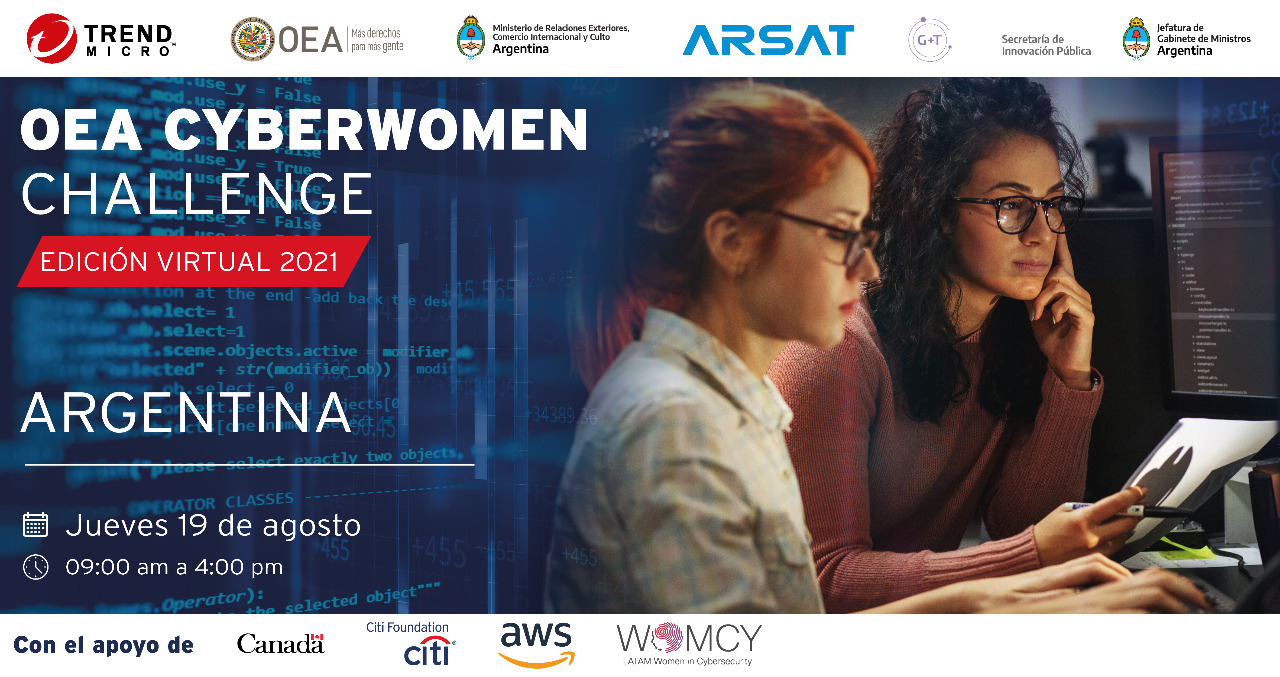
Cyberwomen Challenge Argentina 2021

cw.jpeg

Cyberwomen Challenge Argentina 2021

Iniciativa organizada por la Secretaría de Innovación Pública, Arsat y la Cancillería Argentina junto a la OEA y Trend Micro, centrada en el desarrollo de habilidades de ciberseguridad en las mujeres de la industria de las Tecnologías de la Información y la Comunicación (TIC).

Call for Papers – BIOINFORMATICS 2022

13th International Conference on Bioinformatics Models, Methods and Algorithms

Submission Deadline: September 14, 2021

http://www.bioinformatics.biostec.org

February 09 – 11, 2022

Vienna, Austria

The purpose of the International Conference on Bioinformatics Models, Methods and Algorithms is to bring together researchers and practitioners interested in the design and application of modelling frameworks, algorithmic concepts, computational methods, and information technologies to address challenging problems in Bioinformatics and Biomedical research.
There is a tremendous need to explore how mathematical, statistical and computational techniques can be used to better analyze, predict, and finally understand biological processes and systems. In the face of the massive amount of currently-available biological data, novel methodologies and tools are required. Areas of interest to this community include systems biology and biological networks (regulatory, neuronal, predator-prey, ecological ones, etc.), sequence analysis, biostatistics, graph models, image analysis, scientific data management and data mining, machine learning, pattern recognition, computational evolutionary biology, structural bioinformatics and structure prediction, computational genomics, transcriptomics and proteomics, and related areas.

Conference Chair(s)
Ana Fred, Instituto de Telecomunicações and University of Lisbon, Portugal
Hugo Gamboa, New University of Lisbon, Portugal

Program Chair(s)
Ronny Lorenz, University of Vienna, Austria

In Cooperation with
Association for the Advancement of Artificial Intelligence
Swiss Society for Biomedical Engineering
German Society for Biomedical Engineering
European Alliance for Medical and Biological Engineering and Science
Societe Francaise de Genie Biologique et Medical

With the presence of internationally distinguished keynote speakers:
Federico Cabitza, Università degli Studi di Milano-Bicocca, Italy
Christoph Hölscher, ETH Zurich, Switzerland
Katja Bühler, VRVis, Austria
Claudia Pagliari, University of Edinburgh, United Kingdom

Proceedings will be submitted for indexation by:
SCOPUS
Google Scholar
The DBLP Computer Science Bibliography
Semantic Scholar
Microsoft Academic
Engineering Index (EI)
Web of Science / Conference Proceedings Citation Index

A short list of presented papers will be selected so that revised and extended versions of these papers will be published by Springer in a CCIS Series book.

Also, a short list of best papers will be invited for a post-conference special issue of the Springer Nature Computer Science Journal.

All papers presented at the conference venue will also be available at the SCITEPRESS Digital Library.

Kind regards,
Mónica Saramago
BIOINFORMATICS Secretariat

Address: Av. S. Francisco Xavier Lote 7 Cv. C, Setubal 2900-616, Portugal
Tel: +351 265 520 185
Web: http://www.bioinformatics.biostec.org
e-mail: bioinformatics.secretariat@insticc.org

Design by 2b Consult