Live e-Lecture by Prof. Isabelle Bloch: “Hybrid AI for knowledge representation and model-based medical image understanding”, 8th June 2021 17:00-18:00 CET. Upcoming AIDA AI excellence lectures

Prof. Isabelle Bloch (Sorbonne Université, France), a prominent AI researcher internationally, will deliver the e-lecture:

‘Hybrid AI for knowledge representation and model-based medical image understanding’, on Tuesday 8th June 2021 17:00-18:00 CET (8:00-9:00 am PST), (12:00 am-1:00am CST),

see details in: http://www.i-aida.org/ai-lectures/

You can join for free using the zoom link: https://authgr.zoom.us/j/94165524933 & Passcode: 148148


The International AI Doctoral Academy (AIDA), a joint initiative of the European R&D projects AI4Media, ELISE, Humane AI Net, TAILOR, VISION, currently in the process of formation,

is very pleased to offer you top quality scientific lectures on several current hot AI topics.


Lectures will be offered alternatingly by:

Top highly-cited senior AI scientists internationally or

Young AI scientists with promise of excellence (AI sprint lectures)


Lectures are typically held once per week, Tuesdays 17:00-18:00 CET (8:00-9:00 am PST), (12:00 am-1:00am CST).  Attendance is free.


Other upcoming lectures:

Prof. Konstantinos N. Plataniotis (University of Toronto, Canada): “Digital Pathology: On the intersect of Computer Vision and Data Science”, 29th June 2021 17:00 – 18:00 CET.

More lecture infos in: http://www.i-aida.org/future-lectures/


These lectures are disseminated through multiple channels and email lists (we apologize if you received it through various channels).

If you want to stay informed on future lectures, you can register in the email lists AIDA email list and CVML email list.


Best regards

Profs. M. Chetouani, P. Flach, B. O’Sullivan, I. Pitas, N. Sebe

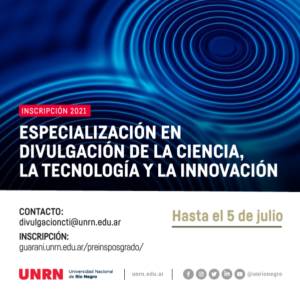
Apertura cohorte 2021 de la Especialización en Divulgación de la Ciencia, Tecnología e Innovación

;color:rgb(80,0,80)”>Universidad Nacional de Río Negro – Sede Andina

Información de interés

Nueva cohorte de la Especialización en Divulgación de la Ciencia, Tecnología e Innovación 

Se encuentra abierta la inscripción a una nueva cohorte de la Especialización en Divulgación de la Ciencia, la Tecnología y la Innovación de la Sede Andina de la Universidad Nacional de Río Negro (UNRN). Esta carrera de posgrado propone formar profesionales que comprendan la complejidad de los procesos comunicacionales y desarrollen habilidades específicas para actuar en este campo.


La especialización se encuentra acreditada por CONEAU, categoría B, y otorga un título de validez nacional. Está dirigida a científicos/as, profesionales de distintas disciplinas como gestores/as, profesores/as, periodistas, extensionistas y todas aquellas personas interesadas en la temática.


Se estructura en un total de 408 horas reales de dictado, organizadas en trece (13) actividades curriculares obligatorias y dos (2) electivas. Las actividades obligatorias serán de dictado mensual y se cursarán a lo largo de un año y medio (considerando un ciclo lectivo de marzo a diciembre).

La carrera comenzará a dictarse el 5 de agosto con cursadas intensivas cada cuatro semanas, los jueves y viernes de 17 a 22 horas y los sábados de 9 a 18 horas. El dictado se realizará de manera virtual hasta tanto se habiliten las actividades presenciales en la ciudad de Bariloche.

Inscripciones: http://guarani.unrn.edu.ar/preinsposgrado/

Para más información, ingresar en https://www.unrn.edu.ar/carreras/Especializacion-en-Divulgacion-de-la-Ciencia-la-Tecnologia-y-la-Innovacion-63 o escribir a divulgacioncti@unrn.edu.ar

Final Call for Papers — FedCSIS 2021 (and all of its events) — IEEE # 52320 — Deadline 24.05.2021 — still time to compete for 600 EURO Prof. Z. Pawlak prize for best paper

16th Conference on Computer Science and Intelligence Systems (FedCSIS’2021)

Online, 2-5 September, 2021

www.fedcsis.org

Strict submission deadline: May 24, 2021, 23:59:59 pm HST (no extensions)

(FedCSIS IEEE conference number: #52320)

************************* COVID-19 Information *************************

While we have planned the 2021 conference to take place in Sofia,
Bulgaria, slow progress in fighting the global pandemic has forced us to
switch to the fully online mode. Therefore, we plan to organize FedCSIS
2022 in Sofia, and hope that by that time COVID will be over, and we
will be able to meet in person.

************************************************************************

Please feel free to forward this announcement to your colleagues and
associates who could be interested in it.

KEY FACTS: expected Proceedings: IEEE Digital Library; indexing: DBLP,
Scopus and Web of Science; 13 Technical Sessions in 5 Tracks; Doctoral
Symposium; conference fee covers preparation of the proceedings volume.

FedCSIS is an annual international conference, this year organized
jointly by the Polish Information Processing Society (PTI), IEEE Poland
Section Computer Society Chapter and Bulgarian Academy of Sciences. It
is technically sponsored by a number of IEEE units and other
professional organizations (for the full list, see the conference site).
The mission of the FedCSIS Conference Series is to provide a highly
acclaimed forum in computer science and intelligence systems. We invite
researchers from around the world to contribute their research results
and participate in Technical Sessions, focused on their scientific and
professional interests in computer science and intelligence systems.

Since 2012, Proceedings of the FedCSIS conference are indexed in the Web
of Science, SCOPUS, DBLP and other indexing services. This already
includes Proceedings of FedCSIS 2018 (we are awaiting the decision for
the FedCSIS 2019 and 2020; we are told that, recently, WoS is
experiencing unusual delays). Information about FedCSIS indexing /
bibliometry / rankings can be found at:
https://www.fedcsis.org/2021/indexation.

FedCSIS TRACKS AND TECHNICAL SESSIONS

The FedCSIS 2021 consists of five conference Tracks, hosting Technical
Sessions:

Track 1: Advanced Artificial Intelligence in Applications (16th
Symposium AAIA'21)
         *Computational Optimization (14th Workshop WCO'21)

Track 2: Computer Science & Systems (CSS'21)
         * Actors, Agents, Assistants, Avatars (1st Workshop 4A'21)
         * Computer Aspects of Numerical Algorithms (14th Workshop CANA'21)
         * Multimedia Applications and Processing (14th International
Symposium MMAP'21)
         * Scalable Computing (12th Workshop WSC'21)

Track 3: Network Systems and Applications (NSA'21)
         * Internet of Things – Enablers, Challenges and Applications
(5th Workshop IoT-ECAW'21)
         * Cyber Security, Privacy and Trust (2nd International Forum
NEMESIS'21)

Track 4: Advances in Information Systems and Technologies (AIST'21)
         * Data Science in Health, Ecology and Commerce (3rd Special
Session DSH'21)
         * Information Systems Management (16th Conference ISM'21)
         * Knowledge Acquisition and Management (27th Conference KAM'21)

Track 5: Software, System and Service Engineering (S3E'21)
         * Cyber-Physical Systems (8th Workshop IWCPS-8)
         * Software Engineering (41th IEEE Workshop SEW-41)
         * Advances in Programming Languages (8th Workshop WAPL'21)

Recent Advances in Information Technology (7th Doctoral Symposium
DS–RAIT'21)

KEYNOTE SPEAKERS

* David Bader
New Jersey Institute of Technology
Keynote title: Solving Global Grand Challenges with High Performance
Data Analytics

* Rajkumar Buyya,
Cloud Computing and Distributed Systems (CLOUDS) Lab, The University of
Melbourne, Australia; and CEO, Manjrasoft Pvt Ltd, Melbourne, Australia
Keynote title: Neoteric Frontiers in Cloud and Edge Computing

* Hristo Djidjev
Los Alamos National Laboratory
Keynote title: Using quantum annealing for discrete optimization

* Moshe Y. Vardi
Rice University
Keynote title: Lessons from COVID-19: Efficiency vs Resilience

ZDZISŁAW PAWLAK BEST PAPER AWARD

The Professor Zdzisław Pawlak Awards are given in the following categories:

•       Best Paper Award (€600)
•       Young Researcher Paper Award (€400)
•       Industry Cooperation Award (€400)
•       International Cooperation Award (€400)

All papers accepted to FedCSIS are eligible to be considered as the
award winners.

This award will be awarded independently from awards given by individual
FedCSIS events (Tracks and/or Technical Sessions).

Past Award winners can be found here: https://fedcsis.org/2021/zp_award

PAPER SUBMISSION AND PUBLICATION

+ Papers should be submitted by May 24, 2021 (strict deadline, no
extensions, submission system is open, via EasyChair
https://easychair.org/my/conference?conf=fedcsis2021).

+ Preprints will be published online.

+ Only papers presented during the conference will be submitted to the
IEEE for inclusion in the Xplore Digital Library. Furthermore,
proceedings, published in a volume with ISBN, ISSN and DOI numbers, will
be posted within the conference Web portal. Moreover, most Technical
Session organizers arrange quality journals, edited volumes, etc., and
may invite selected extended and revised papers for post-conference
publications (information can be found at the websites of individual
events, or by contacting Chairs of said events).

IMPORTANT DATES

+ Paper submission (strict deadline): May 24, 2021, 23:59:59 (UCT-12;
there will be no extension)
+ Position paper submission: June 14, 2021
+ Author notification: July 5, 2021
+ Final paper submission and registration: July 26, 2021
+ Conference date: September 2-5, 2021

CHAIRS OF FedCSIS CONFERENCE SERIES

Maria Ganzha, Leszek A. Maciaszek, Marcin Paprzycki

CONTACT FedCSIS at: secretariat@fedcsis.org

FedCSIS in Social Media:
FedCSIS on Facebook:    http://tinyurl.com/FedCSISFacebook
FedCSIS on LinkedIN:    https://tinyurl.com/FedCSISonLinkedIN
FedCSIS on Twitter:     https://twitter.com/FedCSIS
FedCSIS on XING:        http://preview.tinyurl.com/FedCSISonXING

The Ninth Visual Object Tracking Challenge and Workshop at ICCV’2021

The VOT challenges provide the tracking community with a precisely defined and repeatable way of comparing short-term trackers and long-term trackers as well as a common platform for discussing the evaluation and advancements made in the field of visual tracking. Following eight highly successful VOT challenges, the 9th Visual Object Tracking Challenge VOT2021 and workshop will be held in conjunction with ICCV 2021.

Challenge is still open until 31st May. We encourage you to submit your tracker result and participate! 

We welcome you also to submit a regular paper to the VOT’21 workshop which will take place at ICCV’21
  • Original or improved single object trackers as well as papers that give new insights into existing single object trackers and analysis of tracker performance.
  • Novel ways of using and extending the VOT framework for performance analysis of trackers.
You are also welcome to re-submit your eventually rejected ICCV paper to our workshop. Please, see the conditions for this option on our workshop webpage.

The timeline of VOT’21
  • 23th 31st May: Tracker results submission deadline (challenge ends)
  • 28th June: Winners of sub-challenges identified (but not publicly disclosed)
  • 30th June: Submission deadline for regular papers to VOT2021
  • 1st August: Submission deadline for the “high-quality tracking papers not accepted to ICCV2021 due to, e.g., insufficient significance, but having a great value to VOT community”
  • 4th August: Notification to authors of the contributed papers
  • 15th August: Camera ready deadline
  • 11th or 17th October : VOT2021 workshop in conjunction with the ICCV2021 (winners disclosed) (virtual event)

CFP: AIJ Special Issue on Risk-Aware Autonomous Systems: Theory and Practice


Artificial Intelligence’s Special Issue on “Risk-Aware Autonomous Systems: Theory and Practice” is now open for submissions. The special issue is co-edited by Prof. Sara Bernardini (Royal Holloway University of London), Prof. Luca Carlone (MIT), Dr Ashkan Jasour (MIT), Prof. Andreas Krause (ETH Zurich), Prof. George Pappas (University of Pennsylvania), Prof. Brian Williams (MIT) and Prof. Yisong Yue (Caltech). Submissions will close on October 15th, 2021 and the publication of the special issue is expected for August 15th, 2022. Artificial Intelligence is a world-leading journal in AI with an Impact Factor of 6,628 and CiteScore of 7.7. 


Aims and Scope

This special issue focuses on the theory and practice of risk-aware autonomous systems that reason about uncertainty and risk online to achieve safety, and that combine machine learning and decision making to accomplish real world tasks.

The topic of risk-aware autonomous systems has seen a dramatic increase in importance over the last few years, as autonomous systems are being deployed almost daily within safety-critical applications, including self-driving vehicles, autonomous undersea and aerospace systems, service robotics, and collaborative manufacturing. This broad adoption is a testament to the fast-paced progress of the research community across multiple areas, including planning, learning, perception, decision making, and control. At the same time, today’s widely used AI algorithms for autonomy are beginning to showcase fundamental limits and practical shortcomings. In particular, excessive risk taken by these algorithms can lead to catastrophic failure of the overall system and may put human life in danger. Many AI methods used today do not attempt to quantify uncertainty; they do not assess the risks that uncertainty imposes on system safety and success; they do not guarantee bounds on this risk and they do not perform these assessments in real-time.

To push the envelope of autonomous systems’ safety, this special issue will present ground-breaking research on the theory and practice of designing the next generation of risk-aware AI algorithms and autonomous systems. Key to our envisioned methods is their ability to account for uncertainty and risk of failure during their online execution, their capabilities for proactively quantifying and mitigating risks against task goals and safety constraints, and their ability to offer formal guarantees, such as bounds on the risk of failure. Emerging risk-bounded methods often operate on models of uncertainty, specifications of intended outcomes, and specifications of acceptable risks regarding these outcomes. These models and specifications are diverse. Uncertainty models may be probabilistic, set bounded, or interval based. Intended outcomes include goals achieved, deadlines met, safety constraints respected, required accuracy in model estimation and perception, and rate of false positives. Specifications of acceptable risk include risk bounds and acceptable costs of failure. These intended outcomes and acceptable risks can apply to individual AI components, such as policy and action learners, image classifiers and planners, and the aggregate systems as a whole.

This special issue is intended to represent this diversity. It aims to cover a broad set of topics related to risk-aware autonomous systems, including but not limited to:

● risk-aware task and motion planning;
● robust and adversarial learning;
● certifiable and risk-aware perception, localization and mapping;
● robust task monitoring and execution under uncertainty;
● formal methods for monitoring and verifying uncertain systems;
● constraint and mathematical programming with chance constraints;
● robust control of intelligent systems;
● system-level monitoring and risk quantification.

Submission Instructions

We welcome high quality original (unpublished) articles. Each submission will be peer-reviewed.

All submissions should be formatted following the AI journal instructions for authors (https://www.elsevier.com/journals/artificial-intelligence/0004-3702/guide-for-authors) and submitted to: https://www.editorialmanager.com/artint/default.aspx  


Important Dates

● Submissions open: 15 May 2021

● Submissions close: 15 October 2021

● Publication of the special issue: 15 August 2022


Guest Editors

● Prof. Sara Bernardini (Royal Holloway University of London, sara.bernardini@rhul.ac.uk)
● Prof. Luca Carlone (Massachusetts Institute of Technology, lcarlone@mit.edu)
● Dr. Ashkan Jasour (Massachusetts Institute of Technology, jasour@mit.edu)
● Prof. Andreas Krause (ETH Zurich, krausea@ethz.ch)
● Prof. George Pappas (University of Pennsylvania, pappasg@seas.upenn.edu)
● Prof Brian Williams (Massachusetts Institute of Technology, williams@mit.edu)
● Prof. Yisong Yue (California Institute of Technology, yyue@caltech.edu)


For more information, please contact the editors and visit: https://www.journals.elsevier.com/artificial-intelligence/call-for-papers/risk-aware-autonomous-systems-theory-and-practice


All the best,


Luca


Design by 2b Consult