CFP: 17th International conference on machine vision applications

17TH INTERNATIONAL CONFERENCE ON MACHINE VISION APPLICATIONS

The seventeenth International Conference on Machine Vision Applications will be held at Nagoya Congress Center, Aichi, Japan from July 25 through 27, 2021. The conference is sponsored by the MVA Organization, co-organized by IEICE PRMU and IPSJ SIG-CVIM, and endorsed by IAPR.

The aim of this conference is to bring together researchers and practitioners from both academia and industry, and to stimulate the exchange of knowledge through intensive discussions on the cutting-edge research topics.

Topics-of-interest include, but are not limited to, sensing, algorithms, and applications (Factory automation and robotics, Intelligent Transport Systems, Human computer interaction, biomedical, multimedia, and life) concerning the image media.

Papers should be prepared in the designated format in four pages, and submitted electronically by the deadline.

Accepted papers will be presented in English either as an oral presentation or a poster presentation.

Note that at least one author of an accepted paper must present their work at the conference.
Also we are considering allowing you to participate online as well.

Details can be found in the MVA2021 Web site or our twitter and facebook.
http://www.mva-org.jp/mva2021/
https://twitter.com/MVA_ORG/
https://www.facebook.com/Mva-org/

Important Dates:
– Full Paper (4 pages) Submission Deadline: March 31, 2021
– Notification of Acceptance: June 1, 2021
– Camera Ready Manuscript De

Ph.D. Daniela López De Luise
CI2S lab director
IDTI lab director
Argentina Scientific Society – DCI

adline: June 8, 2021

And, we are pleased to announce MVA2021 IAPR Invited speakers and tutorial speakers.

IAPR Invited speakers:
– Chieko Asakawa (IBM)
– Alexei A. Efros (UC Berkeley)
– Ming-Hsuan Yang (UC Merced)

Tutorial spearkers:
– Jingjing Chen (Fudan University)
– Kris M. Kitani (CMU)
– Björn Stenger (Rakuten Institute of Technology)

Contact:
MVA2021 Organizing Committee (mva2021-sec-AT-mva-org.jp)

General Chairs
– Norimichi Ukita (Toyota Technological Institute)
– Kyoko Sudo (Toho University)

Program Chairs
– Rei Kawakami (Tokyo Institute of Technology)
– Minsu Cho (POSTECH)

ICBDA 2021– 6th Intl. Conf. Big Data Analytics

CBDA2019 | ISBN: 978-1-7281-1282-4 | IEEE Xplore | Indexed by Ei & Scopus


2021 IEEE 6th International Conference on Big Data Analytics (ICBDA 2021)
Xiamen, China | March 5-8, 2021
http://www.icbda.org


ICBDA2019 – IEEE | ISBN: 978-1-7281-1282-4 | IEEE Xplore | Indexed by Ei-Compendex & Scopus 3 months after the conference
ICBDA2020 – IEEE | ISBN: 978-1-7281-6077-1


Publication

All accepted papers after proper registration and presentation, will be published in the ICBDA 2021 conference Proceedings. Conference content will be submitted for inclusion into IEEE Xplore as well as other Abstracting and Indexing (A&I) databases.

Conference Committees & Keynote / Plenary Speakers

Committees
International Advisory Committee 
Zhu Han, University of Houston, USA 
Hayato YAMANA, Waseda University, Japan


Conference Committee Chair 
Sheng-Uei Guan, Xi'an Jiaotong-Liverpool University, China
Minghui Shi, Xiamen University, China


Technical Program Committee Chairs
Goutam Chakraborty, Iwate Prefectural University, Japan
Peng Chen, People’s Public Security University of China, China
Yohei Saika, National Institute of Technology, Japan


Keynote Speakers
Prof. Zhu Han – IEEE Fellow
University of Houston, USA


Prof. Hai Jin – IEEE Fellow
Huazhong University of Science and Technology, China


Prof. Huajun Chen
Zhejiang University, China


Prof. Qing Li
The Hong Kong Polytechnic University, Hong Kong 

Prof. Hayato YAMANA
Waseda University, JAPAN

Important Date

Submission Deadline: January 5, 2021
Notification Date: January 25, 2021
Registration Deadline: February 10, 2021
Conference Dates:March 5-8, 2021

Contact us

Ms Jasmine Nieh 
Tel: +86-18482379767
email: icbda2016@vip.163.com


IEEE NetSoft 2021 in Tokyo, Japan // Paper Submission Extended Deadline is 15 January!

Machine learning is one of the highlighted topics


NetSoft 2021 Banner_No Register Button.png


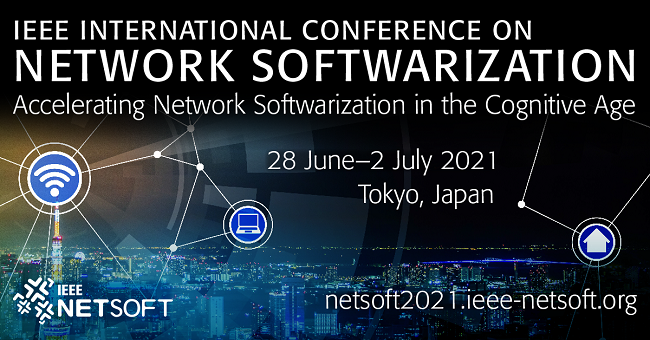
We are seeking technical paper submissions and workshop proposals for the 7th IEEE International Conference on Network Softwarization (IEEE NetSoft 2021), which will be held in Tokyo, Japan from 28 June to 2 July 2021. The conference’s theme is “Accelerating Network Softwarization in the Cognitive Age,” a reflection of the current trend of research in the area of network softwarization.

NetSoft 2021 will feature technical paper presentations, keynotes, tutorials, workshops, demos, and exhibitions from world-leading experts representing service providers, vendors, research institutes, open-source projects, and academia. The conference will showcase the latest research and development results in artificial intelligence and machine learning; self-driving and autonomic networking; policy-based network management; and dynamic network slice provisioning—among other promising research areas—for the sake of robust, reliable and cognitive softwarized networks.

CALL FOR PAPERS:
Prospective authors are invited to submit high-quality original technical papers for presentation at the conference and publication in the NetSoft 2021 Proceedings.  Original technical papers and workshop proposals are sought in the following areas:


  • Softwarized cloud, fog, and edge infrastructures
  • Cognitive and autonomic networking
  • Centralized vs distributed control, management and orchestration
  • Abstractions and virtualization of resources, services and functions
  • AI techniques to support network automation
  • Big data analytics for managing softwarized networks
  • Network slicing and slice management
  • Mobility management in softwarized networks
  • Programmable SDN and NFV: languages and architectures
  • Policy-based and intent-based networking
  • Service Function Chaining (SFC)
  • Mapping and scheduling of SFC
  • Container/microservice-based network functions
  • Efficient network/service monitoring in SDN/NFV
  • QoS and QoE in softwarized infrastructures
  • Resilience, reliability, and robustness of softwarized networks
  • Network softwarization for 5G
  • Network management at the edge
  • Cooperative multi-domain, multi-tenant SDN/NFV environments
  • Security, Safety, Trust and Privacy in virtualized environments
  • SDN switch/router architecture and design
  • Dynamic resource discovery and negotiation schemes
  • Lifecycle management of network software
  • DevOps methodologies for network softwarization
  • Debugging and introspection of software-defined systems
  • Softwarized platforms for Internet of Things (IoT)
  • Energy-efficient and green software-defined infrastructures (SDI)
  • Transition strategies from existing networks to SDN/NFV
  • New value chains and service models enabled by softwarization
  • Socio-economic impact and regulations for softwarization
  • Experience reports from experimental testbeds and deployments

SUBMISSION DEADLINE
Technical Papers – 15 January 2021 (Extended)


Join Comsoc or Renew your membership


Conferences: CGI 2021 Call for Papers

Camera-ready July 20, 2021


CALL FOR VISUAL COMPUTER JOURNAL PAPERS (FIRST CALL)

The scientific program of the conference will include accepted papers from the first call for papers and these accepted papers will be published in the Visual Computer Journal (impact factor 1.45) by Springer-Verlag.

The accepted papers from the second call for papers will be included in the CGI conference proceedings published by LNCS, Springer.

Note that for both call for papers, the review process is double blind, which requires the paper and all supplemental materials to be anonymous. Ensure that self-referencing is anonymous (refer to your full name rather than “I” or “we”). Avoid providing information that may identify the authors in the acknowledgements (e.g. co-workers and grant IDs) and in the supplemental material (e.g. titles in the movies, or attached papers). Avoid providing links to websites that identify the authors. Violation of any of these guidelines will lead to rejection without review.

We invite original contributions that advance the state-of-the-art in topics related to:


KEYWORDS

We invite original contributions that advance the state-of-the-art in topics related to:

  •  Rendering Techniques
  • Geometric Computing
  • Virtual and Augmented Reality
  • Shape and Surface Modeling
  • Physically Based Modeling
  • Computer Vision for Computer Graphics
  • Scientific Visualization
  • Data Compression for Graphics
  • Medical Imaging
  • Computation Geometry
  • Image Based Rendering
  • Computational Photography
  • Computer Animation
  • Visual Analytics
  • Shape Analysis and Image Retrieval
  • Volume Rendering
  • Solid Modelling
  • Geometric Modelling
  • Computational Fabrication
  • Image Processing
  • 3D Reconstruction
  • Global Illumination
  • Graphical Human-Computer Interaction
  • Human Modelling
  • Image Analysis
  • Saliency Methods
  • Shape Matching
  • Sketch-based Modelling
  • Robotics and Vision
  • Stylized Rendering
  • Textures
  • Pattern Recognition
  • Machine Learning for Graphics


Conference Chair

Nadia Magnenat Thalmann, University of Geneva, Switzerland,

Program Chairs

First track, papers submitted to CGI to be selected for Visual Computer

Computational ML, ONLINE, Feb-May 2021

The Continuum Jumpstart Course Computational Machine Learning (ML) for Scientists and Engineers is designed to equip you with the knowledge you need to

understand, train, design and machine learning algorithms, particularly deep neural networks, and even deploy them on the cloud.


You'll learn by programming machine learning algorithms from scratch in a hands-on manner using a one-of-a-kind cloud-based interactive computational

textbook that will guide you, and check your progress, step-by-step. Using real-world datasets and datasets of your choosing, you will understand, and

we will discuss, via computational discovery and critical reasoning, the strengths and limitations of the algorithms and how they can or cannot be

overcome. You will understand how machine learning algorithms do what they claim to do so you can reproduce these while being able to reason about and

spot wild, unsupported claims of their efficacy.


By the end of the course, you will be ready to harness the power of machine learning in your daily job and prototype, we hope, innovative new ML

applications for your company with datasets you alone have access to.


It's ideal for folks who want to go deeper than a regular MOOC and want to learn by coding.


See https://continuum.engin.umich.edu/programs/jumpstart-ml/

for a description — apply by Jan 8th, 2021 for cohort starting Feb 15th.


See https://continuum.engin.umich.edu/programs/jumpstart-ml/testimonials-and-advice/

for testimonials from the pilot cohort.

Design by 2b Consult