CAE 2019


CAE 2019

1st Argentine Conference on Electronics (CAE)

March 14-15, 2019

Universidad Nacional de Mar del Plata

Universidad CAECE


CALL FOR PAPERS (DEADLINE SEPTEMBER 19)

See important information in attached pdf file.

For inquiries: cae.congress@gmail.com

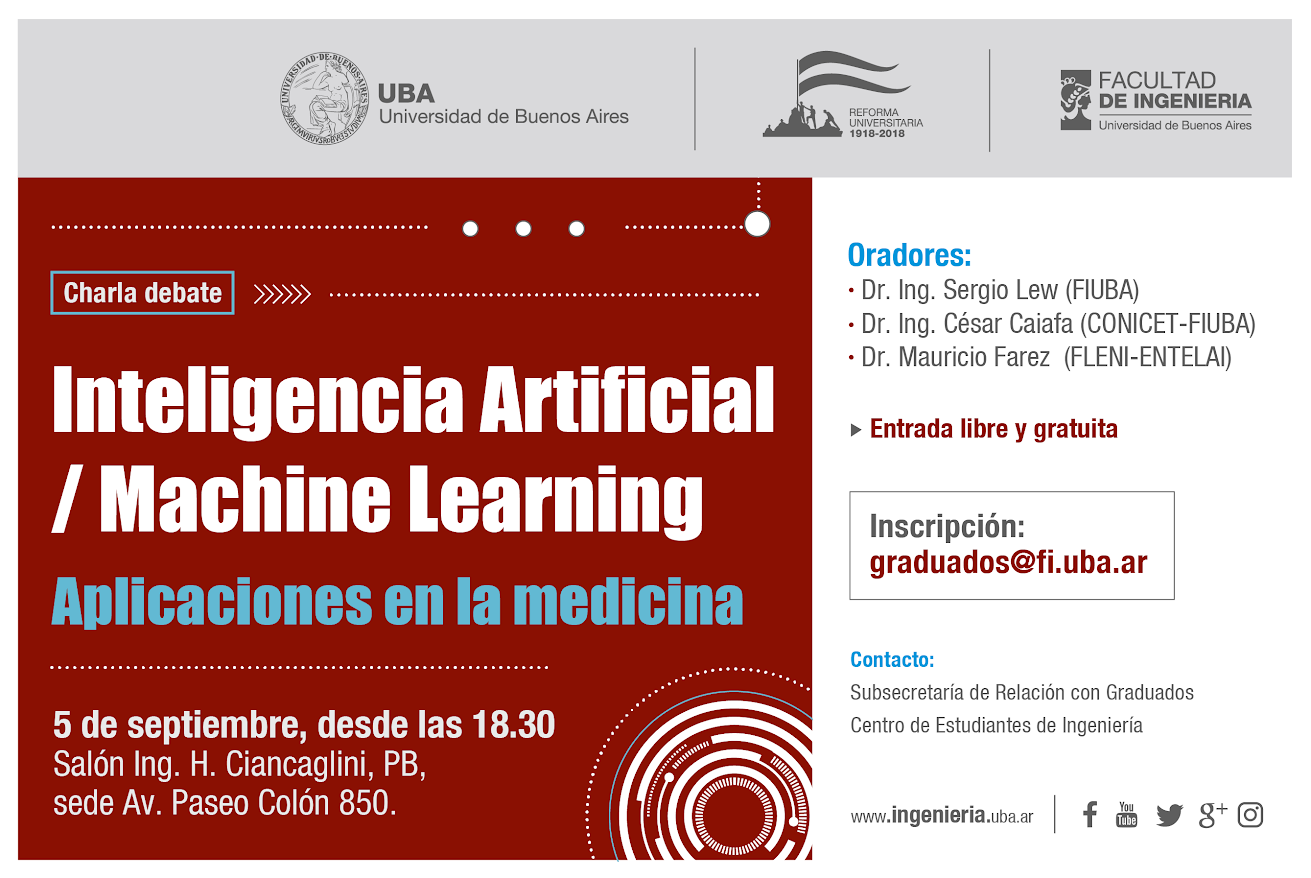
Miércoles 5/09 – ENCUENTRO “INTELIGENCIA ARTIFICIAL / MACHINE LEARNING”

ENCUENTRO SOBRE INTELIGENCIA ARTIFICIAL Y MACHINE LEARNING

El miércoles 5 de septiembre desde la 18.30, la Subsecretaría de Relación con Graduados llevará a cabo en cooperación con el Centro de Estudiantes la conferencia “INTELIGENCIA ARTIFICIAL / MACHINE LEARNING. Aplicaciones en la Medicina.” Será en el Salón de Consejo Directivo de la Facultad ubicado en la sede FIUBA de Paseo Colón 850, C.A.B.A.    

Este encuentro de primer nivel permitirá conocer más sobre esta temática de frontera tecnológica con ejemplos aplicados al campo de la medicina.

Tal y como lo indica el programa, contará con las siguientes disertaciones:

-Dr. Ing. Sergio Lew: "Introducción al machine learning" .

-Dr. Ing. César Caiafa: "El conectoma humano y una técnica para la codificación eficiente del 'cableado' cerebral".

-Dr. Mauricio Farez: "Inteligencia artificial aplicada a la lectura de resonancias magnéticas".

Más información:

*Las inscripciones son a través del correo: graduados@fi.uba.ar

*Se entregarán certificados de asistencia.


¡Los esperamos!


Subsecretaría de Relación con Graduados

Facultad de Ingeniería – UBA

T.E. 5285-0511

IEEE SPM: Special Issue on Learning Algorithms and Signal Processing for Brain-Inspired Computing

Call for Papers

IEEE Signal Processing Society

IEEE SIGNAL PROCESSING MAGAZINE


Special Issue on Learning Algorithms and Signal Processing for Brain-Inspired Computing

 
Neural networks have become the de-facto standard tool to carry out supervised, unsupervised, and reinforcement learning, reaching super-human capabilities in a variety of pattern recognition and strategic tasks. Their emergence has built upon the unprecedented availability of computing power in data centers and cloud computing platforms. In contrast to artificial neural networks, the human brain is capable of performing more general and complex tasks at a minute fraction of the power required by state-of-the-art supercomputers. Insights from neuroscience reveal that the space-time computing capabilities of spiking neurons are among the main reasons for the energy efficiency of the brain. In particular, spiking neurons leverage sparse time-based information encoding, event-triggered plasticity, and low power inter-neuron signalling. As a result, brain-inspired neuromorphic signal processing and learning algorithms and hardware platforms have recently emerged as a low-power alternative to energy-hungry artificial neural networks. These systems implement networks of spiking neurons, or Spiking Neural Networks (SNNs), which consist of asynchronous distributed architectures that process sparse binary time series by means of local spike-driven computations, local or global feedback, and online learning. From a signal processing perspective, the specific features and constraints of neuromorphic computing platforms open interesting new problems concerning regression, classification, control, and learning. 
 
The scope of the emerging field of brain-inspired signal processing, encompassing neuroscience, hardware design, and machine learning, makes it difficult for a non-expert to find a suitable entry point in the literature.  It is the goal of this special issue to bring together key researchers in this area, with the aim of providing the readership of the IEEE Signal Processing Magazine with up-to-date and survey-style papers on algorithmic, hardware, and neuroscience perspectives on the state-of-the-art of this emerging field. Submissions of comprehensive overviews of methodological approaches to brain-inspired learning and computing, with a focus on applications of interest to the signal processing community, are encouraged.
 
Topics of interest include (but are not limited to):
  • Spike-domain learning
  • Spike-domain representation
  • Spike-domain control and reinforcement learning
  • Neuromorphic signal processing hardware platforms
  • Insights from neuroscience to brain-inspired signal processing
  • Information-theoretic perspectives on time encoding and spike-domain computing
  • Probabilistic and Bayesian methods for Spiking Neural Networks
  • Signal processing for time-domain encoding and decoding
  • Statistical learning and complexity considerations


Submission Process

The Special Issue seeks to offer broad coverage of the field including most recent developments in both theory and applications. Submissions of comprehensive overviews of methodological advances are strongly encouraged, as well as papers dealing with new and emerging applications. All submissions will be peer reviewed according to the IEEE and Signal Processing Society guidelines. Submitted articles should not have been published or be under review elsewhere. Manuscripts should be submitted online at http://mc.manuscriptcentral.com/sps-ieee using the Manuscript Central interface, see http://www.signalprocessingsociety.org/publications/periodicals/spm/ for guidelines and information.


Important Dates

White papers (4 pages) due: October 1, 2018
Revised manuscripts due: May 1, 2019
Invitation notification: November 1, 2018
Final acceptance notification: July 1, 2019
Manuscripts due: January 1, 2019
Final manuscripts due: August 5, 2019
Acceptance notification: March 1, 2019
Publication due: November 2019


Guest Editors:

Osvaldo Simeone, Lead Guest Editor, King’s College London, UK, osvaldo.simeone@kcl.ac.uk
Bipin Rajendran, New Jersey Institute of Technology, USA, osvaldo.simeone@kcl.ac.uk

Andre Gruning, University of Surrey, UK, a.gruning@surrey.ac.uk

Evangelos Eleftheriou, IBM, Switzerland, ele@zurich.ibm.com

Mike Davis, Intel, USA, mike.davies@intel.com

Sophie Deneve, Ecole Normale Supérieure, France, sophie.deneve@ens.fr

Guang-Bin Huang, Nanyang Technological University, Singapore, egbhuang@ntu.edu.sg


IEEE CIS AR – TRIC VIII: Extensión fecha limite recepción de trabajos – 7 de setiembre 2018

LLAMADO A PRESENTACIÓN DE TRABAJOS
Convocatoria al TRIC VIII
Torneo Regional de Inteligencia Computacional
Sociedad Científica Argentina – Av. Santa Fe 1145, Buenos Aires (Argentina)
27 al 29 de setiembre de 2018
UN EVENTO DE CIS ORGANIZADO DESDE EL AÑO 2002 POR EL
CAPÍTULO ARGENTINO
(N° Registro IEEE: Conference Record Number 45812)
 
—-  Extensión Límite recepción de trabajos: 7 de setiembre de 2018  —-
Este año, en su octava edición, nos acompañan en su realización IEEE Games Technical Committee (GTC/VGGE), IEEE Woman in Computational Intelligence (WCI) y el Instituto de Comunicaciones Digitales de la Sociedad Científica Argentina como co-organizadores y, en asociación especial para este evento, Unity Technologies, así como numerosos auspiciantes.
 
El evento congrega a entidades universitarias, profesionales, industria e investigadores jóvenes, con el objeto principal de fomentar el estudio, investigación, desarrollo de herramientas de inteligencia computacional y videojuegos, así como el intercambio entre los participantes y difusión de los contenidos. Los trabajos en competencia podrán o no ser inéditos.
Categorías:
o   Inteligencia Computacional y áreas relacionadas (IC)
o   Juegos Digitales (JD)
Fechas importantes:
 – Límite envío de trabajos: 27 de agosto de 2018 7 de setiembre de 2018
 – Publicación de trabajos seleccionados:                     13 de setiembre de 2018
 – Límite envío de videos de trabajos seleccionados:     20 de setiembre de 2018
 – Presentación de pósters de trabajos seleccionados:  27 a 29 de setiembre de 2018
 – Inscripción para la asistencia al evento:                   hasta el 25 de setiembre de 2018
 
Ø  Los trabajos serán evaluados con el método de doble ciego según criterios de aporte al área, originalidad (IC) y relevancia (JD), resultados e impacto, calidad de las presentaciones escrita y oral. Se publicará en la página del evento la lista de trabajos seleccionados que serán candidatos a la premiación (no hay “trabajos rechazados”).
Ø  Los autores de los trabajos seleccionados deberán elegir una de las dos modalidades disponibles para la presentación de su trabajo, lo cual es un requisito indispensable para seguir en competencia: a) póster (ver formato en web TRIC), b) video (.avi, .mp4, Youtube).
Ø  Los que presenten póster tendrán asignado un horario en el evento para realizar la exposición oral del trabajo a los miembros del comité científico. Los que no puedan viajar, deberán enviar un video de no más de 10 minutos con dicha presentación, en la fecha indicada (la interacción con los expositores no se tendrá en cuenta para la premiación en ningún caso).  
Para más información acceder al sitio web:  http://sites.ieee.org/argentina-cis/inicio/tric-viii/
 

CAE 2019


CAE 2019

1st Argentine Conference on Electronics (CAE)

March 14-15, 2019

Universidad Nacional de Mar del Plata

Universidad CAECE


CALL FOR PAPERS (DEADLINE SEPTEMBER 5)

See important information in attached pdf file.

For inquiries: cae.congress@gmail.com

Design by 2b Consult