
CFP Track Accessible Devices and Technologies (ADT ’25) – ACM SAC 2025

Track on Accessible Devices and Technologies (ADT ‘25)

Sicily, Italy, March 31 – April 4, 2025

Part of the 40th ACM/SIGAPP Symposium on Applied Computing (SAC ‘25)

https://sites.google.com/view/adt-sac-2025

https://www.sigapp.org/sac/sac2025/

Theme and Scope

Modern devices and technologies can represent a digital barrier for users with disabilities, but they can be exploited to become enabling tools for them. Accessibility of devices and technologies is a critical topic to allow inclusion of all users, especially due to the European laws that impose accessibility for new products and the definition of an updated version of WCAG (Web Accessibility Guidelines). This track invites scientists, engineers, and decision-makers from government, industry, and academia to present technical papers on their research and development results in areas of accessibility.

This track can interest many researchers since it would give the chance to face a wide range of topics, i.e., web or mobile technologies, with different points of view, taking into account specific technological constraints and digital barriers. It is well-known that the so-called “curb cut effect” can be applied to any technological and digital context (in terms of devices, content, and services): technologies that were originally meant to benefit people with disabilities can help any other users. Moreover, the history and the evolution of several technologies have been influenced and/or motivated by the special needs of people with disabilities. 

We welcome submission on a wide range of topics, including but not limited to:

  • Accessible devices/assistive technologies: assistive technologies refer to all the assistive, adaptive, and rehabilitative devices for people with disabilities that enable users to perform tasks they were formerly unable to accomplish. On the one hand, the widespread diffusion of new devices and technologies stimulates researchers to find and apply new solutions to make them accessible to anyone. On the other hand, experiences in accessibility-related fields have been exploited and have provided benefits to users equipped with non-conventional devices when they emerged in the market.

  • Accessible solutions for e-learning, e-commerce, e-banking, etc: e-services and content often require specific technologies, being bounded by specific constraints when accessed by people with disabilities equipped with assistive technologies. Specific interaction modalities may affect interactive service access, while richness and quantity of content may affect the users’ ability to process information. 

  • Accessible content: e-books, accessible TV, accessible broadcasting, etc.

  • Accessibility of games.

  • AI for Accessibility: AI can be exploited both for personalization (i.e., integrating AI-based personalization to support specific and special needs) and “enabler” (i.e., exploiting LLM to support the creation of accessible applications).

Submission Guidelines

We would like to invite authors to submit papers on research on the Accessibility area, with particular emphasis on assessing the current state of the art and identifying future directions. Original papers addressing any of the listed topics of interest (or related topics) will be considered. Each submitted paper will be fully refereed and undergo a double-blind review process by at least three referees. Accepted papers will be included in the ACM SAC 2025 proceedings and published in the ACM digital library, being indexed by Thomson ISI Web of Knowledge and Scopus. 

The track accepts full papers (max 8 pages), posters (max 2 pages), and SRC abstracts (max 2 pages). Submissions should be properly anonymized to facilitate blind reviewing. Papers that will receive high reviews (that is acceptable by reviewer standard) but will not be accepted due to space limitations can be invited for poster session. Authors of accepted papers must be prepared to sign a copyright statement and must pay the registration fee and guarantee that their paper will be presented at the conference. No-show of scheduled papers will result in excluding the papers from the ACM Digital Library. 

See the track website https://sites.google.com/view/adt-sac-2025 for more details. 

Important Dates

  • September 20, 2024, 11:59 PM (UTC+0.00): Submission of regular papers and SRC research abstracts

  • October 30, 2024: Notification of papers, posters, and SRC research abstracts

  • November 29, 2024: Camera-ready copies of accepted papers

  • December 6, 2024: Authors registration due

Organization

  • Ombretta Gaggi, University of Padua

  • Silvia Mirri, University of Bologna

  • Mike Paciello, AudioEye, WebABLE

  • Catia Prandi, University of Bologna

Submission Portal 

Please submit your contribution through our online submission portal available at https://www.sigapp.org/sac/sac2025/submission.php (regular papers) and https://www.sigapp.org/sac/sac2025/submission_src.php (SRC abstracts).

Contact us

For any inquires regarding the call for papers, please contact gaggi@math.unipd.it.

We look forward to your contributions and to seeing you at the ACM SAC 2025 Conference!
Invitation to Submit Your Research to MedPRAI 2024

Dear Researchers,

We are pleased to invite you to submit your research papers to the upcoming 6th Mediterranean Conference on Pattern Recognition & Artificial Intelligence (MedPRAI 2024), scheduled to be held on October 18-19, 2024, at Istinye University, Istanbul, Turkey. This conference offers a platform for sharing advancements in pattern recognition, artificial intelligence, and related fields.

Paper Submission Deadline: September 10, 2024

Conference Website:

https://medprai.com/

 Submission Link: 

All accepted papers will be published in the Springer book series Lecture Notes in Networks and Systems (LNNS). LNNS is indexed in well-known databases such as EI Compendex, SCOPUS, DBLP, INSPEC, Norwegian Register for Scientific Journals and Series, SCImago, WTI Frankfurt eG, and zbMATH.


Please find attached the Call for Papers (CFP) with detailed information on submission guidelines, important dates, and topics of interest.


We look forward to your participation and contributions to making MedPRAI 2024 a success.

Regards,

Dr. AKHTAR JAMIL

Associate Professor

Department of Computer Science, 
FAST School of Computing
National University of Computer and Emerging Sciences, 
Islamabad, Pakistan.
Office Tel. (051) 111-128-128;  Ext. 633

FAST University  :   http://isb.nu.edu.pk/

Regards,

Dr. AKHTAR JAMIL

Associate Professor

Department of Computer Science, 
FAST School of Computing
National University of Computer and Emerging Sciences, 
Islamabad, Pakistan.
Office Tel. (051) 111-128-128;  Ext. 633

FAST University  :   http://isb.nu.edu.pk/

CfP: Technical track on Graph Models for Learning and Recognition

Call for Papers

Graph Models for Learning and Recognition (GMLR) Track

The 40th ACM Symposium on Applied Computing (SAC 2025)

March 31 – April 4, 2025 Catania, Italy

https://phuselab.di.unimi.it/GMLR2025/

Important Dates

  • Submission of regular papers and SRC abstracts: September 20, 2024
  • Notification of papers/SRC acceptance/rejection: October 30, 2024
  • Camera-ready copies of accepted papers/SRC: November 29, 2024
  • Author registration due date: December 6, 2024

Motivations and topics

The ACM Symposium on Applied Computing (SAC 2025) has been a primary gathering forum for applied computer scientists, computer engineers, software engineers, and application developers from around the world. SAC 2025 is sponsored by the ACM Special Interest Group on Applied Computing (SIGAPP), and will be held in Catania, Italy. The technical track on Graph Models for Learning and Recognition (GMLR) is the fourth edition and is organized within SAC 2025. Graphs have gained a lot of attention in the pattern recognition community thanks to their ability to encode both topological and semantic information. Despite their invaluable descriptive power, their arbitrarily complex structured nature poses serious challenges when they are involved in learning systems. Some (but not all) of challenging concerns are: a non-unique representation of data, heterogeneous attributes (symbolic, numeric, etc.), and so on.

In recent years, due to their widespread applications, graph-based learning algorithms have gained much research interest. Encouraged by the success of CNNs, a wide variety of methods have redefined the notion of convolution and related operations on graphs. These new approaches have in general enabled  effective training and achieved in many cases better performances than competitors, though at the detriment of computational costs. Typical examples of applications dealing  with graph-based representation are: scene graph generation, point clouds classification, and action recognition in computer vision; text classification, inter-relations of documents or words to infer document labels in natural language processing; forecasting traffic speed, volume or the density of roads in traffic networks, whereas in chemistry researchers apply graph-based algorithms to study the graph structure of molecules/compounds.

This track intends to focus on all aspects of graph-based representations and models for learning and recognition tasks. GMLR spans, but is not limited to, the following topics:

  • Graph Neural Networks: theory and applications

  • Deep learning on graphs

  • Graph or knowledge representational learning

  • Graphs in pattern recognition

  • Graph databases and linked data in AI

  • Benchmarks for GNN

  • Dynamic, spatial and temporal graphs

  • Graph methods in computer vision

  • Human behavior and scene understanding

  • Social networks analysis

  • Data fusion methods in GNN

  • Efficient and parallel computation for graph learning algorithms

  • Reasoning over knowledge-graphs

  • Interactivity, explainability and trust in graph-based learning

  • Probabilistic graphical models

  • Biomedical data analytics on graphs

Submission Guidelines

Authors are invited to submit original and unpublished papers of research and applications for this track. The author(s) name(s) and address(es) must not appear in the body of the paper, and self-reference should be in the third person. This is to facilitate double-blind review. Please, visit the website for more information about submission.

SAC No-Show Policy

Paper registration is required, allowing the inclusion of the paper/poster in the conference proceedings. An author or a proxy attending SAC MUST present the paper. This is a requirement for the paper/poster to be included in the ACM digital library. No-show of registered papers and posters will result in excluding them from the ACM digital library.


Track Chairs

  • Vittorio Cuculo (University of Modena e Reggio Emilia)
  • Alessandro D'Amelio (University of Milan)
  • Giuliano Grossi (University of Milan)
  • Raffaella Lanzarotti (University of Milan)
  • Jianyi Lin (Università Cattolica del Sacro Cuore)

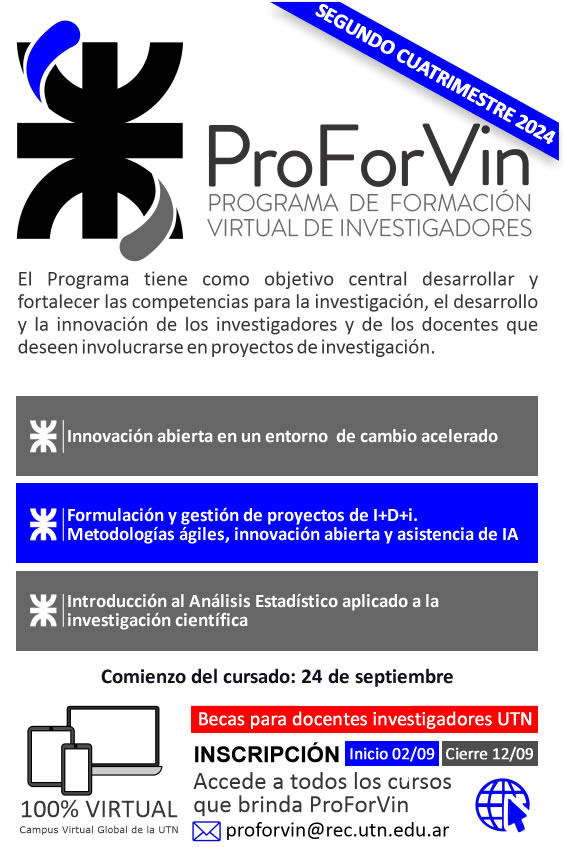
ProForVin: Inscripciones abiertas

Hasta el  12 de septiembre estará abierta la inscripción para una nueva edición de los siguientes cursos virtuales que organiza la Secretaría Académica, a través del Programa de Formación Virtual de Investigadores (PROFORVIN):


Los cursos se dictan a través de las aulas virtuales del Campus Virtual Global de la UTN, accediendo a ellas desde cualquier dispositivo con conexión a Internet. No hay horarios fijos de cursada.   

Los docentes investigadores de la UTN acceden a una beca del 100% del costo del curso.   

Los formularios de solicitud de inscripción y programas de los cursos están disponibles desde la página de cursos de PROFORVIN a la que se accede desde el flyer de este mensaje.   

Invitation to submit papers on indeterminacy and uncertainty for a Springer journal

;text-indent:0px;text-transform:none;word-spacing:0px;background-color:rgb(255,255,255)”>https://fs.unm.edu/NonStandardAnalysis-Imamura-proven-wrong.pdf 
New types of soft sets: HyperSoft Set, IndetermSoft Set, IndetermHyperSoft Set, SuperHyperSoft Set, TreeSoft Set: 
IndetermSoft Operators acting on IndetermSoft Algebra) 
Sociology
Psychology
Philosophy 
MultiAlist System of Thought
Zarathustra and Neutrosophy
The Principles of (Partial Locality, Partial Indeterminacy, Partial
NonLocality) and (Multi Locality,  Multi Indeterminacy, Multi NonLocality)
 
Neutrosophy Transcends Binary Oppositions in Mythology and Folklore 
Neutrosophy means: Common Parts to Uncommon Things and Uncommon Parts to
Common Things
https://fs.unm.edu/NSS/NeutroMeans1.pdf 
Upside-Down Logics: Falsification of the Truth & Truthification of
the False
https://fs.unm.edu/Upside-DownLogics.pdf 
  
Submission Open Date: September 15, 2024

Submission Deadline: January, 2025


Publication date: As per journal schedule
 
No Publication Fees 
Guest editors: 
S. A. Edalatpanah
Ayandegan Institute of Higher Education
Iran

Email: s.a.edalatpanah@aihe.ac.ir </span>” target=”_blank”>s.a.edalatpanah@aihe.ac.ir
 
Florentin Smarandache
University of New Mexico
USA

Email: smarand@unm.edu&lt;/span>” target=”_blank”>smarand@unm.edu 
Dragan Pamučar
University of Belgrade
Serbia
Email: dragan.pamucar@va.mod.gov.rs&lt;/span>” target=”_blank”>dragan.pamucar@va.mod.gov.rs  

Design by 2b Consult