



CALL FOR PAPERS
The 23rd IEEE/WIC International Conference on
Web Intelligence and Intelligent Agent Technology (WI-IAT)
December 9-12, 2024 | Bangkok, Thailand
The key theme: Web Intelligence = AI in the Connected World
A hybrid conference with both online and offline modes
Conference homepage: https://urldefense.com/v3/__https://www.wi-iat.com/wi-iat2024/__;!!KjDnqvtInNPT!iiClb2Ho5a8SDBxd7Jjyz54c_-1IaHk6noXsuyPlOoJHJtusXI-Ttb0InKfKOoZ4DRsg_Xg8jCQSiieHiBuu2A$
+++++++++++++++++++++++++++++++++++++++++++++++++++++++++++++++++
Main Conference Papers Submission System:
Workshops and Special Sessions Paper Submission:
Keynote Speakers
++++++++++++++++++
Professor Danilo Mandic
Fellow of the Institute of Electrical and Electronics Engineering (IEEE) President of the International Neural Network Society (INNS) Imperial College, UK
Professor Ong Yew Soon
Fellow of the Institute of Electrical and Electronics Engineering (IEEE) Nanyang Technological University, Singapore
Professor Guoyin Wang
Vice-President of the Chinese Association for Artificial Intelligence (CAAI) President of Chongqing Normal University Chongqing Normal University, China
Title: Brain Cognition Inspired Artificial Intelligence
More to be confirmed !
Sponsored By:
IEEE Computer Society
(IEEE-CS: https://urldefense.com/v3/__https://www.computer.org/__;!!KjDnqvtInNPT!iiClb2Ho5a8SDBxd7Jjyz54c_-1IaHk6noXsuyPlOoJHJtusXI-Ttb0InKfKOoZ4DRsg_Xg8jCQSiiehPSuReg$ ) IEEE Computer Society Technical Committee on Intelligent Informatics
(TCII: https://urldefense.com/v3/__https://www.computer.org/communities/technical-committees/tcii__;!!KjDnqvtInNPT!iiClb2Ho5a8SDBxd7Jjyz54c_-1IaHk6noXsuyPlOoJHJtusXI-Ttb0InKfKOoZ4DRsg_Xg8jCQSiidFHr5XQQ$ ) Web Intelligence Consortium
(WIC: https://urldefense.com/v3/__https://wi-consortium.org/__;!!KjDnqvtInNPT!iiClb2Ho5a8SDBxd7Jjyz54c_-1IaHk6noXsuyPlOoJHJtusXI-Ttb0InKfKOoZ4DRsg_Xg8jCQSiiftBWRlmw$ ) King Mongkut’s University of Technology Thonburi, Thailand
(KMUTT: https://urldefense.com/v3/__https://www.kmutt.ac.th/en/__;!!KjDnqvtInNPT!iiClb2Ho5a8SDBxd7Jjyz54c_-1IaHk6noXsuyPlOoJHJtusXI-Ttb0InKfKOoZ4DRsg_Xg8jCQSiicnrkanwg$ ) Asia-Pacific Neural Network Society (APNNS) IEEE-CIS Thailand Chapter
PAPER SUBMISSION
++++++++++++++++++
Papers must be submitted electronically via CyberChair in standard IEEE Conference Proceedings format (max 8 pages, templates at https://urldefense.com/v3/__https://www.ieee.org/conferences/publishing/templates.html__;!!KjDnqvtInNPT!iiClb2Ho5a8SDBxd7Jjyz54c_-1IaHk6noXsuyPlOoJHJtusXI-Ttb0InKfKOoZ4DRsg_Xg8jCQSiif-4KDQwg$ ).
Submitted papers will undergo a peer review process, coordinated by the International Program Committee.
The 2024 IEEE/WIC International Conference on Web Intelligence and Intelligent Agent Technology (WI-IAT'24) provides a premier international forum to bring together researchers and practitioners from diverse fields for presentation of original research results, as well as exchange and dissemination of innovative and practical development experiences on web intelligence and intelligent agent technology research and applications. Academia, professionals and industry people can exchange their ideas, findings and strategies in deepening the understanding of all Web's entities, phenomena, and developments in utilizing the power of human brains and man-made networks to create a better world and intelligent societies. More specifically, the fields of how artificial intelligence is impacting the Web of People, the Web of Data, the Web of Things, the Web of Trust, the Web of Agents, the Web in industry, society, health, and smart living, the Web of Everything, and emerging AIGC in WI-IAT.
Therefore, the theme of WI-IAT '24 will be:
“Web Intelligence = AI in the Connected World”.
WI-IAT '24 welcomes research and application paper submissions in these core thematic pillars under wider topics, which demand WI innovative and disruptive solutions for any of the next indicative sub-topics. Relevant topics include but are not limited to:
TRACKS AND TOPICS
++++++++++++++++++
TRACK 1: WEB OF PEOPLE
* Cognitive Modeling and Computing
* Conversational Search and Dialog Systems
* Crowdsourcing and Social Computing
* Human Centric Computing and Services
* Human Creativity and Decision-making Support
* Human-level Collective Intelligence
* Human-machine Co-intelligence in the Connected World
* Information Diffusion Modeling and Analysis
* Opinion Mining and Sentiment Analysis
* Recommendation Systems
* Situation and Personality Awareness
* Social Media and Social Networks
* User and Behavioural Modelling
* Wisdom Services
TRACK 2: WEB OF DATA
* Artificial Intelligence Generated Content (AIGC)
* Big Data Analytics and Deep Learning
* Big Data and Human Brain Complex Systems
* Cognitive Models and Computational Models
* Data Driven Services and Applications
* Data Integration and Data Provenance
* Data-Knowledge-Wisdom Hierarchy
* Data Science and Machine Learning
* Few-shot Learning and Transfer Learning
* Graph Isomorphism and Graph Theory
* Information Search and Retrieval
* Knowledge Graph and Semantic Networks
* Linked Data Management and Analytics
* Multimodal Data Fusion
* Large Language Models (LLMs) and Applications
* Representation Learning
TRACK 3: WEB OF THINGS
* Distributed Systems and Devices
* Dynamics of Networks
* Industrial Multi-domain Web
* Intelligent Ubiquitous Web of Things
* IoT Data Analytics
* Location and Time Awareness
* Open Autonomous Systems
* Sensor Networks
* Streaming Data Analysis
* Web Infrastructures and Devices Mobile Web
* Wisdom Web of Things
TRACK 4: WEB OF TRUST
* Blockchain Analytics and Technologies
* De-Platforming and No-platforming
* Decentralization of Internet
* Fake Content and Fraud Detection
* Hidden Web Analytics
* Monetization Services and Applications
* Trust Models for Agents
* Ubiquitous Computing
* Web Cryptography
* Web Safety and Openness
* Web-scale Security, Integrity, Privacy and Trust
TRACK 5: WEB OF AGENTS
* AI Agents and Multi-Agent Systems
* Autonomy Remembrance Agents
* Autonomy-oriented Computing
* Behaviour Modelling and Individual-based Modelling
* Chatbot and Intelligent Agent
* Computational Social Science
* Deep Reinforcement Learning
* Distributed Problem-Solving and Reasoning
* Edge Computing and Cloud Computing
* Local-global Behavioural Interactions
* Mechanism Design
* Network Autonomy Remembrance Agents
* Self-adaptive and Self-organizing Evolutionary Systems
* Social-cyber-physical Systems
* Symbols-Meaning-Value Space
SPECIAL TRACK: Web in Industry, Society, Education, Health and Smart Living, and the Web of Everything
* AIGC in Industry, Finance, Culture, Tourism, Education and Healthcare
* Data Brain, City Brain and Global Brain
* Data-driven Service Industry
* Data-driven Innovative Service-oriented Society
* Digital Ecosystems and Digital Epidemiology
* Digital Transformation and Digital Twin
* Generative AI and the Web of Everything
* Human-machine Symbiosis in a Connected World
* Web3, Metaverse and Smart Living
* Wellbeing and Healthcare in the 5G Era
SPECIAL TRACK in WI-IAT 2024: FAccT, LLM and AIGC
* Digital Divide, Fairness, Accountability, and Transparency
* Generative AI – LLM and AIGC
* Explainability and Interpretability
* Responsible AI
* Metric and Evaluation
* Applications and Use Cases
* Impact on Society
* Robustness and Security
IMPORTANT DATES
+++++++++++++++
June 30, 2024: Workshop Proposal Submission July 15, 2024: Papers Submission (Main Conference) July 30, 2024: Workshop Papers Submission August 30, 2024: Paper Acceptance Notification (Main Conference) September 15, 2024: Workshop Paper Acceptance Notification December 9, 2024: Workshops and Special Sessions December 10-11, 2024: Main Conference
Organization Structure
++++++++++++++++++++++
Honorary Chairs
* Irwin King, Chinese University of Hong Kong, Hong Kong, China
* Suvit Saetia, King Mongkut’s University of Technology Thonburi (KMUTT), Thailand
General Chairs
* Jonathan Chan, KMUTT, Thailand
* Ah-Hwee Tan, Singapore Management University, Singapore
* Yiyu Yao, University of Regina, Canada
Program Committee Chairs
* Kitsuchart Pasupa, KMITL, Thailand
* Sung-Bae Cho, Yonsei University, South Korea
* Mufti Mahmud, Nottingham Trent University, UK
* Haiqin Yang, International Digital Economy Academy, China
Local Organizing Chairs
* Nipon Charoenkitkarn, KMUTT, Thailand
* Phayung Meesad, KMUTNB, Thailand
* Kuntpong Woraratpanya, KMITL, Thailand
* Ruttikorn Varakulsiripunth, TNI, Thailand
Finance Chair
* Vajirasak Vanijja, KMUTT, Thailand
Workshop/Special Session Chairs
* Mark Chignell, University of Toronto, Canada
* Ashish Ghosh, Indian Statistical Institute, India
* Min Pan, Hubei Normal University, China
* Kaizhu Huang, Duke Kunshan University, China
Publicity Chairs
* Hongzhi Kuai, Maebashi Institute of Technology, Japan
* Susmita Ghosh, Jadavpur University, India
* Ka-Chun Wong, City University of Hong Kong, Hong Kong, China
Publication Chair
* Hongzhi Kuai, Maebashi Institute of Technology, Japan
Liaison Chair
* Sirawaj Itthipuripat, KMUTT, Thailand
WIC Steering Committee Chairs
* Ning Zhong, Maebashi Institute of Technology, Japan
* Jiming Liu, Hong Kong Baptist University, HK, China
WIC Executive Secretary
* Xiaohui Tao, University of Southern Queensland, Australia
Thanks for attention.
Kind Regards,
Ka-Chun
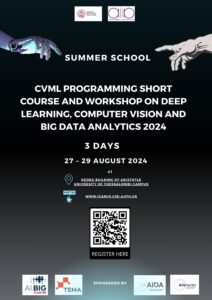
Last Call for Early Registration: Summer School “CVML Programming Short Course and Workshop on Deep Learning, Computer Vision and Big Data Analytics 2024”, 27-29 August 2024, Thessaloniki, Greece.
 July 16th, 2024
  Daniela Lopez de Luise
 the Artificial Intelligence and Information Analysis (AIIA[1]) Lab of Aristotle University of Thessaloniki (AUTH) in cooperation with (TEMA[2]) R&D project, the International AI Doctoral Academy (AIDA[3]), is excited to invite you to register and attend the upcoming “CVML Programming Short Course and Workshop on Deep Learning, Computer Vision and Big Data Analytics 2024[4]” which will take place in Thessaloniki, Greece from August 27th to 29th 2024.
This Summer School offers a three-day short course that delivers an in-depth exploration of programming tools and techniques for addressing a variety of computer vision and deep learning challenges.
The course focuses on the fundamentals of deep learning and its applications in Natural Disaster Management. Here's a glimpse of what the course entails:
- Deep neural networks – Convolutional NNs
- 2D Object Tracking in Embedded Systems
- Real Time Object Detection.
- Real-Time Image Segmentation.
- Natural Language Processing.
- Explainability in Computer Vision applications.
Additionally, hands-on programming workshops will be conducted on each topic, providing participants with practical experience and skills enhancement.
_DETAILS_
HOST INSTITUTION: ARISTOTLE UNIVERSITY OF THESSALONIKI
27, 28, 29 AUGUST 2024, 08:30 – 16:30 EEST (UTC + 3 HOURS)
ON-SITE PARTICIPATION: KEDEA[5] BUILDING, AUTH, THESSALONIKI, GREECE
GENERAL REGISTRATION
EARLY REGISTRATION[6] (TILL 15/07/2024)
Students/Scientists, Engineers from other scientific disciplines
having the necessary mathematical background are also welcomed to
register.
Special Registration for AIDA Students*
On top of the above registration, also enroll on this course using
the “ENROLL ON THIS COURSE” button on the AIDA course page[7], so that
this course is included on your AIDA Certificate of Course Attendance
upon successful completion of the program.
*AIDA Students are PhD students/candidates or Postdoc researchers
belonging to any AIDA member.
Upon successful completion of the course, participants will receive a CERTIFICATE OF ATTENDANCE issued by Aristotle University of Thessaloniki.
For more details, please visit:
https://icarus.csd.auth.gr/cvml-programming-short-course-and-workshop-on-deep-learning-computer-vision-and-big-data-analytics-2024/
School Organizer: Prof. Ioannis Pitas
Chair of the International AI Doctoral Academy (AIDA), Director of
the Artificial Intelligence and Information analysis (AIIA) Lab,
Aristotle University of Thessaloniki, Greece
Digital Data Processing 2024
July 16th, 2024 Daniela Lopez de Luise Yeshiva University. New York. US
September 30-October 01, 2024
(www.socio.org.uk/ddp)
(IEEE Xplore indexed)
As technology advances in different sub-domains of computing, data-driven models are becoming increasingly important. The data-dependent world now faces many challenges in terms of data accuracy and data privacy. High-impact advancements include machine learning, artificial intelligence, deep learning and many more. Data is growing exponentially in terms of diversity and complexity. One organization or industry processes over a few million transactions per hour and stores hundreds of billions of data. We live in a world with a great need for more efficient data analysis and processing. Data analytics can reveal hidden patterns, complex relationships, internal information relations, and even segmentation. Data applications have opened up new possibilities in every aspect of our lives. Studying data and its structure, dynamics, and modern data technologies is ongoing. There is a great deal of literature and research on data management, but it does not address the data processing needs. Many studies focus on developing models and systems for analyzing large datasets.
Data analysis leads to application domains that have a systematic impact on decisions. The knowledge gained from the data analysis enables the generation of critical information for multiple domains. In this conference, we review and discuss the latest trends in data management, the opportunities and challenges, and how they have affected organizations' ability to develop effective business and technology strategies and stay up-to-date in data technology. We also highlight current open research directions in data analytics that need further attention.
The proposed conference will discuss topics not limited to
Data applications in various domains and activities
Data in cloud
Real-world data processing
Data inaccuracy and reliability issues
Data Ecosystem
Business Analytics
New data analytics techniques
Physical and management challenges
Synthetic data
Data synthesis
Crowdsourcing and Sensing
Data modelling
Deep learning techniques
Data fusion
Descriptive analytics, Diagnostic analytics, Predictive Analytics, and Prescriptive analytics
Machine learning impact on data processing
Network optimization
Data in Biomedical Engineering
Data in Materials science and mechanics
Data handling and applications in domains
Wireless Networking Data Management
Data of Electronic & Embedded Systems
Multi-media Systems Data
Artificial Intelligence Models and Systems Data
E-Computing Data
Renewable Energies Data
General Chair
Honggang Wang, Yeshiva University, USA
Program Chairs
Youshan Zhang, Yeshiva University, USA
Ezendu Ariwa, Warwick University, UK
Simon Fong, University of Macau, Macau
Program Co-chairs
Martin Lopez Nores, University of Vigo, Spain
Keynote Speakers
1. Xiaofan (Fred) Jiang, Columbia University
2. Edwin Chihchuan Kan, Cornell University
Publications
All accepted and presented papers will be submitted to IEEE Xplore for publication and indexing.
The DDP 2024 has a co-located workshop on Data Analytics in Biomedicine
Modified versions of the papers will appear in the following journals.
Journal of Digital Information Management
International Journal of Computational Linguistics
Information Services & Use
Important Dates
Submission of Papers: July 31, 2024
Notification of Acceptance/Rejection: August 25, 2024
Camera-ready: September 25, 2024
Registration: September 25, 2024
Conference Dates: September 30- October 01, 2024
Post-Conference Proceedings Release: November 15, 2024
Paper submission
Papers should follow the IEEE template. Submissions at http://socio.org.uk/ddp/paper-submission/
Contact: ddp@socio.org.uk
Inscripciones Abiertas PARA EL DIPLOMADO EN GESTIÓN DE CALIDAD – FCE UNCUYO
July 16th, 2024 Daniela Lopez de Luise Está por iniciar
el Diplomado en Gestión de Calidad – 13ava Edición
El objetivo es capacitar e influir en los diferentes actores involucrados en organizaciones públicas y privadas para desarrollar una cultura organizacional que introduzca los principios en la calidad de gestión y de esta forma mejorar los productos y servicios que brindan
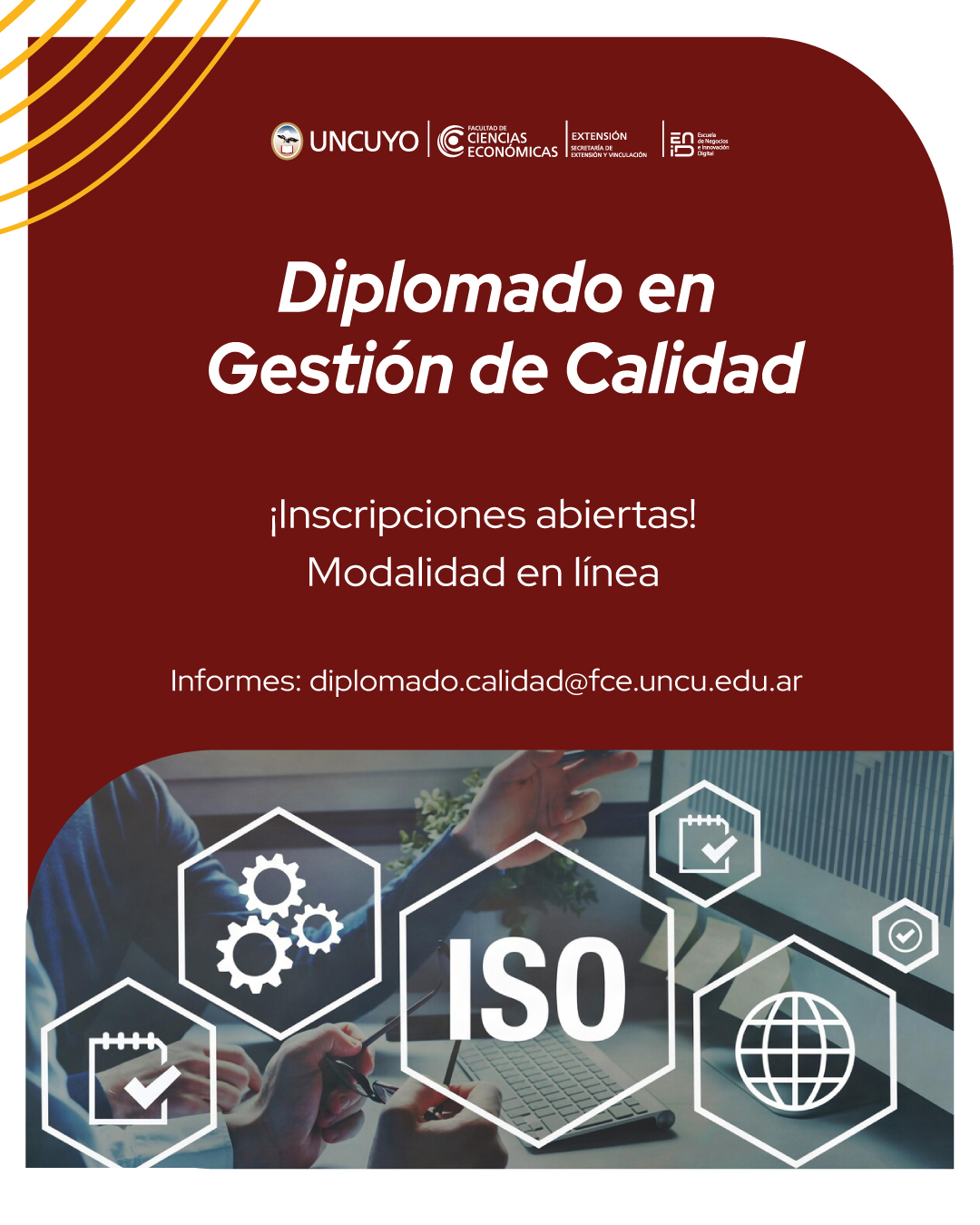
Inicia: 15 de agosto 2024
Para quienes
Aquellos aspirantes de organizaciones públicas, privadas y sociales, profesionales o no. No se requiere poseer título de grado. El aspirante al que se apunta deberá haber alcanzado, al menos, título de nivel secundario y contar con la posibilidad de vincularse con una organización para realizar los ejercicios prácticos.
Take Away
- Desarrolla una cultura organizacional que introduzca los principios de la calidad en la gestión.
- Obtén las herramientas adecuadas para facilitar la competitividad y sostenibilidad organizacional.
- Influye en la formación de personas, para mejorar la calidad de los productos y servicios que brindas.
- Comprende y adhiere a la cultura de la calidad de gestión en tu propio ámbito de ejecución y a los principios de ética y responsabilidad social que ésta comprende.
- Aprendé los sistemas de calidad y las principales herramientas de gestión, así como la aplicación de los mismos, incluyendo normas y modelos estratégicos de gestión.
- Lidera y/o gestiona el desarrollo e implementación de sistemas, procesos, productos y servicios, conforme a las metodologías universalmente reconocidas de la gestión de calidad.
☑️Programa Certificado
☑️Equipo de profesionales expertos
Duración
4 meses.
Dedicación
Total: ciento dos (102) horas.
Modalidad: 100% EN LÍNEA, por videoconferencia. 2 veces por semana.
Días Lunes y Jueves de 18:30 a 21:30 hs.
Las clases se graban
También se deberá elaborar un trabajo final aplicado.
Descuentos Institucionales
- 50% Profesor y Personal de Apoyo de la FCE – UNCUYO
- 20% Egresado y Estudiantes de la FCE-UNCUYO
- 20% Personal No docente UNCUYO
- 20% Matriculado en el CPCE de Mza
- 20% Matriculado en CLAM de Mza
- 20% Personal de Fecovita
- 20% Personal Familia Zuccardi
- 20% Asociación Ejecutivos de Mendoza
- 20% Personal Andes Growers
- 10% Egresado y Estudiante de la UNCUYO
Grupos de Afinidad
- 5% 2 participantes de la misma institución
- 10% 3 – 5 participantes
- 15% 6 – 10 participantes
- 20% 10 o más participantes
Los descuentos y tarifas corporativas NO SON ACUMULABLES.
Formas de Pago
- Transferencia o depósito bancario total o mensual
- Tarjetas de Crédito o Débito
Más Información en el adjunto
Esperamos tu inscripción
Saludos cordiales
October 19 ~ 20, 2024, Sydney, Australia – Online Paper Submission – CLSB 2024
July 16th, 2024 Daniela Lopez de Luise 5th International Conference on Cloud Computing, Security and Blockchain (CLSB 2024)
October 19 ~ 20, 2024, Sydney, Australia
https://csity2024.org/clsb/index
Scope & Topics
5th International Conference on Cloud Computing, Security and Blockchain (CLSB 2024) will act as a major forum for the presentation of innovative ideas, approaches, developments, and research projects in the areas of Cloud computing, Security and Blockchain. It will also serve to facilitate the exchange of information between researchers and industry professionals to discuss the latest issues and advancement in the area of Cloud Computing, Security and Blockchain.
Authors are solicited to contribute to the conference by submitting articles that illustrate research results, projects, surveying works and industrial experiences that describe significant advances in the following areas, but are not limited to.
Topics of interest include, but are not limited to, the following
Cloud Computing
· Case Studies and Theories in Cloud Computing
· Cloud Application, Infrastructure and Platforms
· Cloud Applications in Vertical Industries
· Cloud Based, Parallel Processing
· Cloud Business
· Cloud Computing Architecture
· Cloud Storage and File Systems
· Consolidation NoSQL Data Stores
· Data storage and Management in Cloud Computing
· Design Tool for Cloud Computing
· Energy Management and Programming Environments
· HPC on Cloud
· Location Based Services, Presence, Availability and Locality
· Maintenance and Management of Cloud Computing
· Map Reduce Techniques & Applications
· Networks within Cloud systems, the Storage Area, and to the Outside Virtualization in the Context of Cloud Computing Platforms
· Performance, SLA Management and Enforcement
· Resource Provisioning
· Service-Oriented Architecture in Cloud Computing
· Social Clouds (Social Networks in the Cloud)
· System Integration, Virtual Compute Clusters
· The Open Cloud: Cloud Computing and Open Source
· Virtualization on Platforms in the Cloud
Security
· Agent Based Trust Management
· Authorization, Authentication and Identity Management
· Cloud Integrity and Binding Issues
· Cloud, P2P, Clusters and Grid Computing: Security and Role of Trust
· Cryptographic primitives
· Pervasive Computation Trust
· Security Techniques for the Cloud
· Trust and Reputation Management
· Trust in Service-Oriented Architecture- Open Architecture and Services
· Trust Management for virtual organizations
· Trust Management system for Cloud
· Trust, Security, Privacy, Policy management in cloud
Blockchain
· Blockchain Attacks on Existing Systems
· Blockchain Authentication and authorization
· Blockchain based security for the IoT
· Blockchain Consensus Algorithms
· Blockchain Foundations
· Blockchain in digital forensic
· Blockchain issues and trends
· Blockchain New Design
· Blockchain Privacy
· Blockchain Scalability
Paper Submission
Authors are invited to submit papers through the conference Submission System by July 20, 2024. Submissions must be original and should not have been published previously or be under consideration for publication while being evaluated for this conference. The proceedings of the conference will be published by Computer Science Conference Proceedings in Computer Science & Information Technology (CS & IT) series (Confirmed).
Important Dates
· Submission Deadline: July 20, 2024
· Authors Notification: August 31, 2024
· Registration & Camera-Ready Paper Due: September 07, 2024
Contact Us
Here's where you can reach us: clsb@csity2024.org (or) clsbcon@yahoo.com
For more details, please visit: https://csity2024.org/clsb/index
Paper Submission Link: https://csity2024.org/submission/index.php