TALLER: “Ética en el Ejercicio Profesional de la Ingeniería”
Los Grupos de Afinidad de Miembros Vitalicios de la Región 9 invitamos al taller virtual gratuito sobre “Ética en el Ejercicio Profesional de la Ingeniería”, conducido por Norberto Lerendegui, y que se realizará el próximo jueves 4 de julio de 2024 por videoconferencia WebEx.
No se requiere inscripción previa.
Resumen
En este taller se analizará y discutirá cómo se gestionó y resolvió la falla de diseño en el edificio rascacielos Citicorp de Nueva York en 1978 y las implicancias éticas de las decisiones tomadas por los profesionales y funcionarios. Además se recorrerá la “Ética en Ingeniería y Tecnología” desde una perspectiva histórica y el rol de los Consejos y Colegios Profesionales. Asimismo, se tratará el Código de Ética de IEEE y la función del Comité IEEE de Ética y Conducta de la membresía (IEEE EMCC). Finalmente se analizarán en conjunto varios casos de ejemplo de Ética en el ejercicio profesional.
Facilitador: Norberto Lerendegui
Ingeniero Electrónico, UBA, Argentina y Master of Electronic Engineering, Eindhoven, Holanda
Profesor Titular y Secretario Académico de la Escuela de Ciencia y Tecnología de la Universidad Nacional de San Martín, Argentina
Ingeniero Eminente de IEEE Región 9
Presidente 2022-2023 del Comité de Ética de IEEE Región 9
Presidente 2021 y vicepresidente 2020 del Comité de Ética y Conducta de Membrecía de IEEE (IEEE EMCC)
Director Regional 2014-2015 de IEEE Región 9
Presidente 2005-2006 de la Sección Argentina de IEEE
Este evento es coorganizado por el Life Members Committee de la Región 9 y por los Grupos de Afinidad de Life Members de Argentina, Chile, Colombia, Monterrey, Panamá, Perú, Puerto Rico y Caribe, y Uruguay.
Abstract: El Internet de las cosas, o por sus siglas en inglés IoT, describe aquellos dispositivos cotidianos conectados a través de internet. Aunque esto implica una amplia variedad de situaciones, las cuales dependen de que es considerado “cotidiano”, existen especificaciones que sitúan a los dispositivos en un contexto específico para implementar estás innovaciones. En el siguiente curso, se intentan abordar aquellas temáticas y tecnologías propias del IoT, aplicados para la industria de la automatización y control. Se explicarán los conceptos teóricos y se realizarán las prácticas que impliquen el desarrollo de aplicaciones ciber físicas.
Fundamentación: El proceso actual de transformación tecnológica, conocido como Industria 4.0, se caracteriza por una fusión de tecnologías que están desintegrando las fronteras entre el mundo físico, el mundo digital y hasta la biología. En este contexto, aparece el concepto de Internet de las cosas, para describir aquellos dispositivos cotidianos a través de internet. Aunque este último concepto implica una amplia variedad de situaciones, las cuales dependen de que es considerado “cotidiano” para cada caso. En el siguiente curso, se intentan abordar aquellas temáticas y tecnologías propias de la industria de la automatización y control. Estos representarán el contexto cotidiano en donde se explicarán los conceptos teóricos y se realizarán las prácticas.
Objetivo General: Comprender cómo trabaja un sistema IoT punta a punta, las tecnologías de comunicación remota disponibles y cada una de las capas de aplicación involucradas. Diseñar y construir sistemas de embebidos orientados a un sistema descentralizado. Trabajar con toda clase de sensores en ambientes reales. Implementar dispositivos de acción, visualización y control como servomotores, motores paso a paso, sensores analógicos y digitales, pantallas LCD, teclados, y más. Tener las herramientas necesarias para toma de decisiones, gerenciar y tener un buen criterio del negocio con IoT como herramientas fundamentales.
Objetivos específicos: Aprender a identificar, seleccionar y programar chips de la familia ESP8266 y ESP32 Desarrollo de sistemas embebidos con conexión a WiFi Operar soluciones de comunicación remota GSM/GPRS Desarrollar sistemas del tipo Cliente/Servidor en una placa de desarrollo Uso de protocolos HTTP y MQTT Integración de placas de desarrollos con aplicaciones web
Perfil del destinatario: El curso está orientado a ingenieros y licenciados en sistemas, programadores, analistas, técnicos de infraestructura digital y público en general, que desee introducirse en el desarrollo de sistemas compatibles con los descritos como de Internet de las Cosas. Los estudiantes desarrollarán las habilidades interdisciplinarias necesarias para modelar una solución de Internet of Things para diferentes aplicaciones, tales como: mediciones de variables con o sin alarma, lazo de control digital o analógico con accionamiento digital, lazo cerrado simple de control continuo y otros de un tenor similar. Se le brindarán los conocimientos técnicos y metodológicos para desarrollar criterios de selección e implementación de sistemas ciber-físicos. Orientar a los participantes para desarrollar un enfoque crítico en consideraciones de seguridad para las tecnologías emergentes
Condiciones de admisión: Mínimos: Uso avanzado de PC. Facilidad para navegar por Internet. Lectura básica de textos técnicos en inglés. Conocimientos básicos de programación (Excluyente). Técnicos: Es deseable el conocimiento de programación y lenguajes de consulta a base de datos (Deseable). Conocimientos básicos de arquitectura de software (Deseable). Cada participante deberá asistir con una notebook personal para realizar las prácticas.
Temario:
Título
Teoría
Módulo 1
Introducción
Conceptos básicos. Armado de entorno para la grabación de placas. Primeros pasos
Módulo 2
Proyectos básicos
Ejecución típica del procesador. Opciones de programación. Pines de entrada y salida. Configuración digital y analógica. Uso de PWM.
Módulo 3
Comunicación
Uso de puerto UART. Uso de puerto I2C. Uso de puerto SPI
Módulo 4
Comunicación inalámbrica
Uso de Bluetooth. Conexión WIFI. Modos de funcionamiento STA y AP. Comunicación HTTP
Módulo 5
Cliente-Servidor
Websocket. Comunicación sincrónica y asincrónica. Arquitectura API REST. Aplicaciones Web
Módulo 6
Módulo 7
Proyectos avanzados
Control de flujo. Modularización de programas. Comunicación MQTT
Módulo 8
Esp. TS. Ciro Edgardo Romero:
Especialista en Internet de las cosas y Técnico en Automatización y Robótica. Trabaja en el rubro informático como líder de Investigación y desarrollo de nuevas tecnologías. Experiencia que abarca internet de las cosas, blockchain e inteligencia artificial. También es docente y difusor tecnológico.
Tenemos un concurso académico para un(a) profesor(a) en jornada completa en la Universidad de Talca, en el área de videojuegos o similar. Te agradecería mucho si puedes compartirlo con tus contactos, colegas o estudiantes doctorales prontos a graduarse que puedan estar interesados en postular.
Querido/a colega, te escribo en esta oportunidad para invitarte a participar del encuentro 'Mesa de Desarrollo de la Industria Naval. Avances y sinergias con petróleo y gas, puertos y offshore', organizado por el Instituto Nacional de Tecnología Industrial, INTI, a realizarse el próximo viernes 28 de junio, de 08.45hs a 13hs, en el Aula Magna de la Universidad Tecnológica Nacional, Regional Mar del Plata, con transmisión en vivo.
Nuestra Facultad fue invitada a participar del encuentro a partir del informe que realizamos el año pasado a pedido de YPF, titulado “Potencial impacto en el desarrollo nacional industrial, tecnológico y de transición energética, de la producción de hidrocarburos costa afuera en la Cuenca Argentina Norte (CAN)” y consideramos que es una excelente ocasión para contribuir a que los proyectos de explotación de recursos naturales en Argentina puedan llevarse adelante aprovechando la oportunidad para la aplicación intensiva de conocimientos y capacidades de ingeniería nacional, y para el desarrollo industrial y tecnológico de nuestro país.
Cursos: Diseño de Sistemas Instrumentados de Seguridad / Especializado de Lazo de Control Webinars: Ventosas para Vacío de la Empresa, MICRO AUTOMACION / Válvulas de Seguridad, CV CONTROL / Presentación cursos API REST / NODE-RED / Introducción a la seguridad de maquinarias, KDK ARGENTINA
Aquí encontra un listado de Cursos y Webinars programados para los meses de JUNIO y JULIO ofrecidos por AADECA para socios, estudiantes, docentes y profesionales del sector, los mismos se realizan en forma virtual por la plataforma ZOOM
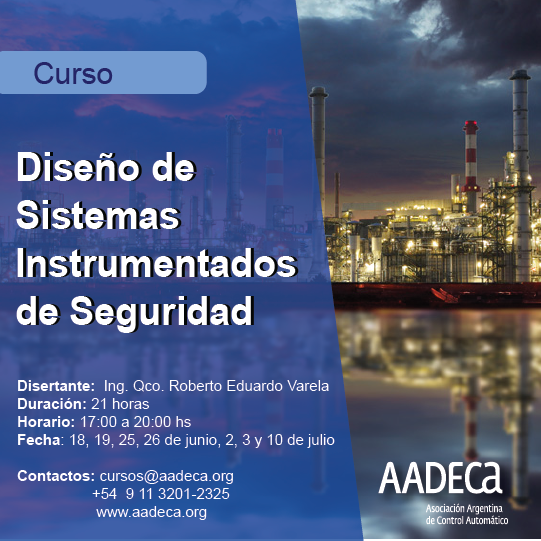
Diseño de Sistemas Instrumentados de Seguridad (Aplicación del Ciclo de Vida de Seguridasd de IE 61511) 10B
Ing. Qco. Roberto Eduardo Varela 18, 19, 25, 26 de junio, 2, 3 y 10 de julio 17:00 a 20:00 hs
ÚLTIMO DÍA DE INSCRIPCIÓN!!!
Existen distintas y variadas maneras de diseñar un sistema instrumentado de seguridad – SIS. Al comenzar con el diseño, los responsables deben encontrar respuesta a preguntas tales como:
Qué nivel de redundancia es el apropiado: simple, dual, triple?
Debe estar certificado? Probado en uso?
Qué normas de diseño se deben aplicar?
Cómo se diseña, instala, opera y mantiene?
Cuál es el intervalo de prueba de funcionamiento de cada una de las SIF implementadas: mensual, trimestral, anual o sólo cuando ocurra una parada?
Qué instrumentos utilizaremos en el campo, tanto para medición y transmisión, como para actuación final de control: Cuál tecnología, qué nivel de redundancia, qué intervalo de prueba, qué tiempo de reparación?
Qué documentación se requiere para el diseño? Qué documentación se debe generar?
Estas son sólo algunas de las preguntas que corrientemente se hacen los usuarios, las empresas de ingeniería, los integradores y aún los vendedores de soluciones, que participan en el diseño de SIS. El debate continúa hasta el momento en que alguien toma las decisiones, ya sea por experiencia, a partir de un análisis cuantitativo, o por decisión cualitativa, o porque ha sufrido un incidente y quiere prevenir un accidente mayor, etc.
Este curso es apropiado para Personal de Ingeniería, Procesos y Seguridad que es responsable del diseño e implementación de sistemas de seguridad; Personal responsable de la aplicación de las regulaciones de protección de medio ambiente, salud y seguridad de la planta y todo otro Personal técnico que use, opere, instale o sea responsable del mantenimiento de sistemas instrumentados de seguridad.
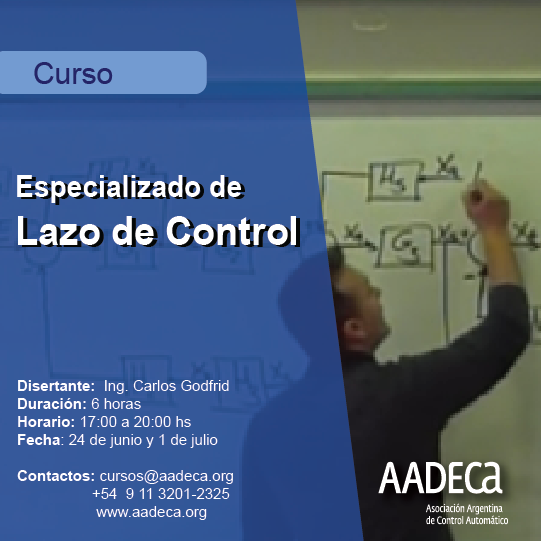
Especializado de Lazo de Control (7B)
Ing. Carlos Godfrid 24 de junio y 1 de julio 17:00 a 20:00 hs
Cuando la inteligencia artificial está en los titulares de los diarios, es fácil caer en la tentación de comprar el último software lanzado al mercado para mejorar el rendimiento de nuestros procesos. Pero para garantizar la estabilidad, el rendimiento y la seguridad de un proceso industrial a veces todo lo que hace falta es aplicar los conocimientos básicos de control automático. Así, dominar los principios y herramientas básicas del control nos ayudará a comprender y resolver problemas más complejos en nuestra área de trabajo. Y ese es el objetivo de este curso, destinado a profesionales en actividad con conocimientos generales del tema.
El Ing. Carlos Godfrid comienza analizando un lazo cerrado de control por medio de diagrama de bloques, y mostrando recursos disponibles para su análisis y diseño, con las fórmulas elementales para calcular seguimiento de referencias, rechazo de perturbaciones y efectos en el camino de realimentación. Luego se discutirá cómo calcular mejoras en la operación del lazo cerrado y se abordarán problemas básicos en control de sistemas dinámicos, como su inestabilidad, utilizando herramientas de análisis y diseño como diagramas de Bode, lugar de raíces y softwares de simulación.
Curso destinado a profesionales de automatización y control que quieran volver a ver los fundamentos del control automático. Siendo un curso de conceptos generales, está dirigido a ingenieros y técnicos de todas las especialidades, con conocimientos básicos de matemáticas.
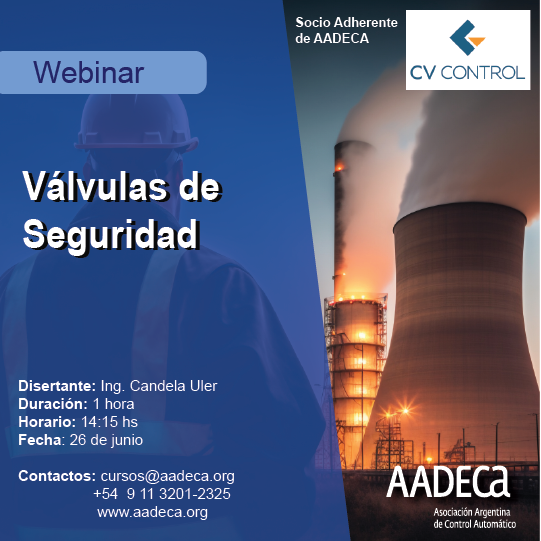
Válvulas de Seguridad
Ing. Candela Uler 26 de junio de 2024, 14:15 hs
WEBINAR GRATUITO! de nuestro socio Adherente CV CONTROL ¡Inscribite y Optimiza tus Conocimientos en Válvulas de Seguridad!
¿Cuáles son los distintos tipos de válvulas de seguridad? – Descubrí las diferencias entre válvulas operadas a resorte y pilotadas. ¿Cuál es la más adecuada para tus necesidades?
¿Cómo operan las válvulas de seguridad? – Entendé el principio de funcionamiento de estas válvulas cruciales. ¿Qué factores afectan su operación y vida útil?
¿Qué problemas comunes pueden afectar el funcionamiento de las válvulas de seguridad? – Aprendé a identificar y solucionar problemas recurrentes. ¿Qué señales indican un mal funcionamiento y cómo podemos prevenirlas?
¡Oportunidad de aprender y mejorar tus habilidades! Conéctate con profesionales del sector y adquirí conocimientos valiosos para tu carrera profesional. Dirigido a: Ingenieros, operarios de mantenimiento, y personal de taller.
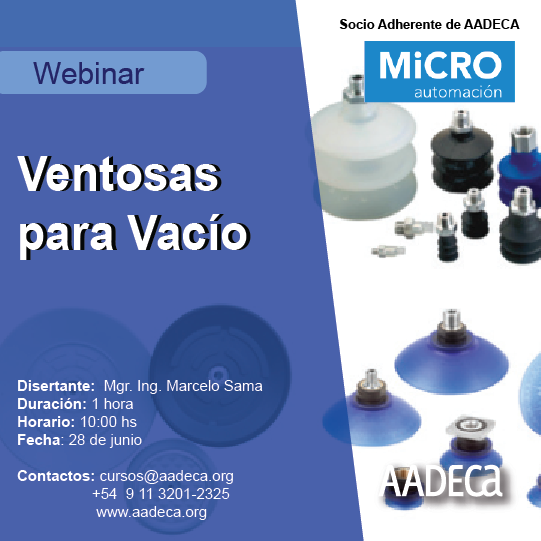
Ventosas para Vacío
Mgr. Ing. Marcelo Sama 28 de junio, 10:00hs
WEBINAR GRATUITO! de nuestro Socio Adherente MICRO AUTOMACIÓN
Principio de funcionamiento y definición de partes
necesidades energéticas
factores de seguridad
aceleración y desaceleración
objetos a manipular
ahorro de energía y costos en el sistema
clasificación de las ventosas
válvulas de control de doble caudal
elección y configuración de las ventosas
condiciones de uso
material de las ventosas
superficie de las ventosas
tipos de ventosas
ventosas planas
ventosas con fuelles
ventosas ovaladas
dimensionamiento de ventosas
coeficiente fricción
cálculo de la fuerza de retención
diámetro de la ventosa
capacidad de aspiración
recomendaciones para la elección de ventosas
materiales de ventosas: resumen de características
sistemas de agarre especiales
ventosas magnéticas: definición
ventajas de las ventosas magnéticas
posibilidades de montaje
campos típicos de aplicación
sistemas agarradores de aguja
posibilidades de uso
campos típicos de aplicación
Presentación cursos API APIREST / NODE-RED
Esp. Ciro Romero 1 de julio, 18:00 hs
WEBINAR GRATUITO!
Una forma de potencializar una solución tecnológica, es brindarle una interfaz amigable para los potenciales usuarios. En un marco de desarrollo de aplicación web, utilizar lenguajes de desarrollo de alto nivel pueden potenciar la integración con aplicaciones industriales.
Este tipo de aplicaciones se pueden lograr con interfaces de integración, conocidas como API-REST. En este conector, Python y Node-RED, son tecnologías de código abierto para el desarrollo de flujos de trabajo, son herramientas esenciales para la creación de aplicaciones robustas y la integración de sistemas en entornos industriales.
¿Qué podemos aprender? Desarrollo Interfaces de integración, o API-REST: D y Aplicaciones con Node-RED
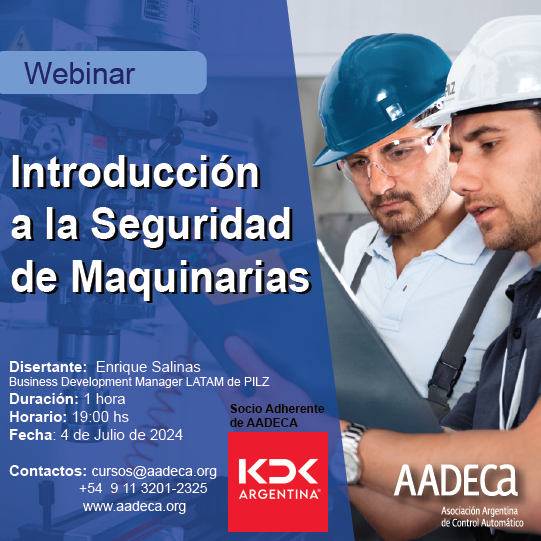
Introducción a la Seguridad de Maquinarias
Enrique Salinas – Business Development Manager LATAM de PILZ 4 de Julio, 19:00 hs
WEBINAR GRATUITO! de nuestro Socio Adherente KDK ARGENTINA La seguridad de máquinas y personas en el entorno industrial es un tema complejo que requiere un enfoque integral.
En este webinar haremos un recorrido por los conceptos más importantes asociados con la seguridad de máquinas, además de brindar herramientas y mejores prácticas para crear un entorno de trabajo más seguro y productivo.
Definiciones básicas sobre
Peligro
Riesgo
Accidente
¿De qué hablamos cuando hablamos de “seguridad”?
La seguridad como elemento crítico en las plantas industriales
El ciclo de la seguridad:
Análisis de riesgos
Concepto de seguridad
Diseño de seguridad
Implementación de seguridad
Validación de seguridad
Dirigido a profesionales de las áreas de: Mantenimiento / Ingeniería / Seguridad / Producción / Gerencia de Planta



 June 25th, 2024
  Daniela Lopez de Luise

 Add Event to Calendar
 iCal
iCal  Google Calendar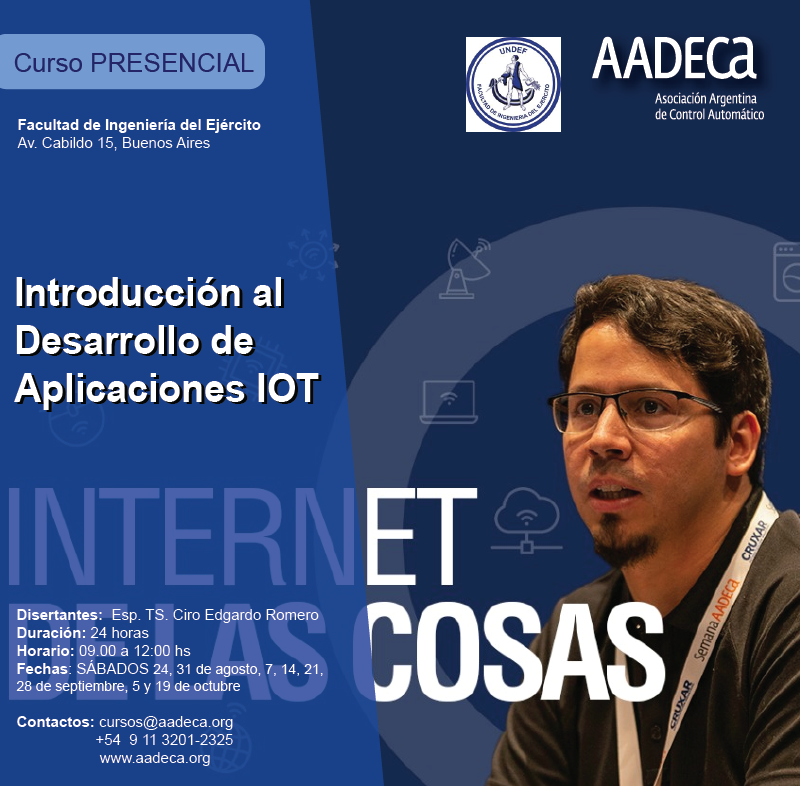

 Aviso-Profesor-Videojuegos-Junio-2024.pdf
.png)