
CfP: RSS 2023 Workshop on Robot Representations For Scene Understanding, Reasoning and Planning

Dear colleagues,

We are happy to announce our RSS 2023 workshop titled “Robot Representations For Scene Understanding, Reasoning and Planning“, scheduled for July 10 in Daegu, Republic of Korea.
We invite contributions (extended abstracts or short papers) focusing on novel advances in 3D scene understanding, predicate/affordance reasoning, high-level planning and at the boundary between these research areas.
Submission deadline: May 22, 2023, anywhere on earth
Acceptance notification: June 16
For more details, see below, visit the workshop website, or contact Julian at fjulian@ethz.ch.
Kind regards,
Jen Jen Chung, Luca Carlone, Federico Tombari, Julian Förster
———————————————————
Abstract
Robots now have advanced perception, navigation, grasping and manipulation capabilities, but how come it’s still exceedingly difficult to bring these skills together to get a robot to autonomously tidy a room? A key limiting factor is that robots still lack the contextual scene understanding capabilities that allow humans to efficiently and compactly reason about our world and our actions within it. Metric (where) and semantic (what) representations are now common, but contextual (how) representations–how do objects interrelate and how can a robot interact with objects to achieve the task?–are still missing. How should we formulate these representations, and crucially, how can we allow robots–embodied agents–learn and update their contextual scene understanding from live experiences? Researchers in AI knowledge representation and reasoning as well as in the more distant field of linguistics have long grappled with similar questions. The goal of this workshop is to bring together those experts with researchers in the fields of robot scene understanding and long-horizon planning to discuss the state of the art and uncover synergies across the currently disparate disciplines.
Speakers
Shuran Song (Columbia University), Jiayuan Mao (MIT), Janet Wiles (The University of Queensland), Manolis Savva (Simon Fraser University), Rajat Talak (MIT), Helisa Dhamo (Huawei)
Call for papers
Participants are invited to submit an extended abstract or short papers (up to 4 pages in RSS format) focusing on novel advances in 3D scene understanding, predicate/affordance reasoning, high-level planning and at the boundary between these research areas. Topics of interest include but are not limited to:
– Novel algorithms for spatial perception that combine geometry, semantics, and context;
– Approaches to learning and structuring contextual knowledge from complex sensory inputs;
– Techniques for reasoning over spatial, semantic, and temporal aspects for long-horizon planning;
– Approaches that combine learning-based techniques with geometric and model-based estimation methods; and
– Position papers and unconventional ideas on how to reach human-level performance in robot scene understanding, task planning and execution.
Contributed papers will be reviewed by the organizers and a program committee of invited reviewers. Accepted papers will be published on the workshop website and will be featured in spotlight presentations and poster sessions.
Workshop on Applications of Computational Intelligence and Interactive Systems (WACIIS-2023), August 18-19, 2023, Banasthali Vidyapith, India

Call for Papers

Dear Madam/ Sir,


We are pleased to inform you that the Centre for Artificial Intelligence, Banasthali Vidyapith is organizing a Workshop on Applications of Computational Intelligence and Interactive Systems (WACIIS-2023) during August 18-19, 2023 in association with IHCI-2023 (https://www.ihcisociety.org/ihci-2023).

Workshop on Applications of Computational Intelligence and Interactive Systems (WACIIS-2023) is a pre-conference workshop which aims to bring together researchers, engineers, and practitioners interested in the advancement of computational intelligence techniques and interactive systems, with a particular emphasis on robotics and automation, signal, vision, and language processing. This workshop will be hosted at the Centre for Artificial Intelligence, Banasthali Vidyapith, Rajasthan, India jointly in collaboration with IHCI-2023 (November 24-26, 2023, Daegu, South Korea).


Authors are invited to submit their original work and ideas to WACIIS-2023 in the following tracks as per the submission guidelines:

Track 1: Computational Intelligence in Signal, Vision, and Language Processing

Track 2: Interactive Systems using Robotics and Automation


Paper Submission:

Paper Submission: The papers may be submitted in the following categories.

Full papers (10 ~ 12 pages) are invited that describe developed work. Authors of papers reporting experimental work are encouraged to make their data and experimental results available online or via data publication.

Poster/ Short papers (4 ~ 6 pages) are invited to share novel ideas that may not have been fully developed but are in progress.

The submitted paper should be in English and PDF format and must strictly meet the LNCS (Springer) Template.

All papers must be submitted electronically using Microsoft CMT portal, available at following link:

https://cmt3.research.microsoft.com/WACIIS2023

All accepted and presented papers will be published in the proceedings of IHCI-2023 and submitted to Lecture Notes in Computer Science (LNCS), Springer. 


Important Dates:

Full Paper Submission: May 30, 2023

Notification of Acceptance: June 30, 2023

Camera Ready Submission: July 15, 2023

WACIIS-2023 Dates: August 18-19, 2023


For updates and other details, please visit workshop webpage at www.waciis.in

Please share the workshop details with your colleagues, students, faculty members, research scholars and encourage them to participate in this event.

In case of queries, please feel free to write to waciis2023@banasthali.in


Thank you.

With regards,

Organizing Committee, WACIIS-2023


CFP: 20th International Conference on Content-based Multimedia Indexing (CBMI 2023) – deadline extension

Call for Papers – Deadline Extension until April 24, 2023
20th International Conference on Content-based Multimedia Indexing (CBMI 2023)
September 20-22, 2023, Orleans, France
Authors are encouraged to submit previously unpublished research papers in the broad field of content-based multimedia indexing and applications. We wish to highlight significant contributions addressing the main problem of search and retrieval. This call also includes artificial intelligence inmultimedia analysis, user interaction, social media indexing and retrieval. In addition, special sessions on specific technical aspects or application domains are planned, such as Multimedia for Healthcare, Explainability of AI tools in Multimedia, Physical models in Multimedia mining. 
The CBMI proceedings are traditionally indexed and distributed by ACM DL. Best papers will be invited to submit extended versions of their contributions to a special issue of a leading journal in the field.
Topics of interest to the CBMI community include, but are not limited to, the following:
  • Content analysis and indexing
  • Audio and visual and multimedia content mining
  • Multimodal and cross-modal indexing
  • New AI /Deep Learning approaches for content understanding
  • Social media analysis
  • Metadata generation, coding and transformation
  • Activity recognition and event-based multimedia indexing Search, retrieval and recommendation
  • Multimedia information retrieval (image, audio, video, text)
  • Mobile media retrieval
  • Event-based media retrieval
  • Multimedia retrieval for multimodal analytics and visualization
  • Multimedia recommendation
  • Multimedia verification (e.g., multimodal fact checking, deep fake analysis)
  • Large scale multimedia database management
  • Summarization, browsing and organization of multimedia content
  • Evaluation and benchmarking of multimedia retrieval systems
  • Multimedia user experience
  • User interaction and relevance feedback
  • Multimedia interfaces, presentation and visualization tools
  • Affective adaptation, personalization
  • Virtual, augmented and mixed reality interfaces for multimedia search
  • Applications of multimedia indexing and retrieval, e.g., cultural heritage, healthcare and medicine, lifelogs, imagery for earth observation and astrophysics, augmented and mixed reality, video surveillance, forensics, security, sustainable environments
Important dates:
  • Regular and special session paper submissions: April 24, 2023 (extended)
  • Demo proposal: April 24, 2023 (extended)
  • Notification of acceptance: June 1, 2023
  • Camera ready: June 15, 2023
  • Early registration: July 1, 2023
  • Late Registration: August 15, 2023
  • Conference dates: September 20 – 22, 2023

What’s Next in Affect Modeling? – ACII Workshop | Deadline April 28

The first workshop on “What's next in Affect Modeling?” (http://whatnext.tamed-project.eu/) will be held online in conjunction with ACII 2023 (https://acii-conf.net/).

*** Description ***

The valid and reliable evaluation of affect and affective interaction is key for the advancement of affective computing (AC). Recent breakthroughs in deep (machine) learning and generative AI have boosted the efficiency and generality of affect models by discovering novel representations of users and their context acting on high resolutions of multimodal signals. Such representations, however, are data-hungry and in need of large datasets that AC is not able to offer. Moreover, as affect models gradually become larger and more complex, their expressivity, explainability, and transparency become increasingly opaque.

This workshop series puts an emphasis on state-of-the-art methods in machine learning and their suitability for advancing the reliability, validity, and generality of affective models. We will be investigating entirely new methods, untried in AC, but also methods that can be coupled with traditional and dominant practices in affective modeling. In particular, we encourage submissions that offer visions of particular algorithmic advancements for affect modeling and proof-of-concept case studies showcasing the potential of new sophisticated machine learning methods. This is the third workshop in the series after the successful first and second events organised in conjunction with ACII 2021 and 2022. Papers were submitted, and after a double-blind peer-review process (three reviewers assigned to each paper), the accepted ones were presented during the event. Besides paper presentations, the workshop featured a keynote talk delivered by Prof. Michel Valstar (2021) and Prof. Erik Cambria (2022). Around twenty-five participants attended each of the workshops.

Topics include but are not limited to:

– Representation learning of affect

– Signal tensorization for affect modelling

– Unsupervised tensor subspace learning and supervised (semi- and self-) tensor-based machine learning for affect modeling

– RL as an affective computing paradigm

– Causal and anticausal predictors in affect modeling

– Contrastive learning paradigms and models for affect modeling

– Neural architecture search and open-ended evolution for affect

– Distributed and Disentangled Affect Representation

– Sophisticated multimodal fusion (e.g. via tensors) of affective signals

– Explainable affect models

– Applications studies in education, art, creativity, health, psychology, and beyond

*** Important dates ***

– Paper submission: 28 April 2023

– Notification of acceptance: TBA

– Camera-ready submission: TBA

Organizers

– Matthew Barthet, Konstantinos Makantasis, Georgios N. Yannakakis, Bjoern Schuller, Guoying Zhao

** Endorsed by ***

AI4MEDIA project: https://www.ai4media.eu 

sustAGE EU RIA project: https://www.sustage.eu

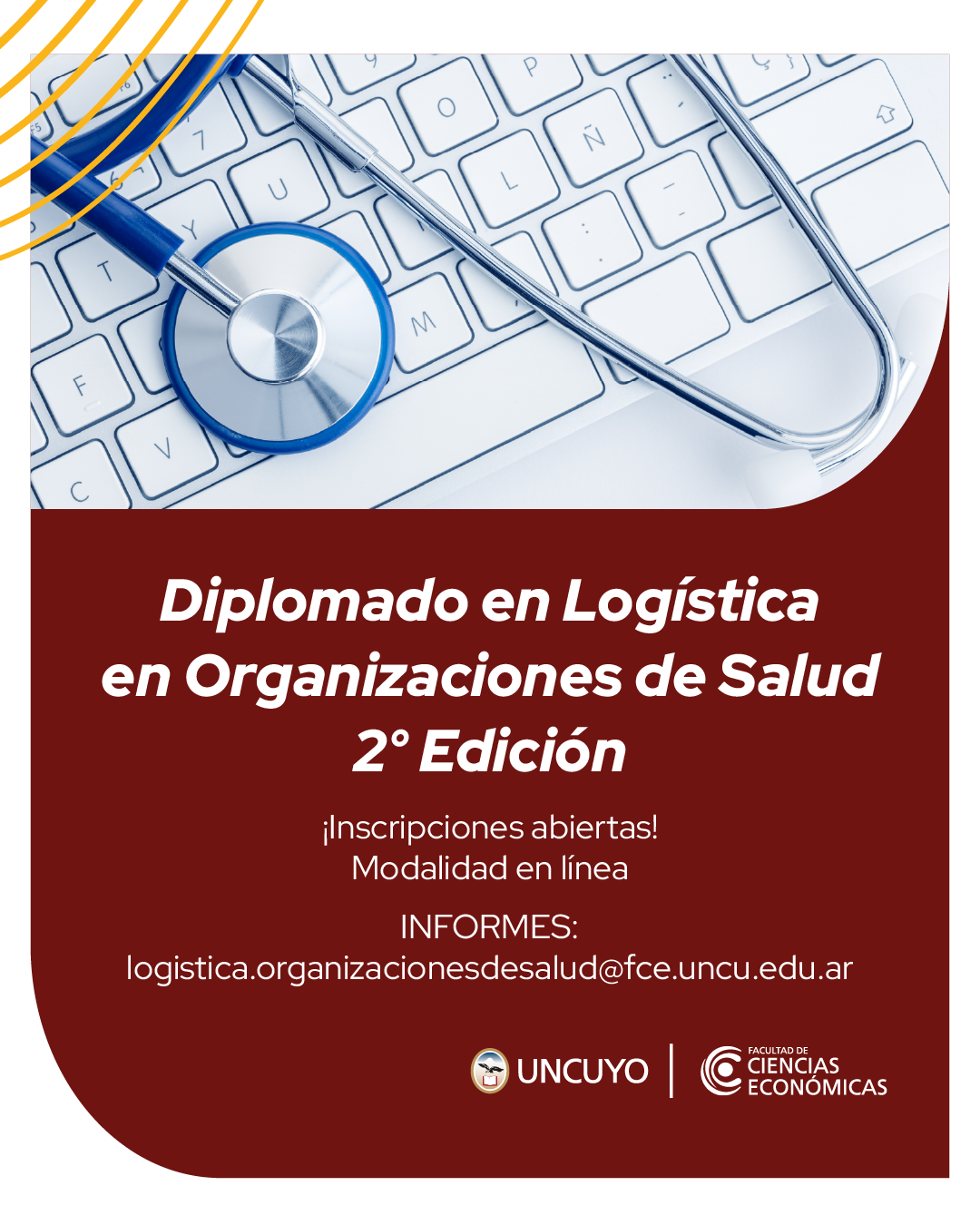
INSCRIPCIONES ABIERTAS para el Diplomado en Logística en Organizaciones de Salud – 2da Edición

To:

En ABRIL inicia

el Diplomado en Logística en Organizaciones de Salud

2da Edición

La logística de las OdS, como depositaria del bien más preciado de la humanidad, la salud, propone soluciones integrales y multidisciplinarias al conjunto de actores que intervienen en la cadena de valor de la salud 


edit_diplomado_copia_21.png


Dictado

El Diplomado tiene carácter virtual. El participante accederá a un aula virtual para completar evaluaciones, obligaciones o trabajos requeridos por cada profesor, así como consultar materiales y participar en foros de análisis y debate, entre otras tareas

Inicia: 26 de abril 2023


Para quienes

Dirigido a todas las personas relacionadas con el ámbito de la salud interesadas en adquirir herramientas logísticas. Personal de OdS y organizaciones afines a la salud, vacunatorios, farmacias, veterinarias, centros de estética, responsables de distintas áreas: administrativas, depósitos/almacenes, laboratorios, mantenimiento, higiene y seguridad, gestión de las personas entre otras, que acrediten como mínimo título secundario.


Take Away 

  • Adquirir conocimientos de logística integral con un enfoque hacia los actores de las OdS.
  • Incorporar herramientas logísticas en el ámbito de la salud.
  • Capacitar en habilidades de planificación, ejecución y control de la cadena de valor de las OdS.

Programa Certificado

Los participantes obtendrán un certificado otorgado por la Facultad de Ciencias Económicas de la Universidad Nacional de Cuyo. Propuesta aprobada por el Consejo Directivo de la Facultad a través de la resolución Nº 402/2021 CD.


Dictado por un equipo de profesionales expertos

Consultá el PROGRAMA con más detalle aquí

CRONOGRAMA

Duración

4 meses

Dedicación

Total: noventa y seis (96) horas. 

Sincrónicas: 16 clases, cuarenta y ocho (48) horas.

Asincrónicas: cuarenta y ocho (48) horas con actividades en plataforma. 

También se deberá elaborar un trabajo final integrador.


Modalidad: 100% EN LÍNEA, por videoconferencia. Una vez por semana

los días Miércoles de 18:30 a 21:30 hs.

Todas las clases se graban


Inversión y formas de pago:

El valor del Diplomado para el público en general es de $45.000. 

Inscripción: $13.000. 

y cuatro (4) cuotas de $8.000. (1ra cuota se abona en marzo)


Descuentos Institucionales

50% Profesor y Personal de Apoyo de la FCE – UNCUYO (Inscripción $13.000 y 4 cuotas de $2.750)
20% Egresado y Estudiantes de la FCE-UNCUYO (Inscripción $13.000 y 4 cuotas de $5.750)
20% Personal No docente UNCUYO  (Inscripción $13.000 y 4 cuotas de $5.750)
10% Egresado y Estudiante de la UNCUYO (Inscripción $13.000 y 4 cuotas de $6.875)
20% Matriculado en el CPCE de Mza (Inscripción $13.000 y 4 cuotas de $5.750)
20% Matriculado en CLAM de Mza (Inscripción $13.000 y 4 cuotas de $5.750)


Grupos de Afinidad

5% 2 participantes de la misma institución
10% 3 – 5 participantes
15% 6 – 10 participantes
20% 10 o más participantes

Los descuentos y tarifas corporativas NO SON ACUMULABLES.

Formas de Pago

  • Transferencia o depósito bancario total o mensual
  • Tarjeta de Crédito o Débito (3 cuotas sin interés)

Los pasos para completar el proceso de inscripción y efectivamente reservar un lugar son:


1. Llenar la ficha de inscripción 

https://forms.gle/EYBhUtMXKe9Tgn1L6


2. En el cuerpo de un mail que debe enviar a logistica.organizacionesdesalud@fce.uncu.edu.ar, los siguientes datos, para que nosotros generemos la factura correspondiente:


NOMBRE COMPLETO o RAZÓN SOCIAL:

CUIT o CUIL:

Dirección:

Condición frente al IVA


3. Y en adjunto del mail 

-foto del DNI (anverso y reverso)

-comprobante de transferencia o depósito de la inscripción


Transferencia Bancaria a la siguiente cuenta:

Asociación Cooperadora FCE UNCUYO (IVA EXENTO)

Cuenta Corriente Nº267-664825311-000
CUIT 30-64825311-3
C.B.U. 0340267400664825311004
ALIAS: FCE.COOP.UNCUYO
Banco Patagonia


Con tarjeta de crédito o débito a través de Mercado Pago

link de pago valor total incluida la inscripción del curso ($45.000) (3 cuotas sin interés)

https://mpago.la/22jA3bv

link de pago inscripción al curso ($13.000)

https://mpago.la/2QW2seo

Esperamos tu inscripción

Saludos cordiales

Lic. Mariángeles Fernández Kaul
Sec. de Extensión y Relaciones Institucionales 

FCE-UNCUYO
Mendoza – Argentina
Tel: +54-261-4494009 Int. 2500
Design by 2b Consult