DEADLINE APPROACHING – ACM ICMI 2026: Call for Special Sessions

!!! DEADLINE APPROACHING !!!
ICMI 2026 CALL FOR SPECIAL SESSIONS
============================================
5-9 October 2026, Napoli – Italy
https://icmi.acm.org/2026/
============================================

The ICMI 2026 organizing committee invites proposals for Special Sessions to be held during the 28th International Conference on Multimodal Interaction (ICMI 2026) in Naples, Italy. ICMI is the premier international forum that brings together multimodal artificial intelligence (AI) and social interaction research. Multimodal AI encompasses technical challenges in machine learning and computational modeling, such as representations, fusion, data, and systems.

* Important Dates
Special Session Proposal Submission Deadline    February 18th, 2026
Notification of Acceptance                      February 27th, 2026

* Special Session Proposals
Special sessions provide an opportunity to explore emerging topics within multimodal interaction and are a key part of this year’s conference program. We are seeking proposals that will enhance the conference’s diversity and offer valuable insights into the conference theme of “Context and Cultural Awareness for Multimodal Interaction”.

Prospective special session organizers are invited to submit proposals via icmi2026-specialsessions-chairs@acm.org. Special Session Proposals should include the following information:

– Title: A title that shows the relevance of the session for the ICMI community and the novelty of the chosen topic.
– Aims and scope: Explain why the chosen topic is novel and relevant, with the potential to contribute to the growth of the ICMI community and/or is aligned with this year’s conference theme.
– Tentative speakers: A list of prospective contributing authors with tentative titles for their contributions. Special Sessions are normally expected to have 4 to 6 papers. While there is some flexibility for invited keynote and industry talks, the majority of the special session should consist of peer-reviewed papers.
– Organizers and bios: A short bio of the session organizers including their experience in the topic of the Special Session.

The primary criteria in evaluating the special session will include the relevance of the topic, the quality and track record of the proposers and speakers, diversity, the coherence of the proposal, and the expected value it will bring to the conference. We prioritize proposals that meet these criteria and welcome submissions from underrepresented communities.

The organizers of accepted special sessions will actively participate in the high-quality peer review process for submitted papers, following ICMI standards for the main track papers. They will serve as Area Chairs (ACs) for their proposed sessions, being responsible for tasks such as assigning reviewers and facilitating discussion phases. Papers submitted to an accepted Special Session will follow the same review process as the main conference track papers, including the same submission system (PCS), formatting guidelines (short or long papers), notification dates, and a rigorous peer review process.

37th IEEE International Symposium on Software Reliability Engineering (ISSRE 2026): First Call for Workshop Proposals

*** First Call for Workshop Proposals ***

37th IEEE International Symposium on Software Reliability Engineering
(ISSRE 2026)

October 20-23, 2026, 5* St. Raphael Resort and Marina
Limassol, Cyprus

Objectives

ISSRE strives to be the conference that appeals to both researchers and practitioners. To
that end, we invite proposals for workshops to co-locate with the Symposium and provide
additional opportunities for collaborating and exchanging information. The workshops
aim at discussing research developments and challenges at an early stage. ISSRE welcomes
workshops that explore new ways to provide and assess software reliability, safety, and
security. We also seek workshops that deal with the provision of reliable, safe, and secure
software and systems in fast-growing, transformative application domains. Appropriately
defined workshop proposals have the following characteristics:

They offer researchers a forum to exchange and discuss scientific and engineering ideas
at an early stage before maturation that would warrant conference or journal publication.
They attract practitioners and researchers to working sessions to discuss and make
progress toward solutions to current and future problems in engineering high assurance
software and systems.
They focus on collaborative discussions and information sharing between researchers
and industry practitioners.
Recurring Workshops

Workshops affiliated with ISSRE in previous years with good organization and numbers of
participants are pre-approved. Their organizers do not need to submit a new workshop
proposal. Their organizers are kindly asked to inform the workshop chairs about returning
the workshop to ISSRE in 2026.
Topics of Interest

Topics of interest include development, analysis methods and models throughout the
software development lifecycle, and are not limited to:

Primary dependability attributes (i.e., security, safety, maintainability) impacting software
reliability
Secondary dependability attributes (i.e., survivability, resilience, robustness) impacting
software reliability
Reliability threats, i.e. faults (defects, bugs, etc.), errors, failures
Reliability means (fault prevention, fault removal, fault tolerance, fault forecasting)
Machine Learning and AI-based approaches for enhancing reliability of systems
Reliability, threads and biases of AI-based software systems, in particular Large
Language Models
Data-related reliability and vulnerability issues and risks
Learning-based models of software systems, threads, and reliability estimates
Automated debugging and program repair
Metrics, measurements and threat estimation for reliability prediction and the interplay
with safety/security
Reliability of software services
Reliability of open source software
Reliability in networks softwarization
Reliability of Software as a Service (SaaS)
Reliability of software dealing with Big Data
Reliability of model-based and auto-generated software
Reliability of software in artificial intelligence based software systems
Reliability of software within specific types of systems (e.g., autonomous and adaptive,
green and sustainable, mobile systems)
Reliability of software within specific technological spaces (e.g., Internet of Things,
Cloud, 5G/6G, edge-to-cloud computing, Semantic Web/Web 3.0, Virtualization,
Blockchain)
Normative/regulatory/ethical spaces pertaining to software reliability
Societal aspects of software reliability
Proposal Submissions

Workshop proposals should include information about the proposed organizing committee
and address the following questions:

Workshop length: Half day or one full day
Workshop style: papers, panels, posters, workgroups
Outline of themes and goals of the workshop
How will you solicit participation (call for workshop papers, invitation only, etc.)
Desired/estimated number of participants
Organizing committee members and their past experience

Submissions need to be performed via Easy Chair, selecting the appropriate track for
workshop proposals. The submission link is:
Proposal Evaluation

Workshop proposals will be evaluated by the ISSRE 2026 Organizing Committee. The
criteria include the alignment with the ISSRE charter, relevance to the larger ISSRE
community, and the strength and experience of the organizing team.
Logistics

The conference will be “in presence” with all presenters of accepted papers expected to
attend the conference physically in Limassol, Cyprus.
Important Dates (AoE)

Workshop proposal deadline: May 14, 2026
Workshop proposal notification: May 21, 2026
Workshop paper submission deadline: July 20, 2026
(NOTE: This date is only indicative – please refer to individual workshop webpages for
information about deadlines)
Workshop paper notification to authors: August 10, 2026
Camera ready papers: August 17, 2026
Organisation

General Chairs
• Leonardo Mariani, University of Milano – Bicocca, Italy
• George A. Papadopoulos, University of Cyprus, Cyprus

Program Coordinator
• Roberto Natella, GSSI, Italy

Research Program Committee Chairs
• Domenico Cotroneo, UNC Charlotte, USA
• Jie M. Zhang, King's College London, UK

Industry Program Chairs
• Jinyang Liu, Bytedance, USA
• Sigrid Eldh, Ericsson AB, Sweden

Workshop Chairs
• Georgia Kapitsaki, University of Cyprus, Cyprus
• August Shi, The University of Texas at Austin, USA

Doctoral Symposium Chairs
• Stefan Winter, LMU Munich, Germany
• Lili Wei, McGill University, Canada

Fast Abstract Chairs
• Luigi Lavazza, University of Insubria, Italy
• Yintong Huo, SMU, Singapore

JIC2 Chair
• Helene Waeselynck, LAAS-CNRS, France

Publicity Chairs
• Allison K. Sulivan, The University of Texas at Arlington, USA
• Jose D'Abruzzo Pereira, University of Coimbra, Portugal

Publication Chairs
• Sherlock Licorish, Otago Business School, New Zealand
• Maria Teresa Rossi, GSSI, Italy

Artifact Evaluation Chairs
• Naghmeh Ivaki, University of Coimbra, Portugal
• Fumio Machida, University of Tsukuba, Japan

Diversity and Inclusion Chair
• Eleni Constantinou, University of Cyprus, Cyprus

Financial Chair
• Costas Pattichis, University of Cyprus, Cyprus

Web Chairs
• Michalis Ioannides, Easy Conferences LTD
• Elena Masserini, University of Milano – Bicocca, Italy

Registration Chair
• Easy Conferences LTD

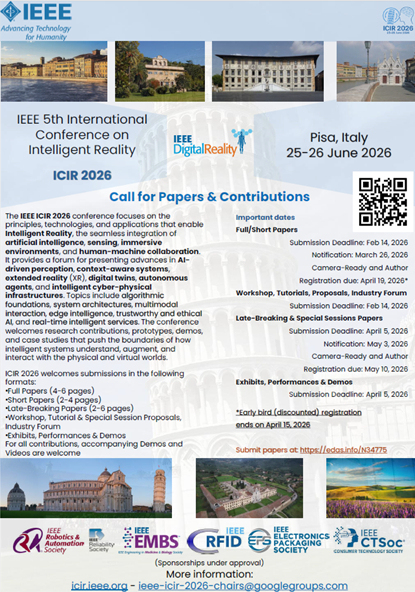
Call for Papers — IEEE ICIR 2026 | Submission Deadline: February 14, 2026

Dear Colleagues and Members of the IEEE Community,
The submission deadline for the first round of papers is approaching. We kindly remind you that full and short paper submissions are due on February 14, 2026 (23:59 AoE).
You are invited to contribute to the IEEE 5th International Conference on Intelligent Reality (ICIR 2026) https://icir.ieee.org/, asset of the IEEE Digital Reality Technical Community (DRTC) (https://digitalreality.ieee.org/), which will be held on June 25–26, 2026, at the Aula Magna Pontecorvo, University of Pisa, in Pisa, Tuscany, Italy.
ICIR 2026, supported by the National Research Council of Italy (CNR) and the University of Pisa, provides an international forum for researchers, educators, and industry professionals working on Intelligent Reality—the convergence of physical and digital worlds enabling effective collaboration between humans and intelligent machines. The conference focuses on advances leveraging Artificial Intelligence, Extended Reality (AR/VR/MR), Digital Twins, IoT, Robotics, Wearables, Blockchain, 5G, and related technologies to enable advanced simulations, real-time analytics, and immersive visualizations.
Areas of Interest include (but are not limited to):
• Emerging Technologies for Intelligent Reality (AI, Machine Learning, etc.)
• Extended Reality (XR), including AR/VR/MR
• Simulation and Digital Twins
• Cyber-Physical Systems (CPS)
• 3D Modeling, Scanning, and Reality Capture
• Computer Vision and Graphics
• Hardware, Software, and Devices for Intelligent Reality
• Security, Ethics, Privacy, and Trust
Important Dates — First Round (Upcoming Deadline)
Full Papers (4–6 pages) | Short Papers (2–4 pages)
Submission Due: February 14, 2026
• Notification to Authors: March 26, 2026
• Camera-Ready Version & Author Registration: April 19, 2026
Workshops, Tutorials, Proposals, Industry Forum
Submission Due: February 14, 2026
Additional opportunities are available through Late-Breaking Papers, Special Sessions, Exhibits, Demos, and Performances, with later deadlines.
All deadlines refer to 23:59 (AoE) of the respective days.
Early Bird Registration ends on April 15, 2026.
Submissions are open at: https://edas.info/N34775
We look forward to welcoming the global Intelligent Reality community to Pisa in 2026.
For more information, please visit the ICIR 2026 website:
https://icir.ieee.org/
We encourage you to submit your work and participate in ICIR 2026. We look forward to welcoming you to Pisa.
Sincerely,
IEEE ICIR 2026 Organizing Committee

To avoid being contacted, please write to the e-mail address of the sender.
facebook

 
twitter

 
instagram

 
linkedin

Alessandro Tonacci
CNR, ISTITUTO DI FISIOLOGIA CLINICA
Tel. 0503152350
Via Giuseppe Moruzzi, 1, 56124 – Pisa
Devolvi il 5×1000 al CNR
CF 80054330586

CfP – Elsevier COMCOM – Special Issue on Intelligence and Service Orchestration in Next-Generation Mobile Networks

================================================================================

DEADLINE APPROACHING – Final Manuscript Submission Deadline 28/02/2026

CALL FOR PAPERS

Elsevier Computer Communications

Special Issue

“Intelligence and Service Orchestration in Next-Generation Mobile Networks”

https://www.sciencedirect.com/special-issue/327227/intelligence-and-service-orchestration-in-next-generation-mobile-networks

================================================================================


Mobile communication and computing infrastructures are undergoing a profound transformation, moving toward highly dynamic, service-centric ecosystems. Fundamental to this evolution is a novel paradigm for the infrastructure and service management for 5G-and-beyond networks.


Indeed, the architectural paradigm of 5G is shifting toward Open Radio Access Network (RAN), which introduces RAN Intelligent Controllers (RICs) for network overseeing and reconfiguring through Artificial Intelligence (AI) applications able to enhance the overall performance. The shift from monolithic components to virtualized functions through Network Function Virtualization (NFV) and the adoption of Software Defined Networking (SDN) allow the deployment of innovative solutions that demand flexible orchestration methods.


In this context, Service Management and Orchestration (SMO) and Network and Service Orchestration (NSO) play a crucial role by enabling real-time automation and optimization across highly dynamic and heterogeneous network environments, whilst integrating radio, transport, and core domains under a single control plane. These solutions are apt to tackle key challenges including service provisioning, resource allocation, power consumption, and quality of service. Central to this scenario is the role of AI, which enables closed-loop network automation and control, predictive management, automated fault detection, and intent-based service delivery. As such, network intelligence is essential for resilient, scalable, and adaptive orchestration techniques capable of meeting the stringent latency, reliability, and performance requirements of future mobile networks.


This Special Issue aims to collect innovations proposed by the research community in the field of Intelligence and Service Orchestration in next-gen mobile networks. These topics and challenges have recently been investigated by researchers, telco stakeholders, government agencies, and international organizations (e.g. NextGenerationEU, CAMARA).


Topics of interest include, but are not limited to:


  • Management and orchestration architectures and techniques for next-gen networks
  • Automation, coordination, management and optimization of network resources and services
  • Placement and resource allocation for VNFs
  • Resource monitoring and service analytics
  • Orchestration solutions for control plane, core, and RAN
  • Orchestration in Transport and Multi-Domain Networks
  • Enabling technologies for network orchestration
  • AI-based network orchestration
  • Closed-loop automation engines in NSO
  • Zero-Touch and intent-driven Open RAN orchestration, optimization, control, and management
  • QoS in network orchestration
  • NSO for sustainability
  • Resilience, scalability, and adaptability of next-gen networks
  • Industry-supported efforts for network optimization
  • Integrated Sensing and Communications
  • Privacy in orchestration frameworks
  • Energy-aware and Sustainable Network Management
  • Testbeds, emulators and benchmarking for orchestration solutions


***Manuscript submission information***


The journal's submission platform (Editorial Manager®) will be open for submissions to this Special Issue from October 26, 2025. Please refer to the Guide for Authors to prepare your manuscript and select the article type of “VSI: Intelligent Orchestration in Next-Generation Networks” when submitting your manuscript online. Both the Guide for Authors and the submission portal could be found on the Journal Homepage: https://www.sciencedirect.com/journal/computer-communications


The impact of SI contributions should be clearly demonstrated in the context of the theme of the special issue. Papers that do not directly address this theme are considered out of scope and are subject to immediate rejection.


***Timeline***


Submission Open Date 26/10/2025


Final Manuscript Submission Deadline 28/02/2026


Editorial Acceptance Deadline 15/09/2026


***Guest editors***


Prof. Abderrahim Benslimane

University of Avignon, France

Email: abderrahim.benslimane@univ-avignon.fr


Prof. Cristiano Bonato Both

University of Vale do Rio dos Sinos (UNISINOS), Porto Alegre, RS, Brazil

Email: cbboth@unisinos.br


Prof. Giang T. Nguyen

Dresden University of Technology, Germany

Email: giang.nguyen@tu-dresden.de


Prof. Giovanni Stanco

University of Naples Federico II, Italy

Email: giovanni.stanco@unina.it


Prof. Stefania Zinno

University of Naples Federico II, Italy

Email: stefania.zinno@unina.it

Boletín Académico | Nueva convocatoria y novedades de indexación

Entropía Educativa - Centro de Investigación

Boletín de Innovación y Difusión Científica

16 DE FEBRERO DE 2026

Estimada comunidad académica: Iniciamos este ciclo fortaleciendo nuestros lazos de colaboración. En esta edición, presentamos una oportunidad excepcional para difundir sus hallazgos en nuestra próxima obra colectiva sobre cultura digital, respaldada por los más altos estándares de indexación internacional.

Convocatoria Abierta

Llamado de capítulos para libro

Educomunicación y ciudadanía digital: participación, alfabetización y cultura en red

Invitamos a investigadores, académicos y profesionales a presentar propuestas de capítulos para esta obra colectiva que explora la intersección entre educación, comunicación y cultura digital.

Fecha límite

30 de marzo de 2026

Inversión

USD $75 (hasta 15 de marzo)

Postular Propuesta


Visibilidad e impacto Académico

Nos enorgullece anunciar que los contenidos de Entropía Educativa han fortalecido su presencia en repositorios globales de alta calidad. Nuestras publicaciones están siendo indexadas en:

✔ OpenDOAR ✔ Isidore.science ✔ ROAR Eprints

Entropía Educativa

Centro de Investigación Latinoamericano

Web Oficial | Contacto

Design by 2b Consult